
An IT change management process is a formal system for managing how technology changes are requested, evaluated, approved, implemented, and reviewed within an organization. Its primary purpose is to minimize risk and operational disruption. Without a structured process, even small, well-intentioned updates can lead to costly downtime, security vulnerabilities, and significant business interruptions.
This process provides a blueprint for controlled, predictable IT evolution. It ensures that every modification—from a server update to a full cloud migration—is assessed for its potential impact on business operations, security, and compliance before it is deployed. This structured approach is critical for maintaining stability and getting the maximum business value from technology investments.
Why a Formal Change Management Process Is a Business Necessity

Viewing a formal IT change process as unnecessary bureaucracy is a common and costly mistake. In reality, it is a core business function that protects revenue, manages risk, and ensures operational continuity. Without clear rules, every technology update becomes an unmanaged gamble.
When changes are made on the fly, the consequences can be severe. A single misconfigured server can crash critical applications, grinding productivity to a halt. A rushed software update could introduce security flaws, exposing sensitive client data and creating a compliance crisis. A formal process replaces this reactive, high-risk approach with a proactive, managed one, ensuring every modification is vetted for its impact on:
- Business Operations: How will the change affect daily workflows and team productivity?
- Security Posture: Does this strengthen our cybersecurity defences or create new vulnerabilities?
- System Reliability: What is the risk of an outage, and is there a documented plan to roll back the change if necessary?
- Compliance: Does the change align with regulatory requirements and internal governance policies?
Key Phases of a Structured Change Process
Every IT change should follow a predictable lifecycle to ensure control and consistency. While specifics may vary, a robust process includes several core phases. The table below outlines these stages, providing a clear overview of a standard IT change management framework.
| Phase | Objective | Key Activities |
|---|---|---|
| Request & Justification | To formally propose a change and articulate its business value. | Submitting a change request form detailing the reason, scope, and expected benefits. |
| Assessment & Planning | To evaluate the risks, resources, and potential impact of the proposed change. | Performing risk analysis, allocating resources, and creating detailed implementation and rollback plans. |
| Approval | To obtain authorization from key stakeholders before implementation begins. | Review by a Change Advisory Board (CAB) or a designated business authority. |
| Implementation | To execute the change according to the approved plan. | Deploying the change, monitoring system performance, and communicating with end-users. |
| Review & Closure | To verify that the change was successful and formally close the request. | Conducting a post-implementation review, confirming objectives were met, and closing the ticket. |
By applying this discipline to every IT modification, technology serves as a stable foundation for the business rather than a source of unpredictable disruption. Adopting a managed IT services framework is an effective way to implement and maintain this critical process.
The Business Impact of a Formal Change Process
Failing to implement a formal change process directly impacts the bottom line. It introduces unnecessary risk and instability into daily operations. A structured approach, however, delivers tangible benefits by protecting revenue, ensuring compliance, and supporting long-term growth.
The flowchart below illustrates how a structured process underpins key business objectives, turning change from a potential liability into a strategic advantage.
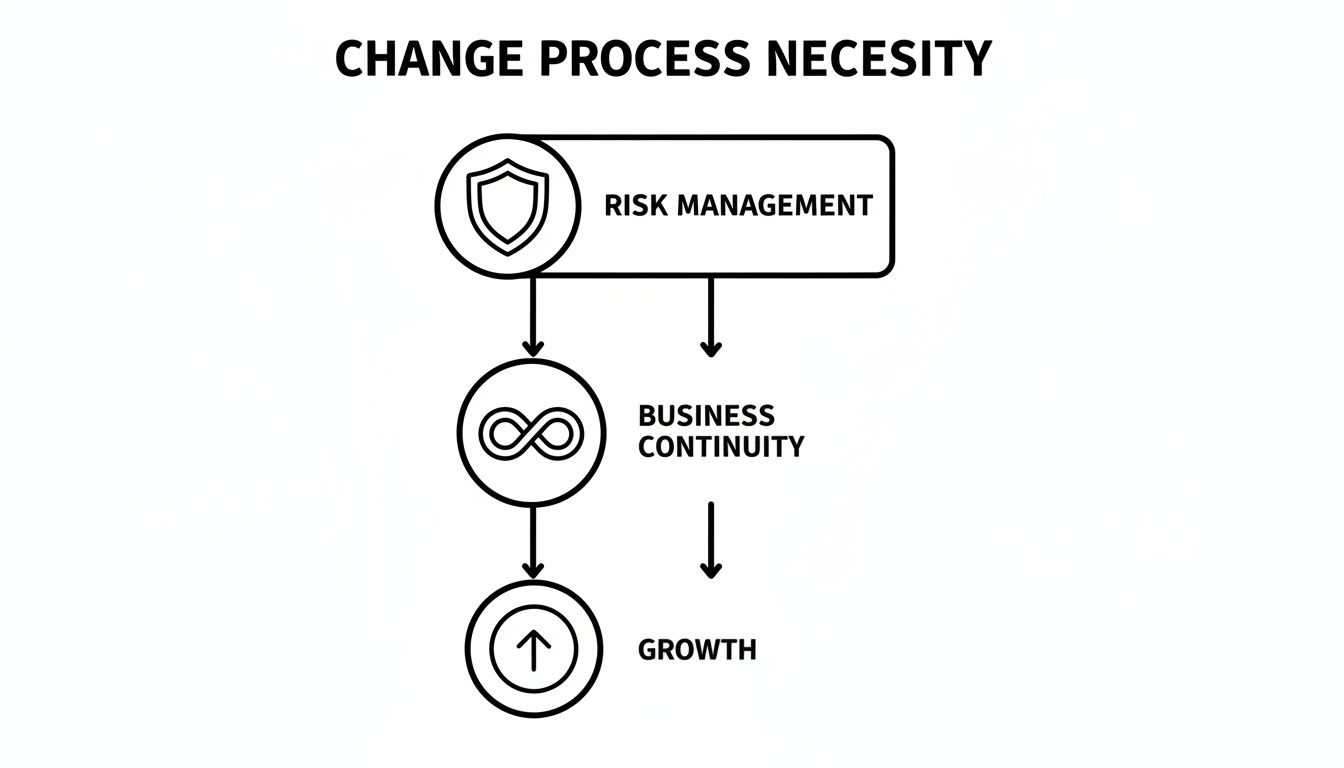
As shown, a methodical process is the foundation for managing risk, maintaining business continuity, and enabling sustainable growth.
Protecting Revenue and Productivity
Unplanned changes are a direct threat to revenue. Even minor disruptions can prevent teams from serving clients, processing transactions, or accessing critical data. Industry data shows that a single hour of downtime can cost a small business thousands of dollars, a figure that increases dramatically for larger organizations.
A structured process mitigates this financial risk by prioritizing reliability. Key benefits include:
- Fewer Unplanned Outages: By systematically checking for conflicts and dependencies, you prevent errors that cause system crashes.
- Guaranteed Resource Availability: A formal request process ensures the right people and tools are available to execute the change correctly the first time.
- Clear Rollback Plans: If an issue arises, a pre-planned rollback strategy enables a rapid return to the previous state, minimizing the duration and impact of any disruption.
This disciplined approach ensures your team remains productive and the business continues to operate without unexpected interruptions.
Ensuring Compliance and Creating Audit Trails
For businesses in regulated industries like finance, healthcare, or law, compliance is non-negotiable. A formal change management process is essential for meeting these strict requirements, as it creates the detailed audit trail needed to document every modification to the IT environment.
A documented change history is proof of due diligence. It demonstrates to auditors and regulators that you have robust controls in place to protect sensitive data and maintain system integrity.
This documentation answers the critical questions every auditor asks:
- Who requested and approved the change?
- What was the business justification for the modification?
- When was the change implemented?
- Was the change tested and its impact properly assessed?
Without these records, proving compliance is nearly impossible, exposing the organization to significant legal and financial risk. A formal process provides the structure needed to maintain this crucial evidence. Guidance from virtual CIO leadership can help align your technology strategy with these demanding standards.
Supporting Scalability and Future Growth
A formal change process is not just about preventing today's problems; it is about enabling tomorrow's growth. Ad-hoc changes create a tangled IT infrastructure that is difficult to manage, secure, and scale. This "technical debt" makes future projects slower, costlier, and riskier.
In contrast, a structured approach ensures each change aligns with the long-term technology roadmap. It prevents short-term fixes from becoming long-term architectural burdens. This strategic oversight keeps the infrastructure clean, organized, and prepared to support future business initiatives. Ultimately, a mature change management process is an investment in the company’s ability to adapt and grow.
Practical Example: A Law Firm’s Migration to SharePoint
To understand the real-world value of a change management process, consider a common project for a regulated business: migrating a law firm from an on-premise server to SharePoint Online.
This is more than a simple technology upgrade; it fundamentally alters how legal staff access, collaborate on, and protect sensitive client information. Without a structured plan, such a project risks data loss, compliance breaches, and poor user adoption.

A methodical change management process, however, transforms this complex challenge into a predictable, successful project that improves both security and productivity.
Step 1: Establish Governance Before Migration
The most critical step occurs before moving a single file. For a law firm, data governance is paramount. The process begins by defining the rules for the new SharePoint environment, bringing together stakeholders to answer key questions:
- Who owns the data? Clear owners must be assigned for case files, administrative records, and financial data to ensure accountability.
- What are the access controls? A permissions structure must be designed to ensure only authorized individuals can view or edit specific client matters.
- What are the retention policies? Legal and regulatory requirements dictate how long documents must be kept. These policies must be built into SharePoint from the start.
- How will legacy data be managed? A plan must be created for archiving old, inactive files to keep the new system clean and efficient.
Skipping this foundational step is a common mistake that leads to a disorganized and insecure SharePoint environment, placing the firm at serious compliance risk.
Step 2: Map Stakeholders and Manage Expectations
With governance rules established, the focus shifts to the people. At a law firm, stakeholders include managing partners, paralegals, administrative staff, and the IT team, each with different concerns.
A partner’s primary concern may be the security of a multi-million-dollar case file, while a paralegal is focused on how the change will affect their daily document-drafting workflow. A successful process must address both perspectives.
The plan must map these stakeholders and create tailored communication and training. Partners receive high-level briefings on security and ROI. Paralegals get hands-on training demonstrating how new collaboration features will improve their efficiency. This targeted approach ensures everyone understands the rationale for the change and its benefits for them. Similar strategies are used to manage complex initiatives across the Caribbean, where clear stakeholder engagement is vital for driving productivity gains through digitalisation in the Caribbean and overcoming regulatory hurdles.
Step 3: Implement a Phased Rollout with User Training
Finally, the plan addresses the technical rollout and user training. Instead of a high-risk "big bang" migration, a phased approach is more effective.
- Pilot Group: The migration starts with a small, tech-savvy group. They test workflows and provide feedback, allowing the project team to resolve issues in a controlled setting.
- Departmental Rollouts: Using feedback from the pilot, the migration proceeds one department at a time. This allows the IT support team to provide focused, personalized assistance.
- Comprehensive Training: Training should include pre-migration workshops, hands-on support during the rollout, and ongoing resources like quick-reference guides and video tutorials.
By combining clear governance, stakeholder-specific communication, and a careful, phased rollout, the law firm's Microsoft 365 migration becomes a strategic success. It avoids common pitfalls, drives high user adoption, and delivers a more secure, compliant, and productive work environment.
Measuring Success and Improving Future Changes
A change management project does not end at go-live. The final phase involves measuring the business impact and using those insights to improve future initiatives. This closes the loop, transforming a one-time project into a cycle of continuous improvement.
Without measurement, you are operating on assumptions. A data-driven approach is what separates an organization that merely survives change from one that masters it. This feedback process builds organizational resilience, making the business more agile and prepared for future challenges.
Defining Key Performance Indicators (KPIs)
To measure success, you must first define it with clear metrics. Key Performance Indicators (KPIs) should be tied directly to the project's original business goals. Focus on tangible results that demonstrate value to leadership.
For a typical IT project, relevant KPIs might include:
- User Adoption Rates: What percentage of employees are actively using the new system or process? Low adoption is a clear indicator that training or communication was insufficient.
- Reduction in Help Desk Tickets: A successful change should lead to fewer support calls related to the old system's problems. While an initial spike is common, the long-term trend should be downward.
- Workflow Efficiency Gains: Can you measure a reduction in the time required to complete a task? For example, has the time to generate a client report decreased by a measurable amount?
- System Performance Metrics: Monitor uptime, application response times, and error rates to confirm the new technology is stable and reliable.
Measuring the right KPIs provides objective proof of value. It shifts the conversation from, "I think it's working," to, "We know it's working because task completion time has been reduced by 15%."
Gathering Qualitative Feedback
Quantitative data tells an important part of the story, but it does not explain the "why." Qualitative feedback from users provides context and uncovers insights into the human side of the change.
Post-implementation reviews and user satisfaction surveys are ideal for this purpose. They help collect feedback on what went well and identify points of friction. Ask direct questions about the quality of training, the clarity of communications, and the support provided during the transition. This feedback is invaluable for refining your process for the next initiative. The importance of these feedback loops is evident in large-scale strategic efforts, where a lack of them can hinder progress, as seen in analysis of regional strategic development challenges at UN.org and regional development dynamics on OECD.org.
What to Do Next: Implement a Strategic Change Process
A robust IT change management process is not an administrative checklist; it is a strategic business discipline. It is the framework that protects your organization from operational risk, controls costs, and ensures you realize the full value of your technology investments.
Poorly managed change creates friction, wastes resources, and frustrates teams. A structured approach, however, creates a stable and predictable environment where technology drives growth instead of causing disruption.
It is time to assess your current approach. How are IT changes proposed, reviewed, and implemented in your organization? Identifying the gaps that could expose your business to downtime, security incidents, or compliance failures is the first step toward building a more resilient operational foundation.
Build a More Resilient Foundation
A proactive approach to change management turns your next technology initiative into a competitive advantage rather than an operational burden. A readiness assessment or a strategic discussion can provide clarity on where to focus your efforts first.
Consider these concrete actions:
- Review Your Existing Process: Map how changes are currently handled to identify where the most significant risks lie.
- Engage a Partner for an Objective Assessment: An external perspective can uncover vulnerabilities and inefficiencies that are difficult to see from within.
- Prioritize Governance and Communication: Start by creating a simple framework for reviewing and communicating changes to build a culture of control.
A mature change management process is fundamental to modernizing your infrastructure and securing your operations. To learn how expert guidance can help you build this capability, explore our virtual CIO leadership services. Let us help you turn change into your competitive edge.
Frequently Asked Questions
Here are answers to common questions business leaders have about implementing a formal IT change management process.
When is a formal change process necessary?
A formal process is necessary for any IT change that could impact business operations, security, or compliance. This includes server updates, new software rollouts, and modifications to security policies. The level of review can be scaled based on the change's size and risk. Minor, low-risk tasks like a single user's password reset are standard operating procedures and do not require formal change management.
Does change management slow down business?
A common misconception is that change management creates delays. In reality, a well-implemented change management process prevents delays by reducing failures, rework, and unplanned downtime. The initial planning is an investment that pays for itself by preventing costly outages and botched rollbacks that bring business to a halt.
A well-organized process builds predictability and reliability into your operations. It transforms IT from a source of reactive firefighting into a stable foundation for growth.
This structured framework gives the business confidence to adopt new technologies because it ensures changes are implemented correctly the first time.
What is the role of a Change Advisory Board (CAB)?
A Change Advisory Board (CAB) is a committee of key stakeholders from IT, operations, security, and finance who review significant change requests before approval. Its purpose is to evaluate a proposed change from every business perspective. The CAB assesses the:
- Business Justification: Does the change align with strategic goals and deliver tangible value?
- Risk Assessment: What are the potential negative impacts on operations, security, or compliance?
- Resource Allocation: Are the necessary people, budget, and tools available to implement the change successfully?
This collective oversight is a crucial governance checkpoint that protects business stability and ensures changes serve a strategic purpose. Our cybersecurity services can provide a clear roadmap for establishing this type of governance.
At Tricord I.T Solutions, we help organisations build resilient and efficient IT operations through expert guidance and proactive management. If you're looking to implement a robust change management process that protects your business and supports your growth, we can help.
Explore Our Managed IT Services to Build a More Controlled IT Environment