
Managed IT services are all about handing over the keys to your company's technology to a dedicated team of experts. For a predictable monthly fee, a Managed Service Provider (MSP) takes full responsibility for your IT, working tirelessly in the background to stop problems before they can ever disrupt your business.
Moving from Reactive Fixes to Proactive Strategy
Think about your business technology like a high-performance vehicle. For years, the standard approach was the "break-fix" model—you’d only call a mechanic when the engine started sputtering or a tire went flat. This is not only inefficient but incredibly stressful. You're always reacting to problems, often at the worst possible moments, and getting hit with unpredictable repair bills.
Managed IT services completely flip this model on its head.
Instead of waiting for a breakdown, an MSP acts as your dedicated pit crew. They’re constantly performing regular maintenance, monitoring all your systems for the slightest warning sign, and making sure every component is optimized for peak performance. This partnership shifts your company from a state of constant IT firefighting to one of strategic technological alignment.
This proactive approach is non-negotiable for businesses in demanding sectors like legal, finance, and healthcare, where uptime and security are everything. The growth in this sector speaks for itself; the Canada Managed Services Market has expanded significantly, with Ontario leading the charge thanks to its strong IT infrastructure.
A Managed Service Provider doesn't just fix what's broken; they build a technology foundation designed to prevent breaks from happening in the first place. Their goal is to make your IT so reliable that you rarely have to think about it.
This shift in thinking is especially critical when it comes to modern infrastructure. To see how this applies directly, you can explore what defines cloud computing management services and how they are a core part of this proactive model. It all comes down to the fundamental difference in approach.
Traditional IT Support vs Managed IT Services
The gap between waiting for things to break and actively preventing them from failing is massive. It’s the difference between putting out fires and fireproofing your building. One is a chaotic, costly reaction, while the other is a calm, strategic investment.
This table breaks down the core differences:
| Feature | Traditional IT Support (Break-Fix) | Managed IT Services |
|---|---|---|
| Approach | Reactive (responds to issues as they occur) | Proactive (prevents issues through monitoring) |
| Pricing | Unpredictable, hourly rates, or per-incident charges | Predictable, fixed monthly fee |
| Focus | Fixing immediate technical problems | Long-term business alignment and strategic goals |
| Security | Addresses threats after an attack | Implements continuous monitoring and prevention |
| Downtime | Frequent and disruptive | Minimized through proactive maintenance |
Ultimately, choosing managed services means you're investing in stability and predictability. You’re not just buying IT support; you're gaining a strategic partner dedicated to keeping your operations running smoothly so you can focus on what you do best—growing your business.
The Core Services That Power Your Business
To really get what managed IT services are, you have to look past the label and see the specific parts that keep your business humming along safely and efficiently. Think of these services as a protective bubble around your operations, making sure technology is a growth engine, not a constant headache. Each piece has a job, from stopping problems before they start to being there with immediate help when your team is stuck.
This is a world away from the old break-fix model, where you only call for help after something has already gone wrong and disrupted your day.
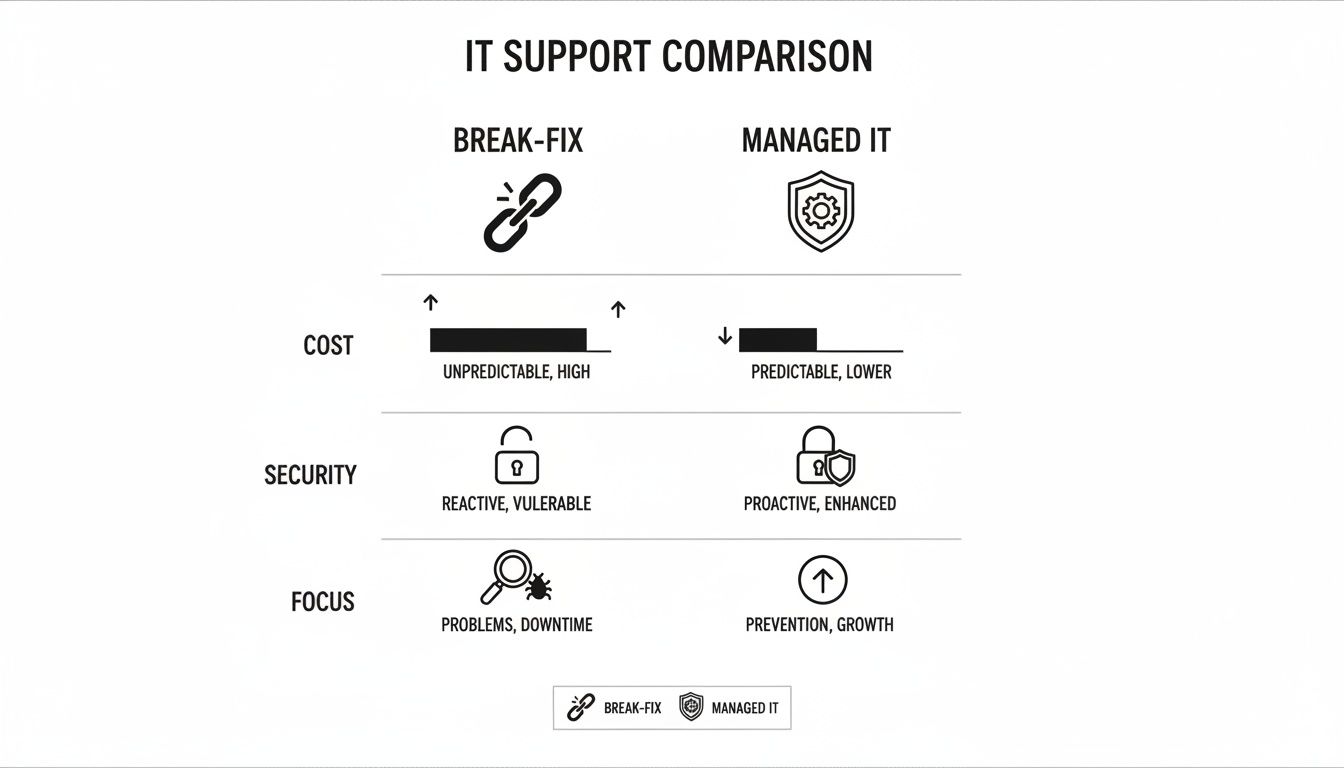
The difference is clear. A managed approach gives you predictable costs and a relentless focus on security, the exact opposite of the reactive, often chaotic, world of break-fix IT.
Proactive Monitoring and Maintenance
The heart of any solid managed services plan is proactive monitoring. Picture a security guard for your network, servers, and computers who never sleeps. This system is always watching for the little warning signs—like a weird spike in activity or a dip in performance—that could point to a future crash or a security threat.
By catching these issues when they're small, an MSP can fix them before they blow up into expensive downtime. For a busy law firm, that could mean stopping a server crash right before a critical case filing. For a healthcare clinic, it means patient record systems are always up and running smoothly.
24/7 Helpdesk Support
When tech problems inevitably pop up, you need an expert on speed dial, not a ticket number you have to wait on. A 24/7 helpdesk gives your people instant access to technical support, whether they’re at the office or working from home. This isn’t just for forgotten passwords; it’s for solving the software glitches, connection drops, and application errors that grind productivity to a halt.
A responsive helpdesk acts as an extension of your own team, empowering your employees to overcome technical hurdles quickly and get back to focusing on their clients and core responsibilities.
This kind of rapid-fire support is critical in high-stakes environments like financial advisory firms, where even small delays can have major consequences.
Cloud and Infrastructure Management
Your technology infrastructure—whether it's in the cloud, on-site, or a mix of both—is the backbone of your entire business. Managing it is a complex job, covering everything from your Microsoft 365 setup to making sure all your network gear is configured for peak performance and security. This is where a managed infrastructure plan becomes so valuable.
An MSP makes sure your digital toolkit is always working for you. Key services include:
- Microsoft 365 Optimization: Setting up tools like Teams and SharePoint for secure and seamless collaboration.
- Server Management: Taking care of all the updates, patches, and performance tuning to prevent slowdowns.
- Network Oversight: Ensuring your Wi-Fi and wired networks are reliable and locked down for all users.
Cybersecurity and Disaster Recovery
Protecting your clients' sensitive data is not optional. A managed services partner builds a digital fortress around your information with a multi-layered security strategy, including firewalls, antivirus software, and constant threat monitoring. This is absolutely essential for meeting compliance standards like PIPEDA.
Just as important is having a solid backup and disaster recovery plan. This is your "get-out-of-jail-free card" for data loss. If a fire, hardware failure, or ransomware attack ever happens, your MSP can quickly bring your data and systems back online, minimizing disruption and protecting your business's reputation.
Tangible Business Benefits of Managed IT
Knowing the core services is one thing, but seeing how they actually impact your business is where the real value of a managed IT partnership clicks into place. It’s not just about the technical details; it’s about how this proactive approach strengthens your bottom line, protects your reputation, and clears the path for growth. It’s the difference between seeing IT as a reactive cost centre and treating it like the strategic asset it should be.

Think about a growing law firm constantly blindsided by unexpected server repair bills. Their small internal IT team is completely swamped, leaving zero time for projects that could actually move the firm forward. This is exactly where the benefits of managed services become obvious.
Gain Predictable Costs and Reduce Overhead
The first thing you’ll notice is the shift from chaotic, unpredictable IT spending to a fixed, manageable monthly fee. The old break-fix model is a budget nightmare—you never know when a five-figure emergency is going to hit. With a managed services agreement, all your support, maintenance, and monitoring are bundled into one predictable cost.
This model is often far more economical than hiring, training, and retaining an in-house IT specialist. You get access to an entire team of experts—from cybersecurity analysts to cloud engineers—for a fraction of what a single senior hire would cost. This allows for dead-simple budgeting and kills off those nasty financial surprises.
By converting volatile capital expenses into stable operational expenses, businesses can forecast their finances with greater accuracy and reallocate resources toward growth-focused initiatives instead of emergency fixes.
Enhance Security and Minimize Risk
In today's world, a single data breach can cause devastating financial and reputational damage. A managed service provider is your dedicated cybersecurity guardian, implementing a robust, multi-layered defence system to protect your critical information. This proactive stance isn't just a good idea; it's essential for keeping your clients' trust and meeting compliance rules.
This partnership drastically cuts down the risk of costly downtime, data loss, and compliance penalties that can cripple a business.
Boost Focus and Scalability
When your leadership team is constantly being pulled into IT fires, they aren't focused on clients, strategy, or innovation. Handing off the entire burden of technology management to an MSP frees up your key people to concentrate on what they do best: running the business. This improved focus directly fuels productivity and profitability.
On top of that, a managed services plan is built to scale right alongside your business. As you add employees, open new offices, or bring in new technologies, your IT support expands to meet those needs without demanding a huge upfront investment.
An MSP can also provide strategic guidance in key areas. For instance, many businesses are implementing FinOps best practices to optimize cloud spend to ensure their tech investments deliver maximum value. By exploring the managed IT services benefits in more detail, you can see how this strategic alignment supports long-term growth.
Here is the rewritten section, following the provided guidelines and examples:
How Managed Services Pricing Models Work
Knowing how you’ll be billed is the first step in making a smart investment in your business’s technology. Unlike the unpredictable, invoice-by-invoice world of break-fix IT, managed services are built on transparent, predictable pricing models. This clarity is a game-changer for budgeting, letting you align your IT spending with actual operational needs.
While plans can always be customized, most providers structure their agreements around a few core models. Each one is designed to fit different kinds of businesses—from small firms with a consistent team size to larger organizations with complex hardware inventories. Getting a handle on these options will help you have a much more informed conversation with potential providers.
Common Pricing Structures
The goal of any good pricing model is to deliver value and predictability. Your choice will ultimately come down to how your team is structured and what assets you need to protect.
- Per-User Model: This is often the simplest and most popular model. You pay a flat monthly fee for each employee, period. It’s an excellent fit for businesses where people use multiple devices (like a laptop, desktop, and mobile phone), because the cost stays fixed per person, not per gadget.
- Per-Device Model: Alternatively, some plans charge based on the number of devices under management. This could include servers, desktops, laptops, and even network equipment. This model makes sense for businesses with fewer users but a significant amount of hardware to monitor and maintain.
- Tiered or Bundled Model: Many providers offer service tiers (think Bronze, Silver, Gold). Each tier bundles a progressively larger set of services for a fixed price. A basic tier might cover monitoring and helpdesk support, while a premium tier could add advanced cybersecurity and strategic consulting.
The right pricing model eliminates financial surprises. It transforms your IT budget from a reactive, fluctuating expense into a predictable operational investment, which is a key component of what is managed IT services truly offers.
At the end of the day, the best model gives you comprehensive coverage for your specific needs without forcing you to pay for services you won’t use. It’s all about finding a financial structure that supports your security, productivity, and growth in a way that makes perfect business sense.
Clear Signs Your Business Needs Managed Services
How do you know when it’s time to stop just patching problems and start building a real IT strategy? It's a question many business owners and practice managers face, often without realizing they've already outgrown their current IT setup. Recognizing the subtle but persistent warning signs is the first step toward a more strategic and stable solution.

If your team is constantly battling the same nagging technical issues—slow computers, network drops, software glitches—it’s a clear sign your IT is holding you back. These aren’t just minor annoyances. They are direct hits to productivity and employee morale. Every minute an employee spends wrestling with technology is a minute they aren’t serving clients or driving revenue.
Your IT Costs Are Unpredictable
One of the biggest red flags is a budget that lurches from one unexpected IT expense to another. One month you’re paying for an emergency server repair, and the next you’re hit with a massive bill to recover from a minor security incident. This kind of reactive spending makes financial forecasting almost impossible and usually costs far more in the long run.
This is a common pain point for businesses stuck in the break-fix cycle. A move to managed IT services for small business introduces a predictable, fixed monthly fee, turning a volatile capital expense into a stable operational one. This financial stability is a core benefit when you're considering what managed IT services are and how they can help.
Growing Anxiety About Cybersecurity
Do you find yourself worrying about the threat of ransomware or a data breach? If you don’t have a clear, documented, and tested plan to defend against and respond to cyberattacks, you are operating with a huge amount of risk. The threats are becoming more sophisticated every day, and a basic antivirus program is no longer enough to protect your business or your clients' sensitive data.
A managed services provider builds a multi-layered security defence to proactively protect you. These defences typically include:
- Continuous Threat Monitoring: Actively watching your network for suspicious activity 24/7.
- Proactive Patch Management: Making sure all your software is up-to-date to close security loopholes before they can be exploited.
- Employee Security Training: Equipping your team to spot and avoid phishing scams and other common attacks.
If your current IT approach feels more like a gamble than a strategy, it’s a definitive sign that you need a proactive partner. Ignoring these warnings doesn't just impact efficiency; it leaves your entire operation vulnerable.
Ultimately, if you lack a clear technology roadmap for the future, it is time to seek expert guidance. Without a plan, your technology can't support your business goals, and you will always be one step behind the competition.
Choosing the Right Managed IT Partner
Finding a managed services provider is easy. Finding the right technology partner is a different challenge entirely. The goal isn’t just to hire a vendor to fix problems but to find a strategic ally who functions as a true extension of your team.
This requires looking beyond the price tag and evaluating providers on criteria that signal a commitment to your long-term success. The selection process is all about finding a fit that aligns with your specific operational needs and future ambitions. A generic, one-size-fits-all approach rarely delivers the security or strategic value professional firms require. You need a partner who understands your world.
Evaluating Potential MSPs
When you start talking to potential providers, your questions should focus on digging into their expertise, reliability, and strategic capabilities. Price is a factor, of course, but value is the ultimate goal. A cheap plan that fails to protect your data or support your growth is far more costly in the end.
Start your evaluation with these critical areas:
- Industry-Specific Expertise: Do they have proven experience in your field? A provider serving law firms must understand compliance rules around client confidentiality, while one supporting healthcare clinics needs to be an expert in protecting patient health information.
- Verified Security Credentials: Ask for proof of their security posture. Look for certifications and ask them to detail their internal security practices. A provider can't protect you if they can't protect themselves.
- Scalability and Flexibility: Can their support model grow with your business? The right partner offers scalable solutions that adapt as you add staff or expand your services, ensuring your technology never holds you back.
Choosing an MSP is like hiring a key executive. You're entrusting them with a critical part of your business. Their reliability, strategic input, and understanding of your goals are just as important as their technical skills.
Looking for Strategic Guidance
Beyond day-to-day support, the best managed IT partners provide high-level advisory services. Do they offer virtual CIO (vCIO) guidance to help you build a technology roadmap that actually aligns with your business objectives? This strategic oversight is what separates a basic IT support provider from a true partner invested in your future.
Finally, always check their references. Speak to current clients, especially those in your industry, to get an honest assessment of their responsiveness, expertise, and overall reliability. These firsthand accounts are often the most telling indicators of the service quality you can expect. They’ll help you confidently choose a partner for the long haul.
Frequently Asked Questions About Managed IT Services
Even when the benefits seem clear, making a big change to your IT operations is bound to bring up some questions. It’s only natural. Getting those final uncertainties sorted out is the key to moving forward with confidence. Here are some straightforward answers to the things business leaders ask most when they start exploring managed IT services.
A lot of small and midsize business owners assume this level of professional oversight is just too expensive. That’s a common—and thankfully, incorrect—assumption.
Is This Only for Large Corporations?
Not at all. In fact, small and midsize businesses often get the most bang for their buck from managed IT services. Think about it: hiring just one qualified, full-time IT professional can cost a fortune, far more than partnering with a managed service provider (MSP).
For a predictable monthly fee, you get access to an entire team of specialists—from cybersecurity pros to cloud engineers—at a fraction of the cost. This model delivers the kind of enterprise-grade support that would otherwise be completely out of reach, making it an incredibly smart investment for growing organizations. It all comes down to finding a plan that fits your specific size and needs.
How Is Our Sensitive Data Kept Secure?
Any reputable provider will tell you that protecting your data is their absolute top priority. Good security isn't a single product you buy off the shelf; it's a multi-layered strategy that weaves together proactive monitoring, advanced threat detection, and strict access controls. Your managed services partner essentially becomes your dedicated security guardian.
This isn’t just talk. Here’s how it happens in the real world:
- Continuous Monitoring: Your systems are watched 24/7 for any hint of suspicious activity.
- Regular Patching: All your software and systems are kept meticulously updated to close security holes before attackers can find them.
- Compliance Management: The provider makes sure your IT environment meets all the necessary industry-specific regulations, whether it’s for law, healthcare, or finance.
The onboarding process is a carefully managed project designed to be as seamless as possible. The goal is to transition your systems without disrupting your day-to-day operations, ensuring your team can keep working effectively from day one.
A proper onboarding starts with a deep dive into your current setup, followed by the deployment of monitoring tools and security protocols. This methodical approach guarantees a smooth and secure handover, laying the groundwork for a successful partnership that lasts.
Ready to build a secure, scalable, and strategic technology foundation for your business? Tricord I.T Solutions offers expert managed IT and cybersecurity services designed for law firms and growing organizations. Let us handle the technology so you can focus on your clients. Schedule a consultation today to learn more.