
When a crisis strikes—a cyberattack, natural disaster, or power outage—the last thing a business can afford is for operations to grind to a halt. Business Continuity Planning (BCP) is the proactive strategy an organization develops to ensure its most critical functions can continue operating during and after a disruptive event. It's a comprehensive roadmap that aligns people, processes, and technology to maintain stability and protect the business.
A business continuity plan is more than just an IT checklist; it's a holistic framework that answers the fundamental question: "How will our business keep running when something goes wrong?" It ensures your teams can serve clients, process payments, and manage operations, no matter the circumstances.
What Is Business Continuity Planning?

At its core, business continuity planning is the process of creating systems for prevention and recovery to deal with potential threats to a company. The primary goal is to enable operations to continue before, during, and after an incident. It provides a clear, documented set of procedures for responding to disruptions in a calm and orderly manner, minimizing the impact on revenue, reputation, and client trust.
For example, an IT-focused disaster recovery plan restores servers after a blackout. The business continuity plan, however, ensures your client service team can still communicate with customers from a remote location and your finance department can process payroll using cloud-based tools. It is a complete strategy designed to protect essential business functions from events like hardware failures, cyberattacks, or supply chain breakdowns.
Differentiating BCP From Disaster Recovery
It is common to confuse business continuity with disaster recovery (DR), but they serve distinct purposes. A disaster recovery plan is a technical subset of a business continuity plan, focusing specifically on restoring IT infrastructure, applications, and data after a significant outage.
A business continuity plan keeps the entire organization functioning through a crisis. A disaster recovery plan is the technical component that restores the technology needed to support that function. Both are essential, but BCP provides the broader framework for resilience.
A strong BCP ensures every department understands its role during an emergency, covering operational details that technology alone cannot solve, such as communications, logistics, and personnel management.
The Core Purpose And Benefits
The primary objective of business continuity planning is to maintain business operations and minimize financial loss, thereby building organizational resilience. A well-executed plan delivers significant business advantages beyond simple recovery.
Key benefits include:
- Reduced Downtime: Minimizes the interruption period, allowing the organization to restore critical operations faster and reduce revenue loss.
- Enhanced Reputation: Demonstrating preparedness builds trust with clients, partners, and stakeholders, showing the business is reliable even under pressure.
- Regulatory Compliance: In regulated industries like finance, healthcare, and law, a documented and tested BCP is often a mandatory requirement.
- Improved Risk Management: The planning process identifies and assesses potential threats, enabling the implementation of proactive mitigation measures.
Ultimately, business continuity planning is about ensuring stability and long-term viability. It shifts an organization from a reactive posture to a proactive one, safeguarding its future. Without a plan, a business gambles with its operations and client relationships. A robust BCP, supported by strong managed IT services, is a fundamental pillar of modern business governance.
Why Business Continuity Is a Critical Investment
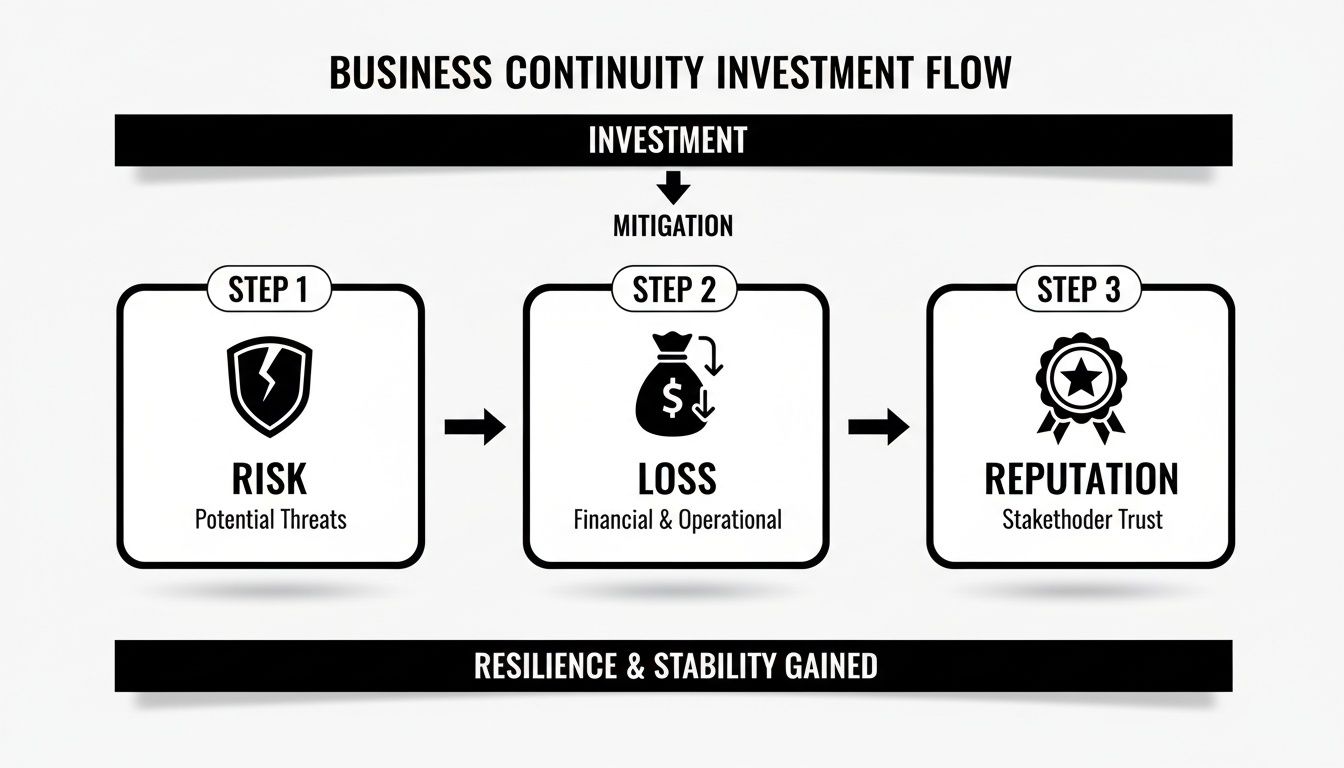
Viewing business continuity planning as a mere operational cost is a dangerous misconception. It is a critical investment in an organization's survival, stability, and reputation. The real cost is not in the planning; it lies in the failure to plan, which leaves a business vulnerable to disruptions that can cause irreversible damage.
Without a solid BCP, a single event can trigger a cascade of negative consequences. Downtime translates directly into lost revenue, diminished client trust, and potential regulatory penalties. For professionals in law, healthcare, or finance, maintaining operational continuity and data integrity is a non-negotiable legal and ethical obligation.
Mitigating Tangible Business Risks
The risks of inaction are severe. Consider a ransomware attack that paralyzes a law firm's servers during trial preparation. Case files, client communications, and billing records become inaccessible, halting operations. The firm faces immediate financial loss, significant reputational damage, and potential claims of professional negligence.
Similarly, if a healthcare clinic's patient management system goes offline due to a regional power outage, staff cannot access medical records, schedule appointments, or process prescriptions. This failure directly impacts patient care, creates compliance risks under regulations like PIPEDA, and erodes community trust.
These are not abstract scenarios; they are practical realities that businesses face. A robust BCP stands between an organization and these threats.
An effective business continuity plan transforms a potential catastrophe into a manageable incident. It provides the team with a clear, documented roadmap, ensuring critical functions continue even when primary systems are unavailable. This capability is the foundation of true business resilience.
Protecting Financial Health and Reputation
Every minute of unplanned downtime has a cost. Direct costs include lost sales and idle employees, while indirect costs mount from recovery efforts and brand damage. A well-structured BCP mitigates these financial impacts by significantly reducing recovery time.
Beyond the balance sheet, an organization's reputation is its most valuable asset. A calm, coordinated response to a crisis demonstrates competence and reliability, reinforcing trust. In contrast, a chaotic reaction can cause lasting harm to a professional standing that may take years to rebuild. Investing in a comprehensive cybersecurity strategy is an essential part of protecting that reputation.
The High Cost of Unpreparedness
For businesses in regions prone to disruption, the consequences are even more pronounced. In areas frequently affected by natural disasters, the absence of a plan is not just a risk—it is a near-guarantee of failure.
In the Caribbean, for example, where SMEs constitute 85% of all businesses, a CARICOM and Caribbean Export Development Agency survey revealed a significant lack of preparation. Despite constant hurricane threats, only 17% had actively prepared for them. When the COVID-19 pandemic arrived, 88% had no contingency plans. As a result, 47% were forced to close temporarily, demonstrating the direct link between planning and survival. This highlights a universal truth: responsible governance demands proactive continuity planning.
The Four Phases of the Business Continuity Lifecycle
Many businesses mistakenly treat continuity planning as a one-time project to be filed away. An effective plan, however, is not a static document; it is a dynamic cycle that evolves with the business.
Viewing BCP as a lifecycle breaks the process into a manageable, continuous improvement loop. This approach consists of four distinct phases, each building on the last, to ensure the plan remains relevant, effective, and ready for activation.
Phase 1: Business Impact Analysis and Risk Assessment
A business cannot protect what it does not understand. This initial phase focuses on identifying critical operations and the threats that could disrupt them.
The process begins with a Business Impact Analysis (BIA). The goal is to identify the core functions that, if interrupted, would cause the most significant damage to finances, reputation, and client services. For a law firm, this might be its case management system; for a healthcare clinic, its patient records database.
Paired with the BIA is a Risk Assessment, which pinpoints specific threats to those critical functions. These can range from power outages and severe weather to sophisticated ransomware attacks or supply chain failures.
Combining the BIA and Risk Assessment helps define two crucial metrics:
- Recovery Time Objective (RTO): How quickly must a critical system be restored before the business impact becomes unacceptable?
- Recovery Point Objective (RPO): What is the maximum amount of data the business can afford to lose?
Phase 2: Strategy and Solution Development
With priorities and risks identified, the next phase is to design the response. This involves developing strategies to maintain essential functions during a disruption, tailored to the specific RTOs and RPOs defined in Phase 1.
Generic, off-the-shelf plans are insufficient. As industry experts note, every organization has unique vulnerabilities that require a customized plan; you can discover more insights about customized continuity planning from specialists. Effective strategies are built from the BIA and risk assessment findings.
Practical strategies often include:
- Implementing cloud-based solutions like Microsoft 365 to enable secure remote work.
- Installing a redundant internet connection from a different provider to prevent a single point of failure.
- Arranging for alternate work locations or call centre support with a third-party vendor.
- Establishing a clear communication plan for employees, clients, and partners.
This is about proactive investment. Addressing these risks directly protects both the bottom line and the organization's reputation.
Phase 3: Plan Implementation and Training
A strategy is only conceptual until it is put into action. This phase involves documenting the formal Business Continuity Plan (BCP), assigning resources, and preparing the team for execution.
The BCP document must be clear, concise, and accessible, especially during a crisis. It should outline step-by-step procedures, key contact lists, and clear role assignments.
A plan is only as good as the people executing it. A common point of failure is neglecting the human element. If the team is not trained, they cannot respond effectively under pressure.
Training must be an integral part of implementation, with hands-on exercises specific to each person's role. Drills, tabletop exercises, and workshops familiarize staff with procedures long before an actual incident occurs.
Phase 4: Testing and Maintenance
This final phase completes the lifecycle, transforming business continuity into a continuous improvement process. A BCP is a living document that requires regular testing, review, and updates to remain effective.
Regular testing is the only way to validate that strategies work and the team is prepared. Tests can range from simple plan reviews to full-scale simulations of a major disruption.
Following each test, the team should analyze what worked, what failed, and where improvements are needed. This feedback loop keeps the plan sharp. The BCP should be reviewed at least annually or whenever the business undergoes significant changes, such as adopting new technology, moving offices, or changing key personnel. This commitment ensures the plan evolves with the organization, providing reliable protection year after year.
How to Build Your Business Continuity Plan

Translating the concept of business continuity into a functional plan can seem daunting, but it follows a series of logical steps. By breaking the process into manageable milestones and adopting a methodical approach, you can build a plan that is both comprehensive and practical.
This structured framework provides a clear path to building organizational resilience from the ground up.
Step 1: Assemble Your BCP Team
First, establish a dedicated team to own the plan's development, implementation, and ongoing maintenance. This is not solely an IT function. An effective BCP team should be a cross-functional group with representatives from all critical business areas.
Your team should include leaders from:
- Operations: To provide insight into critical day-to-day processes.
- Finance: To analyze the financial impact of downtime.
- Human Resources: To manage employee safety and communication.
- Legal/Compliance: To ensure adherence to regulatory requirements.
- IT and Security: To manage the technical backbone of recovery efforts.
This diverse expertise ensures the plan addresses all business facets, not just technology.
Step 2: Conduct a Business Impact Analysis
With the team in place, conduct a thorough Business Impact Analysis (BIA). The BIA is the foundation of the entire plan, identifying essential business functions and the impact of their disruption over time.
For instance, a law firm might identify its client intake and case management systems as top priorities. If these systems are down for more than a few hours, the firm could miss deadlines and damage client trust. The BIA helps set realistic Recovery Time Objectives (RTOs) for each critical function.
Step 3: Perform a Comprehensive Risk Assessment
Once you know what is critical, you must identify what threatens it. The risk assessment evaluates potential threats and vulnerabilities specific to your organization. Categorizing these risks ensures nothing is overlooked.
Common risk categories include:
- Natural Disasters: Floods, fires, or severe weather.
- Technical Failures: Hardware malfunctions, power outages, or internet disruptions.
- Human-Caused Events: Accidental data deletion or malicious ransomware attacks.
This assessment allows you to prioritize threats and develop effective mitigation strategies.
Step 4: Develop and Document Your Strategies
Now, you can build the strategies to maintain business operations. Using insights from the BIA and risk assessment, create clear continuity procedures. This may involve setting up cloud-based failover for critical servers or arranging an alternate work location.
A common mistake is creating a plan that is overly complex or stored in a single, inaccessible location. The best BCPs are clear, concise, and readily available to all team members, even if primary systems are offline.
As you formalize the plan, a solid document control process is essential. It ensures the BCP remains current, approved, and accessible when needed. The plan should be a practical guide, not a dense academic paper.
Step 5: Train Your Team and Test the Plan
A plan is useless if the team does not know how to execute it. Regular training and testing are non-negotiable. Training ensures every employee understands their role and responsibilities during a disruption. This is why ongoing end-user cyber awareness training is a crucial component.
Testing validates your strategies and identifies weaknesses before a real crisis does. Start with simple tabletop exercises where the BCP team discusses a simulated disaster. Over time, progress to more advanced functional tests, such as a full failover of a critical system, to ensure everything works as intended. This continuous cycle of training, testing, and refinement keeps your plan effective and your organization prepared.
Understanding BCP vs. Disaster Recovery vs. Incident Response
In discussions about business resilience, three terms frequently appear: Business Continuity Planning (BCP), Disaster Recovery (DR), and Incident Response (IR). They are often used interchangeably, which is a critical mistake. While related, each plays a unique and essential role in protecting an organization.
Understanding how these disciplines fit together is key to building a truly comprehensive resilience strategy. Confusing them can create dangerous gaps, leaving the business exposed.
An Analogy to Make It Clear
Think of the response to a major car accident to put each discipline into perspective.
Incident Response (IR) is the first responder. Like paramedics arriving on the scene, their job is immediate and tactical. They stop the bleeding, assess damage, and stabilize the situation to prevent it from worsening. In a cyberattack, this is the team isolating infected devices to stop malware from spreading.
Disaster Recovery (DR) is the specialized surgery team. After the immediate threat is contained, the DR team focuses on technical restoration. They rebuild servers, restore data from backups, and bring core IT infrastructure back online.
Business Continuity Planning (BCP) is the hospital administration and logistics team. BCP is the overarching strategy ensuring the entire organization continues to function. It coordinates everything from client communications and supply chains to payroll and HR, enabling people to work even if the primary office is unavailable.
Comparing BCP, DR, and Incident Response
A direct comparison highlights their different objectives and triggers. Each plan activates at a different stage of a disruption and covers a different scope.
| Discipline | Primary Goal | Scope | Typical Trigger |
|---|---|---|---|
| Incident Response | Contain the immediate threat and minimize initial damage. | Narrow and tactical, focused on the specific event. | A security alert, such as a malware detection or data breach. |
| Disaster Recovery | Restore critical IT systems, applications, and data. | IT-focused, centred on technology and infrastructure. | A major system failure, catastrophic hardware loss, or natural disaster. |
| Business Continuity | Keep essential business functions operational during a disruption. | Organization-wide, covering people, processes, and technology. | Any event that threatens to halt critical business operations. |
A common mistake is investing heavily in a Disaster Recovery Plan while neglecting Business Continuity. Restoring your servers is a critical step, but it's useless if your team has no way to access them or if your clients don't know you're still operational.
These three disciplines form a layered defense. Incident Response contains the immediate threat, Disaster Recovery rebuilds the technical foundation, and Business Continuity ensures the business itself survives.
Using an IT disaster recovery plan template can provide a solid start for the DR component, but it must be integrated into a broader BCP to be effective. A resilient organization needs all three working in concert to navigate a crisis successfully.
The Role of Your IT Partner in Business Continuity
While organizational leadership owns the business continuity strategy, an IT partner is essential for its implementation. A BCP remains a theoretical document without the right technology and expertise to support it. A managed IT services provider becomes a key player in building real-world resilience.
A strong partner provides strategic guidance, not just technical support. They help connect business objectives—such as maintaining client communication or enabling remote work—to a practical technology roadmap. This ensures your BCP is an executable set of actions, ready at a moment's notice.
Building a Resilient Technical Foundation
An IT partner's core responsibility is to implement and manage the technologies that maintain operations. They provide deep expertise in designing systems that minimize downtime and prevent data loss.
This technical execution includes several critical areas:
- Resilient Cloud Infrastructure: Implementing and managing cloud platforms with built-in redundancy and failover capabilities to ensure data and applications remain accessible.
- Remote Operations Enablement: Configuring tools like Microsoft 365 and secure remote access so your team can work effectively from any location without compromising security.
- Proactive Cybersecurity Monitoring: Actively monitoring for threats to prevent disruptions before they occur, a fundamental part of any modern continuity plan. Learn more about safeguarding data with advanced cybersecurity frameworks.
Gaining Expertise and Offloading Management
Working with a managed IT provider gives you access to enterprise-grade technology and specialized knowledge that would be cost-prohibitive to build and maintain in-house. This allows your internal team to focus on core business functions instead of managing complex backup systems and security protocols.
The real value of an IT partner is their ability to turn your BCP from a static checklist into a living, managed process. They make sure the plan is constantly tested, updated, and aligned with your business as it evolves, guaranteeing it actually works when you need it most.
Beyond the technical setup, it is crucial to define how your team will communicate during a crisis. It is helpful to explore various communication use cases to see practical examples of how tools are used in continuity scenarios. Ultimately, your IT partner ensures your technology doesn't just support your business—it actively protects it.
Your Top Questions About Business Continuity Planning, Answered
Here are clear answers to the most common questions business leaders ask about implementing a business continuity plan.
How Often Should We Test Our Business Continuity Plan?
At a minimum, test your plan annually. A better practice is to test it once a year and whenever a major change occurs in your operations, technology, or personnel. An untested plan is merely a theory, and a crisis is the wrong time to discover its flaws.
Tests can be simple tabletop exercises where your team discusses a simulated crisis to clarify roles. More advanced tests can include full-scale simulations to validate processes under pressure. Regular testing builds procedural familiarity and confidence.
What Is the Biggest Mistake Companies Make with BCP?
The most common mistake is treating BCP as a "set it and forget it" project. A plan that sits on a shelf provides a false sense of security. Business continuity is a living process that requires regular reviews, updates, and testing to remain effective.
Another frequent error is focusing solely on IT recovery while ignoring the human element. A comprehensive plan must also address how teams will communicate when primary channels fail and how they will continue their work. The objective is to restore business operations, not just technology.
Is a Business Continuity Plan Expensive to Implement?
The cost varies with the size and complexity of your organization, but the cost of not having a plan is almost always far greater. A well-designed BCP does not have to be prohibitively expensive. The key is to focus on smart, cost-effective strategies that protect your most critical operations first.
Working with a managed IT partner can provide significant ROI. Instead of making large capital investments in redundant hardware, you can leverage scalable cloud technologies and shared expertise. This approach delivers enterprise-level resilience without the enterprise-level price tag.
Can Our BCP Rely Entirely on Cloud Services?
While cloud services like Microsoft 365 are essential components of a modern BCP, they are not a complete solution. Your plan must account for scenarios where you cannot access the cloud, such as local internet outages, power failures, or an office evacuation.
A robust BCP integrates cloud tools into a broader operational framework. It defines how people will communicate, where they will work, and what processes they will follow when primary systems or locations are unavailable. The cloud is a critical piece of the puzzle, but not the entire solution.
Building an effective business continuity plan requires a blend of business strategy and technical expertise. At Tricord I.T Solutions, we partner with you to develop and manage a BCP tailored to your specific goals, ensuring your business remains resilient in the face of any disruption.
Schedule a consultation to build your business continuity roadmap today.