
An effective incident response plan template is a strategic playbook that details exactly how your business will manage a security crisis. It provides a documented framework for preparing for, identifying, containing, and recovering from incidents like a data breach or ransomware attack. This plan is not just an IT document; it's a core component of business continuity, designed to minimize financial losses, operational disruption, and damage to client trust.
A well-structured plan turns chaotic, high-stress events into a methodical response. It replaces guesswork with clear, deliberate actions, ensuring every decision is aligned with protecting the business. Without a plan, organizations often face longer downtime, greater data loss, and significant reputational harm.
Why An Incident Response Plan Is A Business Necessity

In today's business environment, a cyber incident is not a remote possibility but an operational reality. Proactive planning has evolved from a best practice to a fundamental responsibility of business leadership. An Incident Response Plan (IRP) provides a clear, documented process that guides your team through the high-stress moments of a security event.
Without a formal plan, most organizations descend into a frantic, uncoordinated scramble. This confusion leads directly to longer downtime, more significant data loss, and severe damage to your brand's reputation. A well-crafted IRP cuts through that chaos, replacing it with a controlled, methodical response where every action is deliberate and effective.
Controlling Costs and Minimizing Disruption
The financial impact of a security breach extends far beyond initial recovery efforts. Businesses must account for operational downtime, potential regulatory fines, and legal fees that can escalate rapidly.
An IRP is one of the most effective tools for controlling these costs because it directly reduces the time required to resolve an incident. Year after year, IBM research shows that organizations with a tested incident response plan experience significantly lower breach costs—often saving over $1.2 million compared to companies that are unprepared.
A formal IRP isn't an expense; it's an investment in financial resilience. By shortening the incident lifecycle, you minimize operational disruption, protect revenue, and preserve the trust you have built with your clients.
Before building the plan itself, it is helpful to understand the fundamentals of What is Incident Response.
Core Components Of An Effective Incident Response Plan
A truly useful IRP is built on several key pillars. Each serves a distinct purpose, combining to create a comprehensive and, most importantly, actionable strategy. Here is a summary of the core components found in a robust template.
| Component | Business Purpose |
|---|---|
| Preparation & Prevention | Proactive measures to strengthen defenses and reduce the likelihood of an incident. |
| Identification & Detection | Tools and processes for quickly recognizing that a security event is occurring. |
| Containment & Eradication | Immediate actions to isolate the threat to prevent further damage, followed by its complete removal. |
| Recovery & Restoration | Steps to safely restore systems and data to normal operations after the threat is neutralized. |
| Post-Incident Review | A critical "lessons learned" phase to analyze the response and improve future preparedness. |
These elements ensure your plan covers the entire incident lifecycle, from proactive defense to post-event improvements.
Building Operational Resilience and Trust
How your business responds during a crisis sends a powerful message. A swift, professional response demonstrates to clients, partners, and employees that you are in control, even under pressure. That confidence is crucial for maintaining long-term relationships and protecting your brand's integrity.
This guide and our template provide the foundation you need to build that resilience. The goal is to shift your organization from a reactive posture to a proactive one, ready to manage incidents with clarity and purpose. A strong IRP is also a key component of a broader continuity strategy, which you can explore by understanding what business continuity planning involves. It's about ensuring your organization can withstand any disruption and continue to move forward.
Assembling Your Cross-Functional Response Team
An incident response plan is only a document until you assign the right people to execute it. Its effectiveness comes from the team tasked with bringing it to life during a crisis. The first and most critical step in customizing your plan is to assemble your Incident Response Team (IRT).
This is not solely an IT function. A significant security incident impacts every part of your business, requiring a coordinated effort from leaders across different departments.
Consider a ransomware attack that locks your primary file server. The IT team can manage technical containment and recovery, but who has the authority to decide on paying a ransom? Who is responsible for communicating with clients whose projects are now delayed? And who navigates the legal requirements of regulatory reporting? These are business decisions, not just technical problems.
A cross-functional team ensures that every critical angle—legal, financial, operational, and reputational—is addressed. It is the difference between a unified, strategic response and a series of disconnected tactical moves that could make the situation worse.
Defining Core Roles and Responsibilities
One of the most common failures in incident response is vaguely defined responsibilities. When time is critical, there can be no room for confusion. Your plan must name specific individuals for each key role and designate backups for each one.
Here are the essential roles every IRT should have:
- Incident Commander: This is the overall leader, typically an executive or senior operations manager. They do not perform the technical work but instead make high-level business decisions, coordinate the team, and ensure the response aligns with business priorities.
- Technical Lead: Usually a senior IT manager or a designated contact at your managed services provider. This person leads the hands-on technical response, including identification, containment, eradication, and recovery.
- Communications Lead: This role is often filled by someone from marketing, PR, or an executive. They manage all internal and external messaging to ensure employees, clients, and partners receive consistent, clear, and calm information.
- Legal Counsel: This role is critical for managing compliance, handling regulatory notifications, and advising on liability. Their guidance on data breach laws and potential legal issues can prevent a bad situation from becoming a legal catastrophe.
- HR Representative: If an incident involves an employee, HR manages internal investigations and any necessary personnel actions with appropriate discretion and process.
The primary objective is to establish a clear chain of command. During a crisis, there should be no ambiguity about who makes the final call on technical, communication, or financial decisions. This structure prevents chaos and empowers decisive action.
Scenario: The Coordinated Response
Let's revisit the ransomware scenario where your cloud document system is compromised. With a well-structured IRT, the response is controlled and methodical.
The Technical Lead immediately works to isolate the infected servers to stop the ransomware from spreading while investigating the entry point and verifying the integrity of backups.
Simultaneously, the Incident Commander convenes the entire team. The Legal Counsel advises on potential breach notification laws based on the type of data exposed. The Communications Lead drafts internal updates for employees and prepares a statement for clients, awaiting approval from the Incident Commander.
This coordinated effort is what separates a controlled recovery from a business-stopping disaster. Building and training this team is the foundation of true resilience. A successful response hinges on people, which is why ongoing end-user cyber awareness training is so crucial for preparing everyone in the organization—not just the formal response team. By defining these roles in your template, you turn a static document into a powerful, actionable strategy.
How To Customize Your Incident Response Plan Template
A template provides a solid starting point, but its true value is realized when you adapt it into an actionable playbook for your specific organization. This customization process ensures your plan reflects your unique operational environment, risk profile, and business priorities.
Customizing your incident response plan means detailing the key phases of a response: Preparation, Identification, Containment, Eradication, Recovery, and the Post-Incident Review. For each stage, you must define clear, practical steps your team can follow under pressure, eliminating guesswork when every second counts.
This visual flow shows how different expertise—leadership, technical, and legal—must come together to form a cohesive response team.
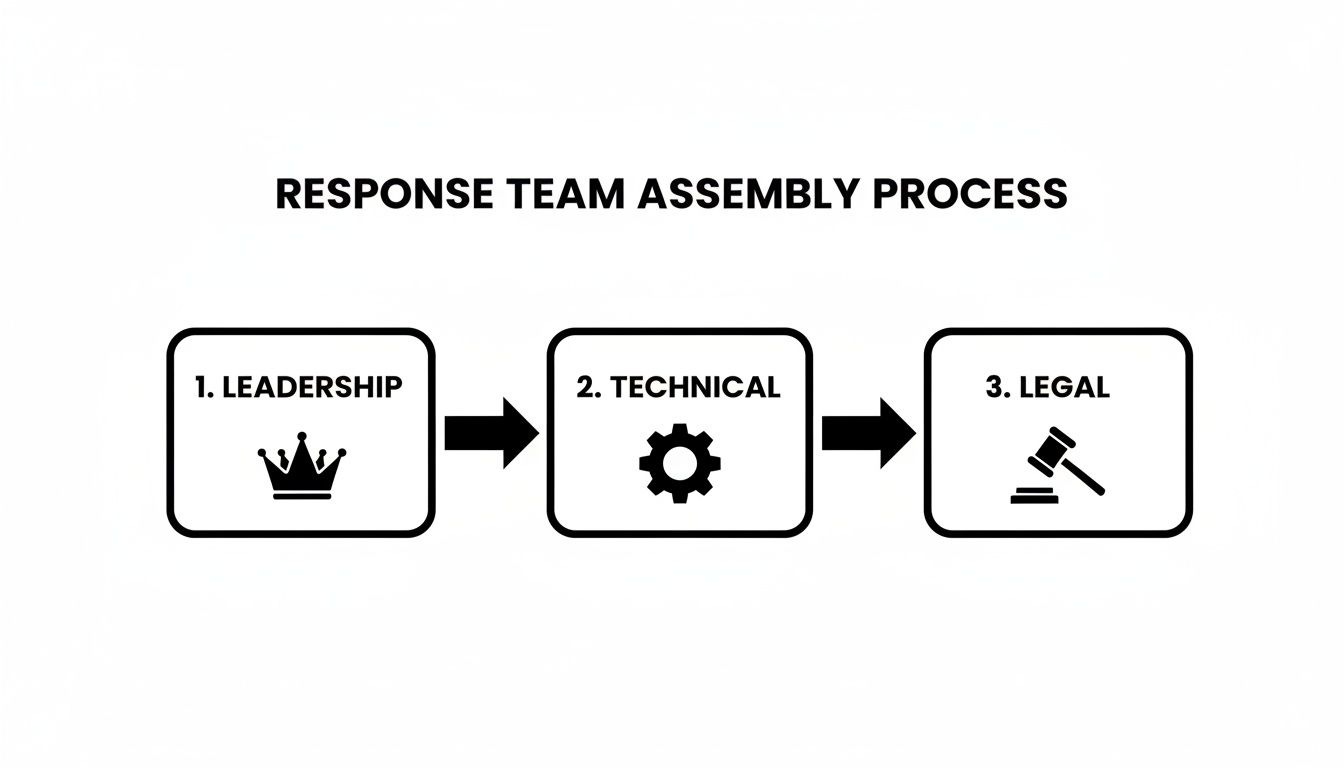
The key takeaway here is that a successful response is never siloed. It requires coordinated action from every critical part of the business to be truly effective.
Identification and Initial Assessment
You cannot respond to an incident if you are unaware it is happening. Your plan must first define what constitutes an "incident" for your business and then outline how to detect the early warning signs.
In a Microsoft 356 environment, potential indicators could include:
- Unusual login activity, such as multiple failed attempts or sign-ins from unexpected geographic locations.
- Alerts from Microsoft Defender flagging suspicious email forwarding rules.
- An employee reporting they received a convincing phishing email that they may have clicked.
Your customized plan should list these specific triggers. It also needs to direct the person who first identifies the issue—whether an employee or an automated system—on exactly who to notify. This section must name the primary and secondary contacts on the Incident Response Team to initiate the response immediately.
The goal of the identification phase is speed and accuracy. Your plan must provide a clear, simple path for escalating a potential issue so the right people can assess the situation without delay.
Containment and Eradication
Once an incident is confirmed, the immediate priority is to limit the damage. Containment strategies are designed to prevent the threat from spreading further across your business operations. Your plan must provide your technical team with practical, pre-approved actions they can take immediately.
For example, if an executive's email account is compromised, your plan's containment section should provide a clear playbook:
- Isolate the Asset: Immediately reset the user's password and force a log-out from all active sessions to lock out the attacker.
- Block Malicious Indicators: Identify the source of the attack (e.g., a malicious domain) and block it at your network firewall and email gateway to protect other employees.
- Preserve Evidence: Take a forensic snapshot or backup of the compromised mailbox before cleaning it up. This is vital for the subsequent investigation.
Eradication involves removing the threat completely. After containing the account, the next step is to ensure the attacker left no backdoors. This means scanning for malicious rules, searching for unauthorized access, and verifying that no other accounts were affected. Your plan must document these eradication steps to guarantee a thorough cleanup. For those refining their own processes, consulting an existing IT disaster recovery plan template can provide valuable structural insights.
Recovery and Post-Incident Review
With the threat eliminated, the focus shifts to resuming business operations safely. The recovery section of your plan should detail how to restore affected systems and data from clean, secure backups. It also needs to specify the validation process—how you confirm that systems are fully functional and secure before bringing them back online.
This phase is a business decision, not just a technical checklist. The Incident Commander, guided by the plan, will determine the appropriate time to restore services to minimize disruption while ensuring the environment is safe.
The final and most important phase is the post-incident review. This is where your organization learns and improves. Your plan must mandate a "lessons learned" meeting within a specific timeframe after the incident is resolved.
This meeting should cover:
- What worked well in the response?
- Where were the communication breakdowns or procedural gaps?
- What new preventative measures can be implemented?
- Does the incident response plan itself require updates?
This continuous improvement cycle turns a negative event into a valuable opportunity to strengthen your defenses. It is a critical component of building long-term organizational resilience.
Getting Your Plan Off the Shelf and Into Microsoft 365
An incident response plan is ineffective if it cannot be accessed and acted upon instantly during a crisis. To make your plan functional, it must be integrated into the tools your business uses daily, especially Microsoft 365.
The goal is to transform your plan from a static document into a dynamic, operational asset. By integrating it with your existing systems, you create a direct link between proactive security monitoring and your structured response process, enabling swift, coordinated action when an incident occurs.
Creating A Centralized Response Hub in SharePoint
First, you need a secure, central location for your incident response plan and all its supporting documents. A dedicated SharePoint site serves this purpose perfectly, becoming the single source of truth for your entire Incident Response Team (IRT).
This SharePoint site should be more than a file repository; it should be a dynamic hub that includes:
- The Master IRP: The most current, approved version of your plan, eliminating confusion from outdated copies.
- Specific Playbooks: Detailed checklists for likely threats, such as ransomware, business email compromise, or data theft.
- Contact Lists: Up-to-date contact information for all IRT members, their backups, and external partners like legal counsel or your IT provider.
- Communication Templates: Pre-drafted internal and external messages for various incident types, ready for quick customization and distribution.
Securing access permissions is critical. Only IRT members and key stakeholders should be able to view and edit these documents, ensuring the plan's confidentiality and readiness.
A dedicated SharePoint site transforms your IRP from a forgotten document into an immediate, actionable resource. When an incident occurs, your team knows exactly where to go for guidance, eliminating confusion and saving precious time.
Using Microsoft Defender Alerts As Triggers
A plan is useless without a trigger to set it in motion. The security tools built into Microsoft 365, such as Microsoft Defender for Office 365 and Microsoft Defender for Endpoint, continuously monitor your environment for threats.
These alerts should be direct triggers for your incident response plan. For example, a high-severity alert from Microsoft Defender flagging "suspicious inbox forwarding rules" should immediately activate the "Business Email Compromise" playbook stored in your SharePoint hub.
This integration creates a seamless workflow:
- Detection: Microsoft Defender identifies a credible threat.
- Alert: An automated notification is sent to your IT partner and the designated Technical Lead.
- Activation: The Technical Lead accesses SharePoint, retrieves the relevant playbook, and begins executing the documented response steps.
This process eliminates manual delays and ensures a consistent, methodical response every time. It operationalizes your plan by embedding it directly into your security infrastructure.
Lessons From Structured Incident Reporting
The need for structured, data-driven response is not unique to cybersecurity. California, for instance, is modernizing its fire incident reporting to improve data analysis and response effectiveness. This shift highlights the importance of standardized data in any crisis, including a cyber incident, where a unified view of evidence is crucial for effective resolution. You can learn more about California's incident reporting evolution on their official site, and the lessons reinforce the need for clarity in cybersecurity response.
Ultimately, operationalizing your plan in Microsoft 365 is about creating a responsive security ecosystem. When your plan, your team, and your technology work in harmony, you build genuine organizational resilience.
Testing And Maintaining Your Response Plan
An untested incident response plan creates a false sense of security, leaving your business exposed when a real crisis occurs. The only way to build genuine resilience is to regularly test the plan, validate your team's roles, and commit to continuous improvement.
Regular testing transforms a static document into a dynamic operational asset that works under pressure. It also ensures your IRP remains aligned with your business as your technology, team, and the threat landscape evolve.
Validating Your Plan With Tabletop Exercises
For most businesses, the most practical and effective way to test an IRP is with a tabletop exercise. This is a structured, discussion-based walkthrough of a hypothetical security incident, not a live technical drill.
The process involves gathering your Incident Response Team (IRT) to talk through a specific scenario, step by step. For example, you could simulate a business email compromise where an attacker has gained control of a senior executive's account.
During the exercise, you would address key questions:
- How would we detect this incident? What are the initial indicators?
- Who is the first point of contact, and what is the escalation path?
- What immediate containment steps does our plan require?
- How would the Communications Lead manage messaging to employees and affected clients?
- What critical decisions would the Incident Commander need to make regarding system shutdowns or customer notifications?
These drills are invaluable for identifying gaps, clarifying roles under simulated pressure, and improving team communication. They expose ambiguities and friction points that appear fine on paper but would cause failure in a real event.
Establishing A Cadence For Review And Improvement
Testing is an ongoing process, not a one-time event. Your incident response plan should be treated as a living document that requires regular maintenance to remain effective. We recommend a formal review and a tabletop exercise at least annually.
However, certain business changes should trigger an immediate plan review:
- Implementation of a major new technology platform, like a new CRM.
- Significant changes to your IT infrastructure.
- Changes in key personnel on the Incident Response Team.
- Immediately following a real incident, as part of the post-incident review.
This proactive approach ensures your plan remains current and effective. For businesses in our region, this diligence is critical. As noted by the California Cybersecurity Integration Center (Cal-CSIC), organizations without formal plans face significantly longer breach recovery times. You can read more about how California is boosting its cybersecurity intelligence sharing to address these growing threats.
A well-maintained plan is a cornerstone of both your security and overall business continuity. As you refine your incident response, you may also find value in our IT disaster recovery plan template to ensure comprehensive preparedness for any type of disruption.
Your Next Steps Toward Cyber Resilience
An incident response plan template is a foundational tool, but it is only the beginning. True cyber resilience comes from transforming that template into a living, operational process that your team can execute effectively under pressure.
We have covered the essential elements: assembling the right team, customizing the plan to your specific risks, integrating it into your daily workflows, and testing it regularly.
The key takeaway is that preparedness is an active, ongoing process. It requires clear communication, well-defined roles, and a commitment to continuous improvement after every drill and every real-world event.
Start The Conversation
Now is the time to turn these concepts into action. Use this guide to initiate a meaningful conversation with your leadership team and your IT partner.
The goal is not to create a perfect plan overnight. It is to conduct an honest assessment of your current posture, identify your most significant vulnerabilities, and agree on the first practical steps to strengthen your organization's security.
This conversation is the bedrock of building real operational resilience. If you need assistance facilitating that discussion or require expert guidance to develop a plan that fits your business, our team is here to help.
Your Incident Response Questions, Answered
When building an incident response plan template, business leaders often have practical questions. Here are straightforward answers to some of the most common inquiries, focusing on business preparedness.
How Often Should We Test Our Incident Response Plan?
The industry standard is to test your plan at least annually. However, you should also review it whenever your organization undergoes a significant change, such as implementing new IT systems, changing key personnel on your response team, or facing new industry-specific threats.
Regular tabletop exercises are a low-disruption method for keeping your team sharp and the plan relevant. These drills ensure your IRP remains an actionable guide that works in practice, not just a document on a server.
What Is The Single Biggest Mistake In Incident Response Planning?
The most common mistake is creating a plan and then failing to maintain it. An incident response plan is a living document. If it is not tested, updated, and integrated into your operations, it becomes ineffective during a real crisis.
An untested plan provides a false sense of security and leads to chaos, with team members fumbling through outdated procedures and unclear roles when every second is critical.
Does A Small Business Really Need A Formal IRP?
Absolutely. Cybercriminals often target small and midsize businesses because they assume their defenses are weaker. For a smaller company with limited resources, a cyberattack can be a business-ending event, not just an inconvenience.
A scalable response plan enables you to react quickly, which is crucial for minimizing financial losses, reputational damage, and downtime. For organizations without the deep resources of a large enterprise, a clear playbook is a vital investment in survival.
Does Cyber Insurance Replace The Need For A Response Plan?
Not at all; they are complementary. In fact, most cyber insurance providers now require businesses to have a documented and tested incident response plan to qualify for a policy. Without one, you may be unable to obtain coverage or have a claim approved.
Insurance helps cover financial losses after an incident. Your IRP is the operational playbook you use to contain the damage and recover faster. A swift, organized response can significantly reduce the final cost of a claim, making your business a lower-risk, more attractive client to insurers.
Developing a comprehensive incident response plan can be complex. The expert team at Tricord I.T Solutions can help you build a customized, practical, and testable plan that creates true resilience for your organization. Schedule a consultation to assess your readiness today.