

IT solution consulting provides businesses with an expert advisor to align technology with strategic goals. It is a partnership focused on improving efficiency, managing risk, and controlling costs by creating a clear technology roadmap. Instead of reacting to problems, a consultant proactively designs and implements IT systems that support operational needs and deliver a measurable return on investment.
This strategic approach helps business leaders make informed decisions about technology, ensuring that every investment in software, hardware, and security directly contributes to the company's long-term success.
What is IT Solution Consulting?
At its core, IT solution consulting moves beyond routine IT support. Rather than simply fixing what is broken, a consultant focuses on building a technology framework that prevents issues and actively drives business objectives. This is a strategic role that translates business needs into a practical, secure, and cost-effective technology plan.
This service is especially valuable for organizations that depend on technology for daily operations but lack the in-house expertise to develop a long-term strategy. The consultant acts as an independent advisor, helping leaders navigate the complex landscape of business IT services to find the right solutions for their specific challenges.
Moving From Reactive to Proactive IT
Many businesses are caught in a reactive cycle, addressing technology problems only after they have caused downtime, data loss, or operational disruption. This approach leads to unpredictable costs, reduced productivity, and significant business risk. IT solution consulting shifts this dynamic from reactive fire-fighting to proactive, strategic management.
Instead of waiting for a server to fail or a security breach to occur, a consultant identifies potential vulnerabilities and operational bottlenecks in advance. This proactive stance is essential for maintaining business continuity, protecting sensitive data, and ensuring systems are prepared for future growth.
Core Functions and Business Outcomes
An IT solution consultant bridges the gap between business objectives and technology capabilities. They achieve this by focusing on several key functions that deliver direct, tangible value. For a practical overview of how these services are applied, exploring our dedicated consultation services can provide a clear picture of what is possible.
Each function is designed to produce a specific business outcome.
An effective IT consultant doesn't just recommend technology; they align it with your balance sheet, your operational realities, and your long-term vision. The goal is to make technology a competitive advantage, not an operational burden.
This table breaks down what a consultant does and the direct impact it has on business performance.
Core Functions of IT Solution Consulting at a Glance
This table outlines the primary roles an IT solution consultant plays and the direct business value each function delivers.
| Consulting Function | Primary Business Outcome |
|---|---|
| Strategic Planning & Roadmapping | Creates a clear, multi-year technology plan that aligns with business growth, ensuring investments are future-proof. |
| Risk Assessment & Mitigation | Identifies cybersecurity, compliance, and operational vulnerabilities before they become costly problems, enhancing business resilience. |
| Technology Evaluation & Sourcing | Recommends and helps implement the right software and hardware, preventing overspending on unsuitable or unnecessary solutions. |
| Process Optimization | Analyzes workflows to identify opportunities for improvement, increasing team productivity and operational efficiency. |
Ultimately, these functions work together to transform IT from a cost center into a strategic asset that fuels growth.
Understanding Core IT Consulting Services
Effective IT solution consulting is not just about high-level strategy; it involves delivering tangible services that solve specific business problems. These services are the building blocks of a resilient, efficient, and secure technology foundation. For any business leader, understanding these core components clarifies how a consultant translates broad goals into practical value.
The scope of these services is broad, reflecting technology's central role in modern business. According to the Canadian IT consulting landscape on ibisworld.com, the market has seen consistent growth driven by increasing demand for cloud adoption and cybersecurity expertise, highlighting how critical professional guidance has become.
This map illustrates how IT solution consulting connects business goals directly to technology solutions to achieve a measurable return on investment.
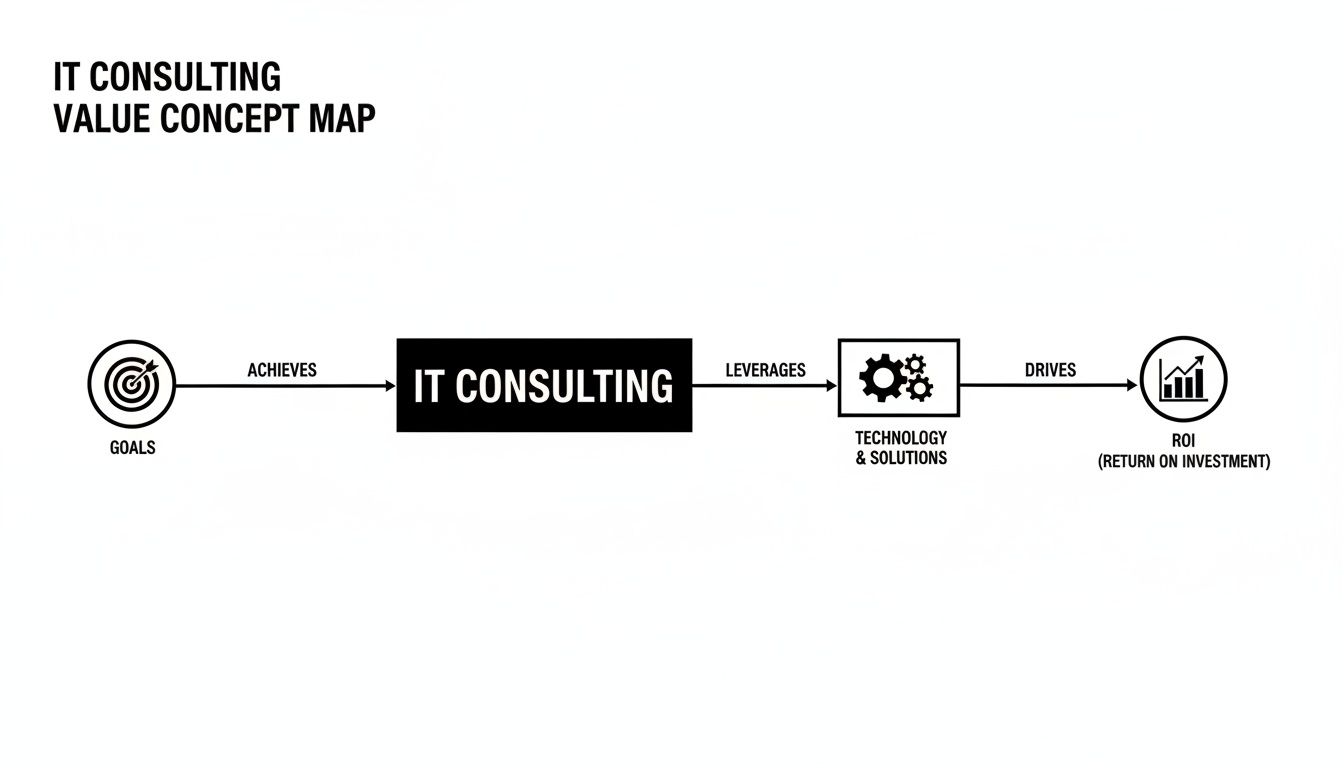
The process is straightforward but powerful: begin with clear objectives, select the right technology to meet them, and measure the improvement in business outcomes.
Virtual CIO (vCIO) for Strategic Leadership
Many growing businesses require executive-level technology guidance but cannot justify the cost of a full-time Chief Information Officer (CIO). A Virtual CIO (vCIO) or fractional CIO services for business growth provides this strategic leadership on a flexible, part-time basis.
A vCIO functions as a member of the leadership team, ensuring the IT roadmap aligns with broader business objectives. Their role is strategic, focusing on budget planning, risk management, compliance, and ensuring technology investments remain relevant and support long-term goals.
Managed Infrastructure for Reliability and Scalability
IT infrastructure—whether in the cloud, on-premises, or a hybrid model—is the engine of daily operations. Managed infrastructure services ensure this engine runs smoothly, reliably, and securely, without requiring constant attention from your internal team.
This service involves proactively monitoring, maintaining, and managing the entire technology stack, from servers and networks to data storage.
- Proactive Monitoring: Consultants use advanced tools to identify and resolve potential issues, such as a failing hard drive or a network bottleneck, before they cause downtime.
- System Maintenance: This includes applying critical security patches, updating software, and optimizing system configurations to maintain peak performance.
- Scalability Planning: A consultant ensures the infrastructure can accommodate growth, preventing performance degradation as business demands increase.
The primary outcome is uninterrupted operational continuity. Stable and reliable systems allow your team to remain productive and ensure clients receive consistent service.
Comprehensive Cybersecurity and Compliance Management
As cyber threats become more sophisticated and regulatory requirements stricter, a reactive approach to security is no longer viable. Comprehensive cybersecurity consulting provides a proactive defense tailored to your specific risks and compliance obligations. This is a critical component of any effective it solution consulting partnership.
A strong security posture is a business necessity that protects your reputation, finances, and client trust. An IT consultant builds layered defenses that account for both technology vulnerabilities and human factors.
Key services in this area include:
- Risk Assessments: Identifying weaknesses in your network, applications, and processes to understand your precise areas of exposure.
- Compliance Management: Implementing technical controls and policies to meet industry regulations, such as those governing legal or healthcare data.
- Threat Monitoring and Incident Response: Actively watching for suspicious activity and having a clear plan to contain and remediate any security breach, minimizing potential damage.
- Security Awareness Training: Educating employees on how to recognize and avoid common threats like phishing, which often represent the weakest link in security.
This strategic approach significantly reduces the risk of a costly data breach or regulatory penalties.
Platform Optimization for Microsoft 365 and SharePoint
Many businesses invest in powerful platforms like Microsoft 365 but only use a fraction of their capabilities. Platform optimization focuses on maximizing the value of your existing technology to improve collaboration, automate processes, and boost productivity.
For example, a consultant can configure SharePoint as a secure, centralized document hub for a law firm, complete with version control and access permissions to meet compliance standards. They can also optimize Microsoft Teams to streamline communication and project management, reducing the need for multiple disparate applications. This service often includes expert advice on managing enterprise software solutions and licenses to ensure you get the most from every platform.
By fine-tuning these tools, you transform a simple subscription fee into a genuine driver of operational efficiency.
The Business Benefits of Strategic IT Consulting
Viewing an IT solution consulting partner as a mere operational expense is a common mistake. It is a strategic investment where the true value lies not in the technology itself, but in the measurable business outcomes it produces, including cost control, risk reduction, improved efficiency, and support for future growth.
For most businesses, moving away from a reactive, break-fix IT model is the first step toward sustained success. According to this market growth analysis on consulting.ca, the Canadian IT services market continues to expand as businesses seek expert guidance to align technology with strategic goals.
A strategic partnership delivers value in four key areas, each contributing to a more resilient, efficient, and future-ready organization.
Achieve Cost Control and Predictability
One of the most significant benefits of strategic IT consulting is converting unpredictable capital expenditures into a fixed, manageable operating expense. The break-fix model is detrimental to budgets, as emergencies and unplanned downtime are invariably more costly than proactive maintenance.
A consulting partner helps establish a clear, fixed monthly budget for technology management. This financial predictability simplifies forecasting and frees up capital that would otherwise be held in reserve for the next IT crisis.
By proactively managing your technology environment, you transform IT from a volatile cost center into a predictable and strategic investment. This stability is the foundation for sound financial planning and growth.
This approach not only stabilizes expenses but also ensures spending is directed toward technology that serves a clear business purpose.
Reduce Business Risk and Enhance Security
In an environment of increasing cyber threats and stringent regulations, risk management is a primary concern for business leaders. IT solution consulting provides a structured framework to systematically identify, assess, and mitigate technology-related risks across the entire organization.
This extends beyond simply installing antivirus software. A consultant helps build a comprehensive security posture that includes:
- Compliance Adherence: Ensuring systems and processes meet industry-specific regulations to avoid significant fines.
- Data Protection: Implementing robust measures to safeguard sensitive client and company information against breaches and unauthorized access.
- Business Continuity: Developing and testing a disaster recovery plan to ensure operations can continue with minimal disruption following a major incident.
Properly addressing these areas protects your reputation, your finances, and the trust you have built with your clients.
Improve Operational Efficiency and Productivity
Inefficient workflows and mismatched technology can quietly drain your team's productivity and your company's profitability. An IT consultant analyzes your current processes to identify opportunities where technology can eliminate bottlenecks and automate repetitive tasks.
For example, a professional services firm might lose billable hours due to cumbersome document management. A consultant could optimize their system to create a secure, centralized platform that automates version control and facilitates seamless collaboration. These targeted improvements, when scaled across an organization, result in significant gains in overall efficiency.
Enable Scalability and Future-Proofing
Your technology should support growth, not hinder it. A common error is investing in systems that solve today's problems but cannot accommodate future needs. Strategic it solution consulting focuses on building a flexible and scalable technology foundation from the outset. For a deeper dive, read our guide on scaling IT for business growth.
This involves selecting solutions that can grow with your business, whether you are adding new employees, opening new locations, or expanding your service offerings. An experienced consultant ensures your IT infrastructure is not just a current asset but a long-term advantage, saving you from the costly and disruptive cycle of replacing core systems every few years.
How to Choose the Right IT Consulting Partner
Selecting the right IT consulting partner is a critical business decision. The ideal firm is more than a vendor; they are a strategic asset. A poor choice can lead to wasted investment, security vulnerabilities, and significant operational friction.
The selection process must go beyond comparing technical skills or price. A true partner invests time in understanding your business—your objectives, operational challenges, and specific compliance requirements. They should function as an extension of your team, guiding your technology roadmap to support long-term growth.

To find this fit, you need to ask targeted questions that reveal a firm's methodology, experience, and commitment to your success.
Evaluate Their Industry Specialization
Generic IT advice is rarely sufficient. A consulting partner with deep experience in your industry—whether legal, healthcare, or manufacturing—understands your specific workflows, data security challenges, and regulatory obligations. This specialized knowledge is invaluable.
When vetting potential partners, ask direct questions about their industry background:
- "Can you provide specific examples of how you’ve solved challenges for other clients in our industry?" This question requires evidence of relevant experience.
- "How do you stay current with the compliance requirements that affect our sector?" This tests their commitment to understanding the rules that govern your business.
A consultant who knows your industry will be more effective, offer more relevant solutions, and address your unique risks and opportunities from the start.
Understand Their Strategic Approach
The distinction between an IT vendor and a strategic partner is simple: a vendor fixes things when they break, while a partner works to prevent them from breaking by aligning technology with your business goals.
A partner’s value is not measured by how quickly they close a support ticket. It is measured by their contribution to your business objectives. Their focus should be proactive strategy, not reactive fixes.
To determine if a firm has a strategic mindset, ask the following:
- "How do you measure success for your clients?" Their answer should focus on business outcomes—such as improved productivity, reduced risk, or predictable costs—not just technical metrics like server uptime.
- "What is your process for developing a technology roadmap?" A strategic partner will describe a collaborative process that begins with your business goals, not a list of hardware to purchase.
This line of questioning helps you identify firms that offer true IT solution consulting rather than just outsourced IT support.
Assess Their Engagement and Support Models
It is crucial to understand how a potential partner will work with your team. Engagement models vary, from one-off projects with a defined scope to ongoing managed services for a flat monthly fee. The right model depends on your specific needs.
When discussing services, get clear answers on these points:
- What are your communication protocols and response time guarantees? You need to know who to contact in a crisis and what to expect.
- How will our teams collaborate during a major project or incident? This reveals their process for partnership and crisis management.
- Who will be our primary point of contact? Consistent access to a dedicated advisor who understands your business is essential for a productive long-term relationship.
A transparent partner will clearly outline their engagement model, so there are no surprises. Finding alignment in how you work together is key to a successful partnership.
Common Mistakes to Avoid When Hiring an IT Consultant
Choosing an IT consulting partner is a decision that can significantly impact your operational stability and future growth. A misstep can lead to wasted resources, new security vulnerabilities, and ongoing frustration. Understanding common pitfalls is the first step to avoiding them.
With more businesses relying on external expertise, it is essential to approach the selection process with a clear strategy.
Focussing on Short-Term Fixes Over Long-Term Strategy
A frequent mistake is hiring a consultant to solve an immediate, isolated problem without considering the broader context. This reactive approach might patch a security flaw or improve a slow server, but it fails to address the underlying issues.
This mindset keeps a business in a perpetual break-fix cycle, constantly addressing symptoms instead of building a resilient technology foundation. A strategic partner delivers a comprehensive technology roadmap that aligns with your business goals, preventing future problems and positioning IT as an asset for growth.
Choosing a Partner Based Solely on the Lowest Price
While budget is always a consideration, basing your decision purely on the lowest bid is a high-risk strategy. The cheapest option often comes with hidden costs, such as inexperienced technicians, poor communication, or a one-size-fits-all solution that is ill-suited to your business.
A low upfront cost can be quickly erased by the expense of a single security breach, a day of operational downtime, or the need to replace an inadequate solution a year later. The true measure of value is the long-term return on investment.
Instead of focusing on the lowest price, evaluate the overall value. A partner with proven industry experience and a strategic approach will almost always deliver better results, stronger security, and a lower total cost of ownership over time.
Failing to Define Clear Goals for the Engagement
Hiring an IT consultant without clear, measurable objectives is like starting a journey without a destination. If you do not define what success looks like, you cannot know if you have achieved it. This ambiguity often leads to scope creep, budget overruns, and mutual frustration.
Before engaging potential partners, define precisely what you want to accomplish.
- Be Specific: Instead of "improve security," a better goal is "achieve compliance with industry data protection standards within six months."
- Be Measurable: Rather than "increase efficiency," aim for a "15% reduction in manual data entry by automating key workflows."
- Be Realistic: Set objectives that are achievable based on your resources and timeline.
Presenting clear goals empowers a consultant to propose a targeted and effective solution, ensuring your investment is directly tied to a meaningful business outcome from the beginning.
Your Next Steps Toward Strategic IT Partnership
Engaging an **IT solution consulting** partner is a strategic investment in your company’s future. It represents a shift from viewing technology as a reactive expense to using it as a proactive tool for growth, security, and efficiency. The right partnership provides clarity, reduces risk, and builds a solid foundation for your business.A reputable consulting firm should make the initial process straightforward and transparent, ensuring you feel confident and informed at every stage.
The Initial Engagement Process
The path to a strategic partnership is a logical process designed to connect technology directly to your business needs. This ensures every recommendation is grounded in your operational reality and long-term goals.
Discovery Call: The process begins with a conversation focused on understanding your current challenges, operational bottlenecks, and business objectives. The goal is to listen, not to sell.
Technology and Security Assessment: Next, a consultant conducts a thorough review of your existing IT environment, security posture, and workflows. This diagnostic assessment identifies vulnerabilities, inefficiencies, and opportunities for improvement.
Strategic Roadmap Development: Based on the assessment findings, the consultant develops a clear, actionable technology roadmap. This plan outlines specific projects, timelines, and the expected business outcomes, providing a practical guide for moving forward.
A well-defined roadmap is a business plan for your technology. It ensures every dollar you invest and every action you take is a deliberate step toward hitting your main goals, whether that’s tightening security or boosting team productivity.
This structured approach removes guesswork from the process, making it manageable and ensuring it is based on evidence, not assumptions.
If you are ready to see how a strategic IT partner can help solve your specific challenges, a brief consultation is often all it takes to gain the clarity needed to make your next move.
Your Questions About IT Solution Consulting, Answered
If you are considering engaging an IT partner, you likely have practical questions. This section provides direct answers about the value, logistics, and costs associated with these services.
What is the difference between IT consulting and managed IT services?
It is helpful to use the analogy of building a house. IT solution consulting is the architect. This is a strategic, project-based service focused on planning, assessing, and designing a technology roadmap to meet specific business goals. A consultant helps you determine what to build and why.
Managed IT services, in contrast, is the building manager. This is the ongoing, day-to-day work of maintaining the systems the consultant designed. For a flat monthly fee, a managed services provider handles monitoring, maintenance, security, and support to ensure operational stability.
How much does IT solution consulting cost?
There is no single price for IT solution consulting, as costs are tied to the scope, complexity, and duration of the engagement. Pricing typically follows one of three models:
- Hourly Rate: Best suited for specific, short-term tasks or ad-hoc advice where the scope is not yet fully defined.
- Project-Based Fee: A fixed price for a clearly defined project, such as a security audit or a cloud migration plan, which provides cost predictability.
- Retainer Fee: A recurring monthly fee for ongoing strategic guidance, often used for vCIO or long-term advisory roles requiring consistent expert access.
A reputable consultant will provide a transparent proposal outlining all costs before work begins.
How long does a typical engagement last?
The duration of an IT consulting engagement depends entirely on the objectives. A security risk assessment might be completed in a few weeks. In contrast, engaging a fractional CIO to guide a multi-year digital transformation is a long-term partnership that could last several years. The engagement should last precisely as long as it takes to achieve the defined goals.
What industries benefit most from IT consulting?
Any business that relies on technology for its operations can benefit. However, certain industries derive exceptional value from expert IT solution consulting, particularly those with stringent regulatory and data security requirements.
Any organization where technology downtime, a data breach, or a compliance failure would cause significant financial or reputational damage is an ideal candidate for strategic IT consulting. This is especially true for professional services and other regulated industries.
Industries that see the greatest impact include:
- Legal: Law firms handle highly sensitive client data and require robust security and compliance measures.
- Healthcare: Medical practices must adhere to strict patient data privacy regulations with no margin for error.
- Finance: Financial services firms need resilient, highly secure systems to manage risk and protect assets.
Ultimately, any business seeking to move from reacting to technology problems to proactively using technology to drive growth will find a consulting partnership invaluable.
If you're ready to shift from reactive IT fixes to a proactive technology strategy, the team at Tricord I.T Solutions can help. We provide the expert guidance and hands-on support you need to build a secure, efficient, and scalable foundation for your business. Schedule a consultation to discuss your specific goals.