
Achieving SOC 2 compliance is a critical step for service organizations to demonstrate a commitment to security and build client trust. For business owners and executives, the process can seem complex, but it is fundamentally about implementing and documenting robust controls over data and systems. This SOC 2 compliance checklist provides a clear, practical roadmap for leaders responsible for managing risk, cost, and operational resilience, even without a deep technical background.
This article moves beyond theory to provide actionable steps. We will break down the essential controls required by auditors, focusing on their business impact and the evidence needed to prove compliance. The goal is to provide a plan that aligns security with business objectives, ensuring you are building a genuinely secure and resilient organization, not just checking boxes.
This guide translates the abstract requirements of the Trust Services Criteria—Security, Availability, Processing Integrity, Confidentiality, and Privacy—into a structured, manageable project. You will learn what controls are necessary, how to implement them, what evidence to collect, and how to assign responsibility within your team. For a foundational understanding, you can start with our comprehensive guide on what is SOC 2 compliance.
1. Access Control and User Authentication
Access control is a foundational element of any security framework and a cornerstone of your SOC 2 compliance checklist. It involves creating and enforcing policies that ensure only authorized individuals can access specific systems, applications, and data. The goal is to implement the principle of least privilege, where users are granted only the minimum level of access necessary to perform their job functions. This is critical for preventing both accidental and malicious data breaches.
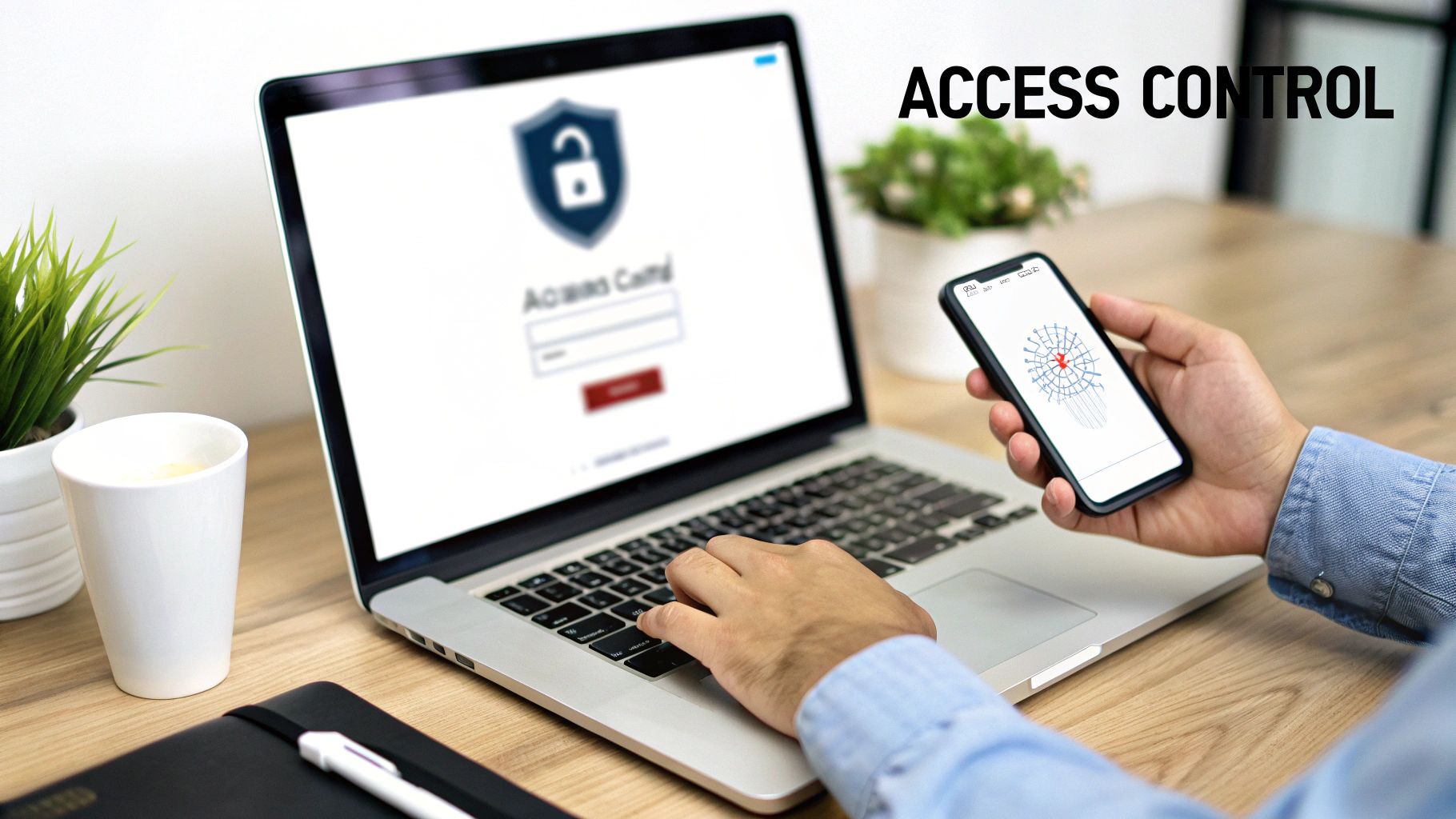
For a law firm managing sensitive client files in Microsoft 365, or a healthcare organization protecting patient records, robust access controls are non-negotiable. They directly support client confidentiality requirements and regulatory mandates, forming a primary line of defense against unauthorized data disclosure.
Implementation and Evidence
To meet SOC 2 requirements, your organization must demonstrate systematic control over user access. This involves a combination of technical configurations and documented policies.
- Role-Based Access Control (RBAC): Define user roles based on job responsibilities (e.g., Paralegal, Accountant, System Administrator). Assign permissions to these roles rather than individual users to ensure consistency and simplify management.
- Multi-Factor Authentication (MFA): Enforce MFA for all users, especially for access to critical systems and remote connections. Prioritize authenticator apps over less secure SMS-based methods.
- Periodic Access Reviews: Conduct regular (e.g., quarterly) reviews of user access rights. This process verifies that permissions remain appropriate and helps identify and remove orphaned accounts for former employees.
Microsoft 365 Configuration Notes
For organizations utilizing Microsoft 365, Azure Active Directory (Azure AD) provides powerful tools to enforce these controls.
- Conditional Access Policies: Configure policies in Azure AD to restrict access based on user, location, device compliance, and risk level. For example, block access attempts from unrecognized countries or require MFA for all administrative roles.
- Privileged Identity Management (PIM): Use PIM to manage, control, and monitor access to important resources. It enables just-in-time privileged access, requiring users to request and justify temporary administrator permissions, which significantly reduces risk.
2. Change Management and Configuration Control
Change management is a critical process within a SOC 2 compliance checklist, designed to ensure that any modifications to your IT environment are controlled, tested, and documented. It establishes a formal system for requesting, approving, and deploying changes to systems, applications, and infrastructure. The primary goal is to maintain system integrity, prevent service disruptions, and ensure that all changes are deliberate, authorized, and auditable.
For a managed IT provider responsible for multiple client environments, a robust change management process is fundamental. It prevents uncoordinated modifications from causing widespread outages and provides a clear audit trail demonstrating responsible stewardship of client systems. This control is equally vital for a financial services firm, where an unauthorized database change could have significant regulatory and operational consequences.
Implementation and Evidence
To satisfy SOC 2 auditors, your organization must prove it has a systematic and consistently followed change management process. This requires both a documented policy and evidence of that policy in action.
- Formal Change Request Process: All changes, from minor patches to major system upgrades, must begin with a formal request. This request should detail the change, its justification, potential impact, and a rollback plan.
- Change Advisory Board (CAB): Establish a CAB or a similar approval body composed of key stakeholders. The CAB is responsible for reviewing, prioritizing, and authorizing change requests to ensure they align with business needs and risk tolerance.
- Testing and Validation: All changes must be tested in a non-production environment before deployment. Document the testing procedures and results to prove the change will function as expected without introducing new vulnerabilities.
Microsoft 365 Configuration Notes
Managing changes within a dynamic environment like Microsoft 365 requires specific tools and practices to maintain control and provide a clear audit trail.
- Azure DevOps for Change Tracking: Utilize Azure DevOps or a similar platform like Jira to manage the change lifecycle. Create work items for each change request, track them through approval and testing stages, and link them to deployment pipelines for a complete, end-to-end record.
- Use Version Control for Configurations: Store infrastructure-as-code (IaC) scripts, SharePoint configurations, and PowerShell scripts in a version control system like Git. This not only tracks every modification but also allows for controlled deployments and rapid rollbacks if an issue arises.
3. Encryption of Data in Transit and at Rest
Implementing strong encryption is a non-negotiable component of a modern SOC 2 compliance checklist. This control involves using cryptographic methods to protect sensitive data both when it is stored on servers or devices (at rest) and when it is being transmitted across networks (in transit). The primary goal is to render data unreadable and unusable to unauthorized parties, even if they manage to bypass other security controls. This is crucial for protecting data from interception or direct physical theft of hardware.

For a financial services firm handling transaction records or a professional services organization storing sensitive client project data, encryption is the last line of defense. It directly supports confidentiality and integrity by ensuring that even if a server is breached or network traffic is captured, the underlying data remains secure.
Implementation and Evidence
To satisfy SOC 2 auditors, your organization must prove that encryption is systematically applied to all sensitive data. This requires a combination of technical enforcement and clear, documented policies governing encryption standards and key management.
- Enforce End-to-End Encryption: Utilize modern, strong cryptographic protocols like TLS 1.2 or higher for all data in transit. This applies to web traffic (HTTPS), API calls, and internal network communications.
- Data-at-Rest Encryption: Ensure all storage media containing sensitive data is encrypted. This includes server hard drives, databases, cloud storage (like SharePoint and OneDrive), and backup media.
- Cryptographic Key Management: Establish and document a formal policy for managing encryption keys. This policy should cover key generation, secure storage, rotation schedules (e.g., annually), and a defined process for retiring old keys.
Microsoft 365 Configuration Notes
Microsoft 365 offers robust, built-in encryption features that can be configured to meet stringent compliance requirements.
- Service Encryption with Customer Key: While Microsoft encrypts data by default, you can use Customer Key to gain an extra layer of control. This allows you to provide and manage your own encryption keys for services like SharePoint Online, Exchange Online, and Microsoft Teams.
- Azure Information Protection (AIP): Use AIP to classify and protect documents and emails by applying labels. These labels can enforce encryption and access restrictions that travel with the data, ensuring it remains protected no matter where it is stored or who it is shared with.
4. Logging and Monitoring of System Activity
Comprehensive logging and real-time monitoring of system activity are indispensable components of a SOC 2 compliance checklist. This control involves capturing, centralizing, and analyzing data about user actions, system events, and security alerts across all infrastructure and applications. The objective is to maintain a detailed audit trail, providing clear visibility into who accessed what, when, and what actions were performed. This capability is crucial for incident investigation, forensic analysis, and proving compliance to auditors.
For a financial services firm, logging all database transactions with automated alerts is vital for detecting suspicious account modifications. Similarly, a managed IT provider leverages centralized logging to monitor client environments, enabling rapid detection of threats. Effective logging demonstrates accountability and provides the forensic evidence needed for a swift, organized response.
Implementation and Evidence
To satisfy SOC 2 criteria, your organization must show it systematically logs and reviews system activity. This requires deploying the right tools and establishing documented procedures for monitoring and response.
- Centralized Log Management: Implement a Security Information and Event Management (SIEM) solution like Azure Sentinel or Splunk to aggregate logs from all sources, including servers, applications, and network devices.
- Alerting on Critical Events: Configure automated alerts for high-risk activities such as administrative privilege escalation, multiple failed login attempts, mass file downloads, or unusual after-hours access.
- Regular Log Review: Establish and document a process for regular log review. Critical system logs should be reviewed daily, while others can be reviewed weekly. Document all findings and actions taken.
Microsoft 365 Configuration Notes
Microsoft 365 and Azure offer robust, built-in logging and monitoring tools that are essential for demonstrating compliance.
- Unified Audit Log: Ensure the Microsoft 365 Unified Audit Log is enabled to capture user and administrator activities across services like SharePoint Online, Exchange Online, and Teams. This provides a single source for audit evidence.
- Azure Sentinel for M365: Connect Microsoft 365 data sources to Azure Sentinel. This allows for advanced threat detection using pre-built analytics rules, anomaly detection, and automated response actions (SOAR) for common alerts.
5. Vulnerability Management and Patching
A systematic process for managing security vulnerabilities is a critical component of any effective SOC 2 compliance checklist. This involves proactively identifying, assessing, and remediating weaknesses across all systems and applications before they can be exploited by attackers. The goal is to minimize the attack surface and demonstrate a mature, risk-aware security posture to auditors and clients alike.
For a professional services firm managing sensitive project data or a financial institution protecting client assets, a robust vulnerability management program is non-negotiable. It provides documented evidence of due care, prevents costly breaches resulting from known exploits, and builds trust by showing a proactive commitment to security. This control is fundamental to protecting the integrity and availability of your services.
Implementation and Evidence
To satisfy SOC 2 requirements, your organization must prove it has a formal, repeatable process for vulnerability and patch management. This is achieved through a combination of automated tools, documented procedures, and consistent execution.
- Vulnerability Scanning and Penetration Testing: Conduct regular, automated vulnerability scans (e.g., quarterly) on all internal and external network assets. Supplement these scans with annual penetration tests performed by a qualified third party to identify more complex security flaws.
- Formal Patch Management Policy: Create a policy that defines service-level agreements (SLAs) for patching based on severity. For example, mandate that critical vulnerabilities are patched within 14-30 days, while high-severity issues are addressed within 60 days.
- Remediation Tracking: Use a centralized system to track all identified vulnerabilities from discovery to resolution. This log should document the vulnerability, assigned owner, remediation steps taken, and verification of the fix, serving as crucial evidence for auditors.
Microsoft 365 Configuration Notes
Microsoft provides powerful, integrated tools that help organizations automate and document their vulnerability management efforts within the M365 ecosystem.
- Microsoft Defender for Endpoint: Utilize Defender for Endpoint's Threat & Vulnerability Management feature. It continuously discovers, prioritizes, and remediates vulnerabilities and misconfigurations on enrolled devices, providing a real-time risk score and security recommendations.
- Windows Update for Business and Intune: Configure patch deployment rings using Intune and Windows Update for Business. This allows you to test patches on a pilot group of devices before rolling them out across the entire organization, ensuring stability while meeting compliance timelines.
6. Incident Response Planning and Procedures
A robust incident response plan is a critical component of any SOC 2 compliance checklist, ensuring your organization can react swiftly and effectively to security events. This involves creating and maintaining documented procedures to identify, investigate, contain, and remediate security incidents. The goal is to minimize damage, reduce downtime, and ensure a coordinated, predictable response when an incident occurs, which is vital for maintaining operational integrity and client trust.
For a managed IT provider detecting lateral movement in a client’s network, or a financial services firm investigating suspicious database access, a well-rehearsed incident response plan is indispensable. It transforms a chaotic situation into a structured process, ensuring all regulatory and client notification requirements are met while containing the threat efficiently.
Implementation and Evidence
To satisfy SOC 2 auditors, your organization must demonstrate a formal, tested incident response capability. This requires not just a plan on paper, but evidence that it is understood, maintained, and effective in practice.
- Documented Incident Response Plan: Create a formal plan that establishes an incident response team with defined roles (e.g., Incident Commander, Technical Lead, Communications Lead). The plan should include procedures for each phase of an incident: preparation, identification, containment, eradication, recovery, and lessons learned.
- Incident Tracking and Reporting: Maintain a log or ticketing system to document all security incidents. Each record should include details like the date of detection, a description of the event, steps taken to remediate it, root cause analysis, and preventive actions implemented.
- Regular Testing and Training: Conduct at least annual tabletop exercises or simulations of common scenarios like ransomware or data exfiltration. Document the results of these tests and any updates made to the plan based on lessons learned.
Microsoft 365 Configuration Notes
Microsoft 365 and Azure offer integrated tools that are essential for a modern incident response strategy, providing visibility and control within your cloud environment.
- Microsoft Sentinel: Utilize this Security Information and Event Management (SIEM) tool to centralize log collection from across your environment. Configure analytics rules to detect suspicious activities and use automated playbooks to orchestrate initial response actions, such as isolating a compromised device or disabling a user account.
- Microsoft Defender for Cloud Apps: Implement policies to detect and respond to anomalous behavior, such as mass downloads or impossible-travel alerts. Configure automated governance actions, like revoking access tokens or requiring a user to sign in again, to contain threats in real-time. For a comprehensive overview of creating your plan, explore our incident response plan template.
7. Employee Background Screening and Confidentiality Agreements
The individuals you hire are integral to your security posture, making personnel controls a key part of your SOC 2 compliance checklist. This involves implementing pre-employment background screening for all personnel with system access and ensuring they sign confidentiality or non-disclosure agreements (NDAs). This control establishes a baseline of trustworthiness and creates legally enforceable obligations to protect sensitive information, directly supporting the Confidentiality criterion.
For a financial services firm handling client investment data or a law firm managing attorney-client privileged communications, these measures are fundamental. They demonstrate due diligence in hiring and provide a contractual framework for protecting data, which is essential for meeting client expectations and regulatory requirements.
Implementation and Evidence
To satisfy SOC 2 auditors, your organization must show a consistent and documented approach to vetting employees and binding them to confidentiality. This process should be applied uniformly to all relevant roles.
- Standardized Screening Process: Define and document your background screening policy, outlining the types of checks conducted (e.g., criminal record, employment verification). Use a reputable third-party service for consistency and compliance with employment laws.
- Confidentiality Agreements (NDAs): Ensure every new hire, contractor, and relevant third party signs an NDA before being granted access to sensitive systems or data. These agreements should clearly define what constitutes confidential information and the consequences of a breach.
- Secure Record Keeping: Maintain secure, confidential personnel files containing evidence of completed background checks and signed NDAs. This documentation must be readily available for auditors to review. To further secure your organization by vetting personnel, consider reviewing a comprehensive UK pre-employment checking guide for additional best practices.
Microsoft 365 Configuration Notes
While Microsoft 365 doesn't directly manage HR processes, it is critical for managing the information and access that these controls are designed to protect.
- Onboarding and Offboarding Workflows: Use Power Automate to create standardized workflows. For onboarding, ensure access is only provisioned after HR confirms the background check is complete and the NDA is signed. For offboarding, the workflow should immediately revoke all access and enforce data retention policies.
- Data Loss Prevention (DLP) Policies: Configure DLP policies within the Microsoft Purview compliance portal to reinforce NDA obligations. These policies can identify, monitor, and automatically block the improper sharing of sensitive information defined in your confidentiality agreements, such as files labeled "Attorney-Client Privileged."
8. Disaster Recovery and Business Continuity Planning
A robust Disaster Recovery (DR) and Business Continuity (BC) plan is a critical component of a SOC 2 compliance checklist, addressing the Availability Trust Services Criterion. It ensures your organization can maintain critical operations and restore services promptly following a significant disruption, such as a natural disaster, cyber-attack, or hardware failure. This involves defining recovery objectives, testing procedures, and ensuring failover mechanisms are in place to minimize downtime and data loss.

For a managed IT provider responsible for client data or a law firm reliant on uninterrupted access to Microsoft 365, a documented and tested DR/BC plan is non-negotiable. It demonstrates a commitment to operational resilience and the ability to uphold service-level agreements (SLAs), even in adverse conditions. Understanding and documenting your strategy is a core part of effective business continuity planning.
Implementation and Evidence
To satisfy SOC 2 auditors, you must prove that your DR and BC plans are not just theoretical but are practical, tested, and maintained. Evidence should demonstrate a mature approach to operational resilience.
- Define RTO and RPO: Clearly document your Recovery Time Objectives (RTO)—the maximum acceptable downtime—and Recovery Point Objectives (RPO)—the maximum acceptable data loss. For example, a financial services firm might set a 15-minute RPO for its core transaction system.
- Regular Testing: Conduct and document regular tests of your recovery procedures. This includes annual full-scale DR tests simulating a complete site failure and quarterly tabletop exercises to ensure key personnel understand their roles and responsibilities.
- Documented Plans: Maintain comprehensive DR and BC plan documents that include step-by-step recovery instructions, contact lists for key personnel and vendors, and an inventory of critical systems and their dependencies.
Microsoft 365 Configuration Notes
Microsoft 365 has built-in redundancy, but your organization is still responsible for a comprehensive recovery strategy that aligns with your specific operational needs.
- Azure Site Recovery: For hybrid environments with on-premises servers, leverage Azure Site Recovery to orchestrate the replication and failover of virtual machines to Azure. This provides a powerful, cloud-based DR solution that can significantly reduce your RTO.
- Third-Party Backups: While Microsoft provides infrastructure resilience, it operates on a shared responsibility model. Implement a third-party backup solution for your Microsoft 365 data (Exchange Online, SharePoint, OneDrive) to protect against accidental deletion, ransomware, and other data loss scenarios not covered by native retention policies.
9. Third-Party Risk Management and Vendor Assessment
Third-party risk management is a critical component of a modern SOC 2 compliance checklist, addressing the reality that your organization’s security is linked to your vendors. This process involves establishing and maintaining controls to assess, monitor, and manage security risks introduced by suppliers and partners who have access to your systems or data. The objective is to ensure your vendors' security practices meet your own standards, preventing outsourced security gaps from undermining your compliance.
For a law firm using a cloud-based practice management system or a financial services firm relying on a SaaS provider for data analytics, effective vendor management is essential. It ensures that the security and confidentiality of your data are maintained across your entire supply chain, protecting you from breaches that originate outside your direct control.
Implementation and Evidence
To satisfy SOC 2 auditors, your organization must demonstrate a systematic and repeatable process for managing third-party risk. This includes due diligence before onboarding, contractual obligations during the relationship, and secure off-boarding procedures.
- Vendor Security Assessments: Before engaging a new vendor, conduct a thorough security assessment. Use standardized questionnaires to evaluate their controls. For critical vendors, request their SOC 2 Type II report or ISO 27001 certification as direct evidence of their security posture.
- Contractual Requirements: Embed specific security requirements into your vendor contracts. These should include clauses mandating data encryption, access controls, timely breach notifications (e.g., within 48 hours), and the right to audit their security practices.
- Ongoing Monitoring and Review: Maintain a vendor inventory that classifies vendors by risk level. Conduct periodic reviews (e.g., annually for critical vendors) to ensure they remain compliant with your security standards and that their risk profile has not changed.
Microsoft 365 Configuration Notes
While vendor management is primarily a procedural control, Microsoft 365 offers tools that help manage risks associated with vendors who need access to your environment.
- Azure AD B2B Collaboration: Use Azure AD B2B to grant vendors secure guest access to specific SharePoint sites, Teams channels, or applications without creating full user accounts. This allows you to apply the same security policies, such as MFA and Conditional Access, to your vendors as you do to your internal users.
- Entitlement Management: Leverage Azure AD Entitlement Management to create access packages for external partners. This bundles all the necessary permissions a vendor needs into a single package with defined access durations, justifications, and approval workflows, ensuring access is automatically revoked when the project ends.
10. Data Retention and Secure Deletion Procedures
Establishing clear data retention and secure deletion procedures is a critical component of a robust SOC 2 compliance checklist. This control involves creating and enforcing policies to retain data only for as long as necessary to meet business, legal, and regulatory requirements. Once data is no longer needed, it must be securely and permanently deleted. This practice supports the principle of data minimization, reducing the attack surface and minimizing the potential impact of a data breach.
For a financial services firm needing to maintain transaction logs for a specific regulatory period, or a managed IT provider handling client backup media, these procedures are fundamental. They ensure compliance with industry mandates and prevent the unnecessary accumulation of sensitive data, which can become a significant liability over time.
Implementation and Evidence
To meet SOC 2 requirements, your organization must demonstrate a systematic and documented approach to the data lifecycle. This includes formal policies, automated processes, and verifiable records of data disposal.
- Data Retention Matrix: Create a comprehensive matrix that documents the retention period for each type of data your organization handles (e.g., client files, employee records, transaction logs). This matrix should cite the business or regulatory justification for each retention period.
- Secure Deletion Methods: Implement and document procedures for secure data disposal. This includes using cryptographic erasure for cloud storage and certified data destruction tools for physical media to ensure that deleted data is unrecoverable.
- Legal Hold Procedures: Establish a formal process for placing a "legal hold" on data relevant to litigation or regulatory investigations. This process must override standard deletion schedules to prevent spoliation of evidence.
Microsoft 365 Configuration Notes
For organizations using Microsoft 365, the Purview compliance portal offers powerful tools for automating data lifecycle management.
- Retention Policies: Configure retention policies in Microsoft Purview to automatically retain or delete content across Exchange Online, SharePoint, OneDrive, and Teams. For example, you can create a policy to automatically delete all chat messages after 90 days unless they are subject to a hold.
- Retention Labels: Apply retention labels to specific documents or folders to manage their lifecycle with more granularity. A law firm could apply a "Client Matter – Closed" label that triggers a seven-year retention period, after which the files are put into a disposal review process.
SOC 2: 10-Point Checklist Comparison
| Control | Implementation Complexity (🔄) | Resource Requirements (⚡) | Expected Outcomes (📊) | Ideal Use Cases (💡) | Key Advantages (⭐) |
|---|---|---|---|---|---|
| Access Control and User Authentication | High 🔄🔄🔄 | Medium‑High ⚡⚡⚡ | Strong reduction in unauthorized access; compliance evidence 📊 ⭐⭐⭐⭐⭐ | Law firms, Microsoft 365, healthcare, finance | Prevents breaches; centralized user management; audit trails |
| Change Management and Configuration Control | Medium 🔄🔄 | Medium ⚡⚡ | Fewer unplanned outages; auditable deployments 📊 ⭐⭐⭐⭐ | Managed IT providers, multi‑tenant infra, regulated services | Stability; rollback capability; controlled releases |
| Encryption of Data in Transit and at Rest | Medium 🔄🔄 | Medium‑High ⚡⚡⚡ | Confidentiality protection; regulatory alignment 📊 ⭐⭐⭐⭐⭐ | Client data stores, backups, web/email services | Mitigates data exposure; meets HIPAA/GLBA; secure remote work |
| Logging and Monitoring of System Activity | High 🔄🔄🔄 | High ⚡⚡⚡⚡ | Faster detection/forensics; incident evidence 📊 ⭐⭐⭐⭐⭐ | SOCs, law firms, healthcare, financial institutions | Enables rapid IR, threat hunting, compliance reporting |
| Vulnerability Management and Patching | Medium 🔄🔄 | Medium ⚡⚡⚡ | Reduced exploit risk; prioritized remediation 📊 ⭐⭐⭐⭐⭐ | All sectors with internet‑facing systems, regulated apps | Proactive risk reduction; audit trail of fixes |
| Incident Response Planning and Procedures | Medium 🔄🔄 | Medium‑High ⚡⚡⚡ | Faster containment and recovery; documented response metrics 📊 ⭐⭐⭐⭐⭐ | Organizations handling sensitive data; MSPs | Limits damage; preserves evidence; regulatory communication |
| Employee Background Screening & Confidentiality Agreements | Low‑Medium 🔄 | Low‑Medium ⚡⚡ | Lower insider risk; contractual remedies 📊 ⭐⭐⭐⭐ | Law firms, healthcare, finance, technicians with client access | Reduces insider threats; legal protections; demonstrates due diligence |
| Disaster Recovery & Business Continuity Planning | High 🔄🔄🔄 | High ⚡⚡⚡⚡ | Faster restoration; defined RPO/RTO compliance 📊 ⭐⭐⭐⭐⭐ | Critical services, SharePoint/Email‑dependent firms, data centers | Ensures service continuity; protects reputation; meets SLAs |
| Third‑Party Risk Management and Vendor Assessment | Medium 🔄🔄 | Medium ⚡⚡ | Reduced supply‑chain risk; contractual controls 📊 ⭐⭐⭐⭐ | SaaS adoption, outsourced services, BAA/PCI environments | Mitigates vendor gaps; enforces security terms; incident notification |
| Data Retention and Secure Deletion Procedures | Medium 🔄🔄 | Medium ⚡⚡ | Minimized data exposure; privacy compliance 📊 ⭐⭐⭐⭐ | Law firms, regulated records, backup/archival systems | Reduces breach surface; lowers storage costs; supports legal holds |
What to Do Next: From Checklist to Compliance
Navigating the path to SOC 2 compliance is a significant undertaking, but this checklist provides a strategic roadmap. We have detailed the essential controls, from robust access management and encryption to rigorous change management and incident response procedures. Each item represents a critical pillar in building a secure and trustworthy operational framework, demonstrating to clients and partners that you are a serious custodian of their data.
True compliance is an ongoing state, not a one-time achievement. It requires a cultural shift towards security-first thinking, embedded into your daily operations. The most successful SOC 2 attestations result from a continuous commitment to monitoring, reviewing, and improving your security posture. This process transforms compliance from a burdensome obligation into a powerful business differentiator.
Key Takeaways and Actionable Next Steps
Mastering this SOC 2 compliance checklist is about building a resilient and secure organization, not just passing an audit. The real value lies in the operational discipline it instills. Your immediate focus should be on translating this checklist into a concrete action plan.
Here are your next steps:
- Conduct a Gap Analysis: Use this checklist as a benchmark. Methodically compare your current policies, procedures, and technical controls against each relevant Trust Services Criterion. Document where you are compliant, where you fall short, and the specific evidence you lack.
- Prioritize and Assign Ownership: You cannot tackle everything at once. Prioritize the identified gaps based on risk and effort. Assign clear ownership for each control to specific individuals or teams. Accountability is crucial for making tangible progress.
- Develop a Remediation Roadmap: Create a project plan with realistic timelines and milestones. For each gap, define the necessary remediation steps, required resources, and a target completion date. This roadmap will be your guide from your current state to audit-readiness.
- Engage an Expert Partner: The complexities of implementing and managing SOC 2 controls, especially within sophisticated environments like Microsoft 365, often require specialized expertise. A managed IT and cybersecurity partner can accelerate your timeline, prevent common missteps, and provide the continuous monitoring necessary to maintain compliance long-term.
Ultimately, this SOC 2 compliance checklist is your blueprint for building a provably secure environment. It provides the structure needed to protect sensitive data, meet contractual obligations, and build lasting trust with your clients. By approaching this not as a project but as a foundational element of your business strategy, you invest in your organization's long-term resilience and competitive advantage.
Ready to turn your checklist into a successful audit?
The journey to SOC 2 compliance is complex, but you don’t have to navigate it alone. Our team specializes in implementing and managing the precise technical and procedural controls required for a successful audit, helping you build a secure, compliant, and resilient business. Schedule a consultation to discuss your SOC 2 roadmap today.