

When a major disruption hits—a cyberattack, a natural disaster, or a critical supply chain failure—how does your business keep operating? Do you have a clear, actionable plan to protect your revenue, serve your clients, and manage the chaos?
That is the core question that business continuity planning (BCP) answers. BCP is a comprehensive strategy that outlines how a business will continue its essential functions during and after a disruptive event. It goes beyond IT to encompass every critical aspect of your organization: your people, processes, and technology.
In short, business continuity planning is the proactive process of building organizational resilience. It provides a structured framework for identifying potential threats, assessing their impact on operations, and developing strategies to ensure stability and protect your brand, reputation, and bottom line.
Understanding Business Continuity Planning
Business continuity planning is not a single document you file away; it is the strategic playbook your organization uses to navigate a crisis. Its primary goal is to maintain an acceptable level of service and operations, protecting your organization from the significant financial, reputational, and regulatory fallout of downtime.
It's easy to confuse business continuity with disaster recovery, but they play distinct roles. Disaster recovery is a component of BCP, focused specifically on restoring IT infrastructure—servers, networks, and data—after an outage. Business continuity is the overarching strategy that keeps the entire business running. For a deeper dive, check out this UK guide to business continuity and disaster recovery plans.
At its heart, business continuity planning is about building organizational resilience. It’s the structured process of answering, "What are our most critical functions, what could possibly interrupt them, and how will we keep going if the worst happens?"
The goal is to maintain an acceptable level of service and operations, protecting your organization from the devastating fallout of downtime.
Why BCP Is a Strategic Imperative
Without a formal plan, a disruptive event can quickly spiral out of control. The result is often significant financial loss, lasting damage to your reputation, and potential regulatory penalties. For many businesses, particularly small and medium-sized enterprises, a prolonged outage can be an existential threat.
A well-structured BCP provides the framework to manage a crisis calmly and effectively. It shifts your team from a reactive, panicked state to a proactive, controlled response. The benefits directly address key business risks:
- Minimized Operational Downtime: Predefined recovery strategies enable you to restore critical functions much faster, limiting the impact on productivity and client service.
- Reduced Financial Impact: Less downtime means less lost revenue, fewer penalty fees, and more controlled recovery costs. A BCP is an investment that pays for itself when a crisis hits.
- Protection of Brand Reputation: How you handle a crisis speaks volumes about your company's competence and reliability. A smooth, professional response builds and maintains client trust.
- Enhanced Regulatory Compliance: For industries like finance, healthcare, and legal services, a tested BCP is often a non-negotiable legal and contractual requirement.
Ultimately, business continuity planning delivers stability when everything else feels uncertain. It ensures your team knows exactly what to do, who to contact, and how to access the resources they need to keep the business running.
The Four Foundational Pillars Of a Resilient BCP
A robust Business Continuity Plan is a living framework built on four interconnected pillars. Each addresses a crucial component of resilience, transforming your plan from a theoretical exercise into a practical tool that protects your organization during a disruption. Understanding how they fit together is the first step toward building a plan that genuinely safeguards your business.
This map illustrates how business continuity planning integrates people, processes, and technology into a cohesive strategy.
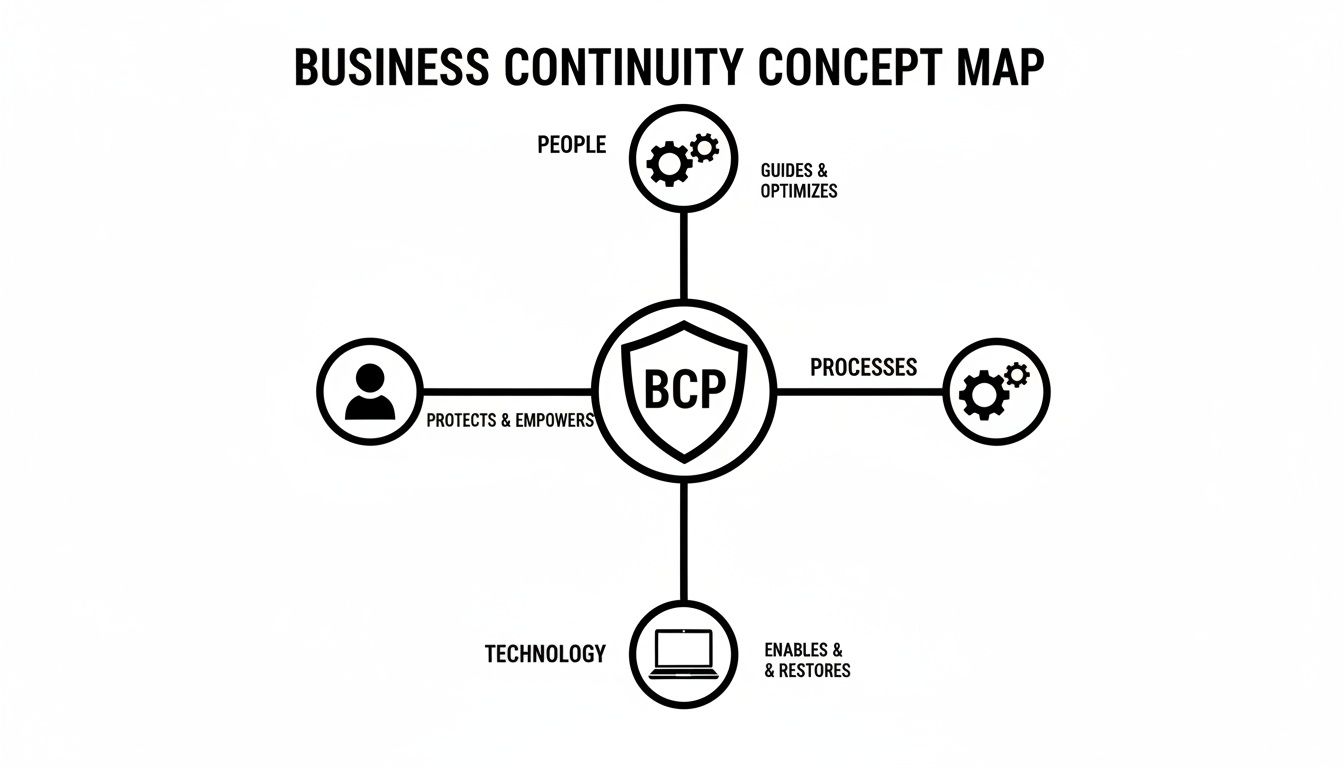
A successful BCP acts as a central shield, integrating every part of your organization so that no single point of failure can bring your operations to a halt.
Business Impact Analysis
The first pillar is the Business Impact Analysis (BIA). This is the diagnostic phase where you identify your most critical business functions and the resources—people, software, equipment—required to support them. The goal is to understand the tangible impact if any of those functions were to fail.
A BIA requires answering critical questions:
- Which of our operations are essential and cannot be paused?
- What is the financial cost for every hour or day these operations are offline?
- How would an outage affect our reputation, client commitments, or compliance standing?
The answers provide a clear priority order for recovery, creating a logical foundation for the rest of your plan. Without a BIA, recovery efforts can become scattered, and you may waste valuable time restoring less critical functions first.
Risk Assessment
Once you know what is most important, you must identify what could disrupt it. That is the purpose of the second pillar: Risk Assessment. This process involves identifying potential threats to your critical functions and evaluating their likelihood against their potential impact.
Threats can include:
- Natural Disasters: Hurricanes, floods, or earthquakes.
- Technical Failures: Power grid outages, server crashes, or internet service disruptions.
- Human-Caused Incidents: Ransomware attacks, data breaches, or critical employee error.
- Supply Chain Disruptions: The failure of a key vendor or partner.
Analyzing these risks allows you to prioritize your defensive measures. A business in a storm-prone region might focus on power redundancy and remote work capabilities. A law firm, however, would likely prioritize defenses against a ransomware attack that could compromise sensitive client data. Understanding advanced cybersecurity frameworks is essential to building a strong security posture.
Incident Response Plan
The third pillar is the Incident Response Plan (IRP). While the BIA and Risk Assessment are strategic, the IRP is tactical. It is the step-by-step guide your team follows the moment a disruption is detected.
An Incident Response Plan is not about the long-term recovery; it is about immediate crisis management. Its goal is to contain the damage, control the narrative, and stabilize the situation as quickly and calmly as possible.
This plan assigns clear roles and responsibilities. Who is authorized to make key decisions? How will you notify employees, clients, and regulators? What are the immediate technical steps to mitigate the issue? For example, in a cyberattack, the first step is to isolate affected systems to prevent the threat from spreading.
Recovery Strategies
The fourth pillar is your set of Recovery Strategies. These are the specific, pre-planned actions for restoring business functions after an incident has been contained. Guided by the priorities established in the BIA, these strategies detail exactly how to return to normal operations.
Recovery strategies may include:
- Activating a secondary work location for your team.
- Switching IT systems to a cloud-based backup environment.
- Restoring critical data from secure, off-site backups.
- Engaging alternate suppliers to maintain the supply chain.
Together, these four pillars create a comprehensive, logical framework. They ensure your business continuity plan is a proactive strategy built on a deep understanding of your operations, risks, and recovery capabilities.
Defining Your Recovery Objectives: RTO and RPO
After completing a Business Impact Analysis, the next step is to define specific recovery targets. How quickly must you be operational again? And how much data can you afford to lose without causing significant harm to the business?
These questions are answered by two of the most important metrics in business continuity: the Recovery Time Objective (RTO) and the Recovery Point Objective (RPO). Together, they form the technical blueprint for your recovery strategy, translating vague goals into measurable targets that guide technology choices, backup protocols, and budget allocations.
Understanding this distinction is critical for any leader focused on managing operational risk.
Recovery Time Objective (RTO): The Downtime Clock
The Recovery Time Objective (RTO) is a duration. It represents the maximum acceptable amount of time a critical system, application, or business function can be unavailable before the impact—to revenue, reputation, or client trust—becomes unacceptable.
The question RTO answers is simple: "How long can we afford to be down?"
Your RTO is measured in real-world time: minutes, hours, or days. A customer-facing e-commerce site might have an RTO of less than one hour, as every minute offline equates to lost sales. In contrast, an internal HR platform might have a more lenient RTO of 24 hours.
Recovery Point Objective (RPO): Your Data Rewind Point
While RTO is about time, the Recovery Point Objective (RPO) is about data. It defines the maximum age of files that must be recovered from backup storage for normal operations to resume. In other words, it sets the point in time to which you can "rewind" your data.
The key question RPO answers is: "How much data can we afford to lose?"
If your RPO is one hour, it means your systems must be backed up at least hourly. An RPO of 24 hours means a daily backup is sufficient. For a law firm managing active case files, the RPO could be near zero, as losing even a few minutes of updates could have serious consequences.
RTO vs. RPO: What Business Leaders Need To Know
| Metric | Definition | Business Question | Example Impact |
|---|---|---|---|
| RTO | The maximum tolerable duration of an outage. | How long can we afford to be down? | An RTO of 4 hours means your systems must be restored within 4 hours to avoid major business disruption. |
| RPO | The maximum acceptable amount of data loss, measured in time. | How much data can we afford to lose? | An RPO of 15 minutes requires backups to run at least every 15 minutes to prevent losing more than 15 minutes of data. |
Understanding these metrics helps you move from abstract goals to concrete, actionable plans that protect what matters most.
Balancing RTO and RPO is a strategic trade-off between risk tolerance and cost. Near-zero RTO and RPO—meaning instantaneous failover with no data loss—provides the highest level of protection but also requires the most significant investment in technology and managed infrastructure.
Expert guidance is crucial in this process. Your objectives must align with both your operational needs and your financial reality, as these decisions directly influence your cloud environment, backup frequency, and the recovery solutions you implement. The market for Disaster Recovery as a Service (DRaaS) in the Caribbean, for instance, is expected to hit US$49.22 million in 2025, driven by this urgent need for robust continuity. You can read more about why Caribbean companies need customized continuity plans to see why this trend is accelerating.
Business Continuity Planning For Regulated Industries
For businesses in finance, healthcare, or legal services, business continuity is not just a best practice—it is a strict compliance requirement. Regulators and industry bodies require proof that you can protect sensitive client data and maintain operations through a crisis. A simple checklist is insufficient; you need a documented, tested, and auditable plan.
Failing to meet these standards can lead to severe consequences, including significant financial penalties, legal action, and irreparable damage to your professional reputation. In these fields, business continuity is the bedrock of client trust and fiduciary duty.
The High Stakes Of Compliance
Consider a common scenario: a sophisticated ransomware attack hits a law firm, encrypting its entire Microsoft 365 and SharePoint environment. Active case files, client communications, and billing records become inaccessible. Without a compliant business continuity plan, this single event can trigger a cascade of operational and legal failures.
This is not just an operational disruption; it is a potential compliance disaster. Regulations governing data privacy and security mandate specific, swift actions. If you cannot prove you had adequate safeguards and a clear recovery strategy in place, the operational crisis can quickly become a legal and financial one.
This is where a well-designed BCP demonstrates its true value. It ensures you can:
- Rapidly failover to clean backups to restore critical data within your predetermined RTO and RPO.
- Maintain secure client communication channels to provide updates and manage expectations professionally.
- Document every step of your response, creating a clear audit trail for regulators and cyber insurance claims.
A plan transforms a potential catastrophe into a managed incident, proving due diligence and shielding the firm from the worst consequences.
The Role Of Specialized IT Expertise
Meeting these stringent requirements is a significant challenge for an internal team. Integrating complex compliance mandates into technical recovery strategies requires specialized knowledge. This is why many regulated businesses partner with a managed IT services provider.
An expert partner understands the specific rules governing your industry. They can build and maintain a BCP that withstands scrutiny by implementing:
- Secure cloud configurations that meet data residency and privacy regulations.
- Proactive cybersecurity threat monitoring to identify and mitigate threats before they cause a major disruption.
- Rapid incident response capabilities tailored to the unique pressures of your sector.
This proactive approach is vital, especially in regions facing multiple threats. For instance, a staggering 70% of CDEMA Participating States in the Caribbean lack a national or sectoral Post-Disaster Recovery Plan. This systemic vulnerability leaves regulated industries dangerously exposed. You can discover more about disaster recovery planning in the Caribbean to understand the full scope of these regional risks.
In regulated fields, business continuity is a core component of risk management. The plan must be designed not only to restore operations but also to satisfy auditors, regulators, and clients that you have taken every reasonable step to protect their interests.
For regulated industries, a BCP is not an IT project—it is a fundamental pillar of business strategy. It provides the assurance that your organization can withstand any disruption while upholding its legal, ethical, and professional obligations.
Putting Your Business Continuity Plan Into Action
A business continuity plan is useless if it only exists on paper. Its real value is realized when it becomes a living strategy that your team practices and understands. Creating the plan is just the beginning; putting it into action through clear roles, communication, and regular testing is what builds true resilience.
First, assemble a business continuity team. This should be a cross-functional group with leaders from IT, operations, finance, and human resources who are empowered to make critical decisions during a crisis. Their primary responsibility is to translate the findings from your BIA and risk assessment into a formal, documented plan.

This plan must be clear, concise, and accessible. In an emergency, no one has time to search through a lengthy document. It should contain actionable checklists, contact lists, and straightforward procedures for specific scenarios.
Creating Clear Roles And Communication Channels
A critical function of the BCP team is to define roles and responsibilities. During a disruption, confusion is the enemy. Everyone must know their role, their reporting structure, and how decisions are made. Ambiguity is not an option.
This clarity must extend to communication. Your plan must specify how you will communicate with key stakeholders:
- Employees: Provide safety instructions, work status updates, and guidance on remote work protocols.
- Clients: Manage expectations, deliver status updates on services, and maintain their trust.
- Suppliers: Coordinate logistics and activate contingency plans with backup vendors.
- Regulators: Meet all mandatory reporting requirements accurately and on time.
Establishing these communication channels is a non-negotiable part of activating your plan. This guide on how to create a crisis communication team offers a solid framework for structuring your messaging during a crisis.
The Critical Role Of Testing And Refinement
The most important step is testing. An untested plan is merely a hypothesis, and a real crisis is the wrong time to discover its flaws. Regular testing validates your strategies, trains your team, and identifies gaps in your procedures before a disaster occurs.
A business continuity plan is not a static document. It must be a dynamic framework that evolves with your business. Regular testing is the mechanism that ensures it remains relevant, effective, and ready.
Testing can be conducted in several ways, with varying levels of complexity:
- Tabletop Exercises: The BCP team gathers to discuss a simulated crisis, such as a ransomware attack. This low-stress environment allows them to walk through their roles and identify procedural gaps.
- Functional Drills: These are hands-on tests of specific components of the plan. For example, the IT team might test its ability to restore critical data from backups, measuring the time against RTO and RPO targets.
- Full-Scale Simulations: This is the most comprehensive test, mimicking a real disaster as closely as possible. It might involve employees working from a backup site or failing over major applications to a disaster recovery environment.
Every test provides valuable lessons that should be used to refine and update the BCP immediately. This cycle of test, measure, and improve transforms your plan from a document into a reliable operational capability. Partnering with a provider of managed IT services for small business can help automate and manage the technical aspects of testing and recovery.
Your Next Steps Toward True Business Resilience
Business continuity planning is not just another IT project; it is a direct investment in your organization's long-term viability. It is the framework that ensures operational stability, protects your reputation, and maintains client trust during periods of uncertainty.
The good news is that you don't need a massive, disruptive effort to get started. The most effective approach is to begin with small, focused steps and build momentum.
Take the First Step
Start with your single most critical business function. Convene your leadership team and ask one powerful question: "What would be the full impact if this one process was down for an entire business day?"
The resulting discussion is the foundation of your first Business Impact Analysis. Document the consequences—financial, operational, and reputational. This simple exercise creates the urgency and clarity needed to expand your planning efforts and provides a practical foundation to build upon. From there, you can map its dependencies and establish a realistic Recovery Time Objective.
Business continuity isn't a one-time project. It’s a continuous cycle of preparation, testing, and refinement. The goal is to weave resilience into your company culture until it’s not just a plan, but a core operational strength.
Seek Expert Guidance for a Clear Path Forward
While starting small is effective, building a comprehensive and compliant plan requires specialized expertise. For organizations seeking a structured, expert-led approach, partnering with an experienced advisor can clarify the path forward and prevent common mistakes.
A professionally conducted business resilience assessment will help you identify specific risks, define achievable RTO and RPO targets, and create a practical roadmap. This collaborative approach removes guesswork, ensuring your investment in continuity aligns with your strategic business goals. It transforms a daunting task into a manageable strategy that delivers genuine peace of mind.
If you are ready to put these concepts into action, consider scheduling a consultation to explore how a tailored assessment can fortify your operations.
Frequently Asked Questions About Business Continuity
Here are answers to some of the most common questions we hear from business leaders about business continuity planning.
How Is Business Continuity Different From Disaster Recovery?
The key difference is scope. Disaster Recovery (DR) is a subset of business continuity and is focused specifically on restoring IT infrastructure and data after an outage.
Business Continuity Planning (BCP) is the holistic strategy for keeping the entire business operational. It encompasses people, processes, and technology. In short, DR gets your servers back online; BCP ensures your team can continue serving clients and generating revenue while that happens.
How Often Should We Test Our Business Continuity Plan?
Best practice is to conduct a full-scale test or simulation at least once a year. This validates that your recovery strategies and technology work as intended under pressure.
However, smaller, less disruptive tabletop exercises, where your team discusses a crisis scenario, should occur more frequently—ideally quarterly or semi-annually. Regular testing ensures the plan remains current and that your team members understand their roles.
What Is The Biggest Mistake Businesses Make With BCP?
The most common mistake is the "set it and forget it" mindset. Many businesses invest time and resources to create a detailed plan, only to file it away and never review it again. They fail to test it, update it as the business changes, or train new employees on their responsibilities during a crisis.
An untested plan is just a document. A plan that sits on a shelf protects no one when a real disaster strikes. Resilience isn't built from paperwork; it's built through practice.
Can A Small Business Afford A Comprehensive BCP?
Yes. In fact, a small business cannot afford not to have one. Business continuity is not a one-size-fits-all solution; it is fully scalable to your organization's needs and budget. A smaller business can start by identifying its two or three most critical functions and building simple, low-cost strategies to protect them. Modern cloud services and partnerships with managed IT providers have made enterprise-grade resilience tools accessible and affordable for businesses of all sizes.
A robust business continuity plan is your organization's ultimate insurance policy. At Tricord I.T Solutions, we help businesses move beyond documents to build truly resilient operations with expert guidance and managed services.
Ready to turn your continuity strategy into a core strength? Contact us to schedule a business resilience assessment today. Learn more at https://bvc.ee2.myftpupload.com.