
Business IT services are a comprehensive suite of solutions designed to manage a company's entire technology environment. It involves partnering with an external provider to handle IT operations, from daily maintenance and user support to long-term strategic planning. The primary goal is to transform technology from a reactive expense into a proactive asset that enhances operational stability, manages risk, and supports business growth.
This approach moves away from the traditional "break-fix" model, where IT is only addressed after a problem occurs. Instead, managed business IT services focus on continuous monitoring and proactive maintenance to prevent issues, ensuring technology reliably supports your core objectives.
What Are Business IT Services?
At its core, professional business IT services are about ensuring your technology infrastructure is as reliable and predictable as any other utility. When you flip a light switch, you expect the lights to turn on. Your network, cloud applications, and data should deliver the same consistent performance, allowing your team to focus on their work without disruption.
This is a strategic departure from the old break-fix model, where an IT provider is only called—and paid—after a system has already failed. Modern managed services provide constant oversight to identify and resolve potential issues before they can impact operations. It’s a partnership designed to deliver tangible business outcomes, such as reduced operational risk, predictable monthly costs, and improved overall efficiency. To understand this strategic shift in more detail, you can start by exploring the fundamentals of managed IT services.
The difference between the two approaches is fundamental. The traditional model is reactive, meaning your business pays for downtime and emergency fixes. The modern, managed approach is proactive, focused on preventing those very issues from ever occurring.
Comparing IT Support Models: Break-Fix vs. Managed Services
| Feature | Traditional Break-Fix Model | Modern Managed IT Services Model |
|---|---|---|
| Service Approach | Reactive: Service is provided only when something breaks. | Proactive: Continuous monitoring and maintenance to prevent issues. |
| Cost Structure | Unpredictable: Billed per hour or per incident, leading to volatile costs. | Predictable: Flat, recurring monthly fee for a defined set of services. |
| Business Alignment | Transactional: The provider profits from your problems and downtime. | Partnership: The provider's success is tied to your stability and uptime. |
| Downtime | High risk: Problems are addressed after they cause disruptions. | Minimized: Potential issues are identified and resolved before they impact work. |
| Focus | Fixing immediate problems. | Long-term strategic health and security of your IT environment. |
As the table shows, the managed services model is built on a different philosophy. It aligns the IT provider's goals with yours—they succeed when your technology runs smoothly, not when it fails.
A Focus on Proactive Strategy
The primary goal is to maintain system health and security around the clock, which minimizes downtime and protects against threats. A dedicated IT partner handles routine but critical tasks—maintenance, security patching, system monitoring—freeing your team to concentrate on core business functions. This preventative care is what keeps your infrastructure resilient and efficient.
For example, instead of a server crashing before a critical deadline, a managed services provider would have already identified warning signs like slowing performance or unusual activity and resolved the underlying issue. That foresight is crucial for maintaining productivity and avoiding the significant costs of emergency repairs.
The true value of modern IT services lies in their ability to anticipate needs and mitigate risks. It’s about ensuring technology consistently supports your business objectives, providing a stable foundation for growth and innovation without the constant worry of unexpected failures or security breaches.
This strategic oversight transforms technology from a potential liability into a competitive advantage. By aligning IT with your business goals, a professional provider helps you make smarter technology investments, strengthen security, and ensure your operations are resilient enough to handle future challenges.
The Core Pillars of Modern IT Services
To understand what professional business IT services deliver, it is helpful to look at the components that create a secure and efficient technology environment. A modern IT strategy is built on several key pillars, each addressing a critical aspect of your business. When these pillars work in concert, they form a robust framework that supports growth, manages risk, and improves productivity.
This comprehensive approach goes beyond simply fixing broken equipment. Let's examine the five fundamental pillars that constitute a complete IT service offering.
Managed Infrastructure
Your IT infrastructure—servers, network, workstations, and Wi-Fi—is the backbone of your operations. If it fails, work stops. Managed infrastructure services involve proactively monitoring, maintaining, and optimizing these core components to ensure they remain reliable and secure.
This is about preventing problems, not just reacting to them. It includes continuous health checks, applying critical security patches, and managing system updates before they can cause downtime. For a busy law firm, this could mean preventing a server crash before a major filing deadline, ensuring uninterrupted access to case files and client data. The objective is to maintain a stable foundation so your team can remain productive.
This diagram illustrates the critical shift from the reactive break-fix model to proactive managed services.
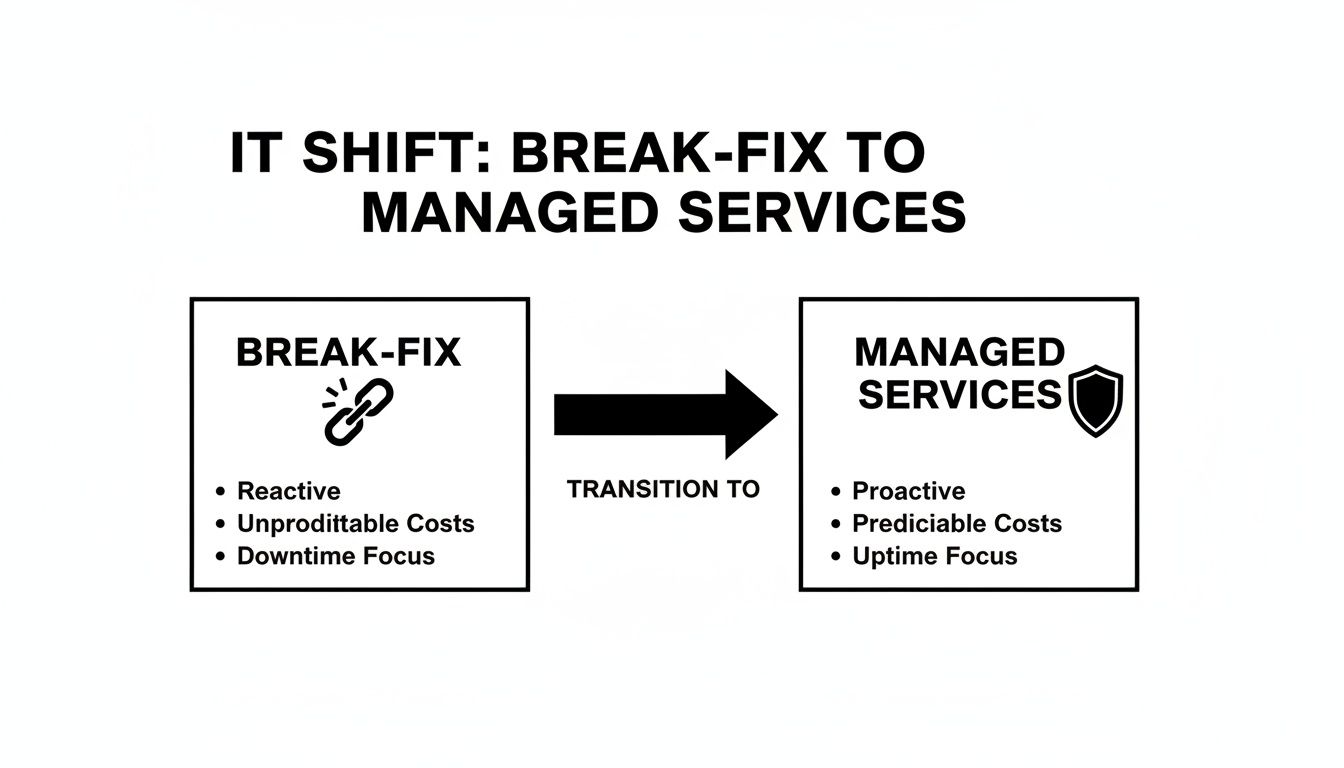
As shown, managed services focus on prevention and predictable costs, a stark contrast to the expensive disruptions inherent in a reactive model. This foundational support is a significant part of the national economy. The Canadian IT services industry reached $42.3 billion in revenues in 2023, with infrastructure services accounting for 57.5% of that, or $24.3 billion.
Proactive Cybersecurity
In an environment of constantly evolving cyber threats, a purely defensive security posture is no longer sufficient. Proactive cybersecurity services are designed to actively hunt for, identify, and neutralize threats before they can cause damage. This involves a multi-layered defense strategy that protects everything from your servers to individual employee devices.
Key components of a strong cybersecurity pillar include:
- Advanced Threat Monitoring: Using sophisticated tools to watch for suspicious network activity 24/7.
- Vulnerability Management: Regularly scanning for and patching security weaknesses in software and systems.
- Employee Security Training: Educating your team to recognize and avoid phishing scams and other social engineering tactics.
- Incident Response Planning: Having a clear, tested plan to contain and recover from a security breach quickly.
For a financial services firm, this means protecting sensitive client data not only to maintain trust but also to meet stringent regulatory requirements. A security failure can lead to significant fines and reputational damage. To see how these protections are structured, you can learn more about advanced cybersecurity frameworks and how they safeguard critical assets.
Cloud Services Management
Cloud computing offers businesses significant flexibility and scalability, but managing it effectively requires specialized expertise. Cloud services management ensures your cloud environment—whether public, private, or a hybrid model—is configured for optimal performance, security, and cost-efficiency.
This includes managing cloud-based applications, data storage, and virtual servers. A qualified IT partner will handle migrations, monitor resource usage to prevent overspending, and ensure your cloud infrastructure aligns with your business continuity and disaster recovery plans. When managed correctly, you gain the benefits of the cloud without the risks of misconfigurations or uncontrolled costs.
The purpose of cloud management is not just to move operations off-site. It's about building a more resilient and agile business by using the cloud strategically to give your team secure access to data and applications from anywhere, at any time.
Microsoft 365 and SharePoint Optimization
Many companies use Microsoft 365, but few leverage its full potential. When managed effectively, this powerful suite can become a central hub for collaboration, communication, and document management. This involves configuring tools like Teams, OneDrive, and especially SharePoint to match your specific workflows.
For example, a law practice can customize SharePoint to enforce strict document governance, control access to sensitive case files, and streamline the e-discovery process. This level of optimization not only improves team productivity but also enhances data security and compliance, turning a standard software license into a strategic business asset.
Virtual CIO Strategic Guidance
Technology decisions should never be made in a vacuum. A Virtual Chief Information Officer (vCIO) provides the high-level strategic guidance needed to ensure your IT investments align with your business objectives. It offers executive-level expertise without the expense of a full-time CIO.
A vCIO assists with critical functions such as:
- IT Budgeting and Planning: Creating a predictable and effective technology budget.
- Technology Roadmapping: Developing a long-term plan for your IT infrastructure to support future growth.
- Risk Management and Compliance: Ensuring your technology environment meets industry regulations and security standards.
- Vendor Management: Evaluating and managing relationships with other technology vendors to ensure you receive the best value.
This strategic oversight is what unifies all other pillars. It ensures that every technical decision—from purchasing a new server to migrating to the cloud—is made with a clear understanding of its impact on your bottom line, operational efficiency, and long-term goals.
Why Your Industry Demands Specialized IT Support
A generic, one-size-fits-all approach to IT support introduces unnecessary risk, particularly for businesses in regulated industries. Your company has unique operational rules, competitive pressures, and client expectations. Specialized IT support understands this and delivers solutions that are not only technically sound but are also aligned with your specific operational and compliance challenges.
This is about more than basic helpdesk services. It's about having an IT partner who speaks your industry's language, is familiar with the software you depend on, and understands the regulatory bodies that oversee your work.

This deep industry knowledge is non-negotiable. What might be a minor IT issue in one sector could be a catastrophic compliance failure in another. The right business IT services are designed to prevent those specific disasters before they can occur.
Legal Practices: Confidentiality and E-Discovery
For law firms, client confidentiality is a foundational duty. A data breach is more than an inconvenience; it can be an ethical violation with severe consequences. IT providers specializing in the legal sector focus on securing sensitive client data, communications, and case files from unauthorized access.
They also understand the technical complexities of e-discovery. This involves implementing systems to properly preserve, search, and produce electronically stored information (ESI) in a manner that is defensible in court. A general IT provider might not grasp the nuances of litigation holds or metadata preservation, exposing your firm to significant legal risk.
A provider familiar with legal software can also optimize tools like SharePoint for robust document governance, ensuring case files are managed with strict access controls and retention policies. This expertise is a critical part of effective small business IT support for any practice.
Healthcare Organizations: PHIPA and Data Integrity
In healthcare, protecting patient information is a legal and ethical imperative. An IT partner in this field must have a deep understanding of Canada's Personal Health Information Protection Act (PHIPA). This extends far beyond standard cybersecurity practices.
It requires implementing specific technical safeguards, including:
- Access Controls to ensure only authorized staff can view patient records.
- Encryption for all data, whether at rest on a server or in transit across a network.
- Audit Trails that create a detailed log of every access and modification to electronic health records (EHR).
Beyond compliance, the integrity and availability of patient data are directly linked to patient safety. Systems must be highly reliable to prevent downtime that could disrupt care in a clinical setting or long-term care facility.
An IT provider for healthcare must also be a compliance partner. Their role is to build and maintain an infrastructure that not only keeps clinical operations running smoothly but also provides auditable proof that you are protecting sensitive patient information.
Financial Services: Security and Regulatory Adherence
The financial services industry is a primary target for sophisticated cyberattacks. IT services for this sector are built around a defense-in-depth security model that assumes you are being targeted. This involves advanced threat monitoring, proactive vulnerability management, and a robust incident response plan.
Compliance is another major driver. Financial firms must navigate a complex web of regulations designed to protect consumer data and ensure market stability. An experienced IT provider understands these rules and can implement the necessary controls to meet your obligations, turning your technology into a compliance asset.
Manufacturing: Uptime and Operational Technology
For manufacturers, the primary IT concern is often uptime. Any disruption to the systems managing production lines, inventory, or logistics can trigger a cascade of costly delays and lost revenue. Specialized IT for manufacturing focuses on building a highly resilient infrastructure that simply works.
This often includes managing not only office IT but also the Operational Technology (OT) on the plant floor. Securing and maintaining the network connecting machinery and control systems requires a different skill set. A provider with manufacturing experience knows how to create backup and disaster recovery plans tailored to a production environment to restore operations quickly after any interruption.
How to Choose the Right Business IT Services Provider
Choosing an IT partner is one of the most important decisions your business will make, directly impacting daily reliability, security, and growth potential. With so many providers available, it’s easy to focus solely on price. However, the best partner is a strategic asset, not just a vendor. The true value lies in their technical depth, industry understanding, and cultural fit. A thoughtful evaluation process will help you find a partner truly aligned with your business goals.
Define Your Core Requirements
Before evaluating providers, you must first look inward. You cannot find the right solution until you clearly understand the problem you need to solve.
Start by identifying your primary objectives and biggest challenges. Are you struggling with unreliable systems and downtime? Concerned about cybersecurity threats and compliance requirements like PHIPA? Or are you seeking a strategic advisor to help you leverage technology for a competitive advantage?
Consider these key areas:
- Operational Needs: What are the absolute requirements for your daily operations, such as guaranteed support response times and system uptime?
- Security and Compliance: What specific regulatory standards must you meet? What is your current risk tolerance?
- Strategic Goals: Where do you envision the business in three to five years? Your IT partner must offer services that can scale with you.
- Budget: Establish a realistic budget based on the value you expect to receive, not just the lowest cost. Remember to factor in the potential costs of downtime or a security breach.
Key Questions to Ask Potential Providers
Once you have a shortlist of providers, it is time for interviews. Your questions should assess their technical skills, business acumen, and service philosophy to determine if they are a genuine partner. A strong candidate will welcome detailed questions and provide transparent answers that clearly illustrate their capabilities, processes, and client relationship management.
A provider's true worth is not demonstrated when everything runs smoothly. It is revealed in how they respond when things go wrong. Their communication, problem-solving, and strategic planning are as critical as their technical expertise.
Here is a checklist of essential questions to guide your discussions:
- Industry Experience: "Can you provide examples of how you've helped other companies in our industry, such as [Legal/Finance/Manufacturing]?"
- Team Expertise: "What technical certifications does your team hold? How do you ensure your technicians stay current on the latest technologies and threats?"
- Onboarding Process: "What does your client onboarding process involve from start to finish? How do you ensure a smooth transition with minimal disruption?"
- Strategic Guidance: "How do you provide strategic guidance (vCIO services)? How often would we meet to review our technology roadmap and align it with our business goals?"
- Security Posture: "How do you protect your own systems? What is your incident response plan if your own network is compromised?"
- Client Support: "What are your guaranteed Service Level Agreement (SLA) response times? Can you walk me through your support process from ticket submission to resolution?"
When assessing potential IT providers, it’s also important to consider specialized cybersecurity needs. For example, knowing how to choose the right pentest partner that aligns with your business objectives is a key part of a thorough security evaluation.
This vetting process helps you make an informed choice and secure a partner who is genuinely invested in your success. With Canada's IT Consulting industry expected to reach $114.0 billion in 2025, taking the time to select the right one from over 111,000 businesses is more critical than ever. You can discover more insights about these industry trends and see why a detailed evaluation is non-negotiable.
Understanding IT Service Costs and Calculating ROI
Investing in professional business IT services is a shift from unpredictable, reactive expenses to a stable, strategic investment. The focus moves from simply keeping computers running to future-proofing your operations. Let’s examine the common pricing models and, more importantly, how to calculate the real return from a strategic IT partnership.
Common Pricing Models Explained
Most IT service providers use a few common pricing structures. The goal is to find a model that provides predictable costs and allows for effective technology budgeting.
- Per-User/Per-Device Model: This is the most common model. You pay a flat monthly fee for each employee or device (e.g., computer, server) covered. It is straightforward, easy to budget for, and scales as your team grows.
- Tiered Pricing: This model offers different service levels. A basic tier might cover routine monitoring and maintenance, while a premium tier could include advanced cybersecurity and strategic vCIO guidance.
- A La Carte Services: This model allows you to select specific services, such as only backup and disaster recovery or only helpdesk support. While flexible, it can lead to unpredictable costs if your needs change.
For most growing businesses, a fixed-fee model (typically per-user) offers the best balance. It provides comprehensive coverage and predictable spending, eliminating surprise bills after an emergency.
Calculating the True Return on Investment
The ROI from managed IT services extends beyond direct cost savings. The real value comes from mitigating major risks and improving operational efficiency. A proper ROI calculation should consider both direct cost avoidance and indirect value gains.
The biggest financial wins from professional IT services often come from preventing things that haven't happened yet. Avoiding a single hour of company-wide downtime or a minor data breach can easily pay for months of service.
To determine your true ROI, consider these key factors:
- Increased Employee Productivity: When systems are reliable and support is readily available, your team spends less time dealing with technology issues and more time on revenue-generating work.
- Enhanced Security and Risk Mitigation: The average cost of a data breach is significant. Proactive security services help you avoid the financial and reputational damage of a cyberattack.
- Strategic Scalability: A well-managed IT infrastructure allows your business to grow without being constrained by technology. You can add new team members or open new offices without a large upfront capital investment.
A side-by-side comparison can help clarify the numbers.
Cost-Benefit Analysis: In-House IT vs. Managed Services
Many businesses default to an in-house team, but a managed services partner often provides more value for a more predictable cost. Here’s a breakdown of how they compare.
| Cost/Benefit Factor | In-House IT Department | Managed IT Services Partner |
|---|---|---|
| Direct Salaries & Benefits | High, fixed costs for full-time staff, including benefits, training, and overhead. | Predictable, fixed monthly fee. No overhead costs for staff. |
| Expertise & Skill Gaps | Limited to the knowledge of your in-house team. Specialized skills (e.g., cybersecurity) are expensive to hire. | Access to a deep bench of experts in various fields without individual hiring costs. |
| Tool & Software Costs | You bear the full cost of expensive monitoring, security, and management software. | Costs are spread across multiple clients, providing access to enterprise-grade tools for less. |
| Employee Productivity | Downtime can be prolonged if the team is small or lacks specific skills to fix an issue quickly. | Faster issue resolution from a dedicated support team, minimizing operational disruption. |
| Scalability | Scaling up or down requires a slow and costly hiring or layoff process. | Easily scale services up or down based on your business needs with a simple contract adjustment. |
| Security & Compliance | Keeping up with evolving threats and compliance rules can be a full-time job for a small team. | Proactive security management and expertise in compliance standards reduce risk significantly. |
| 24/7 Coverage | Difficult and expensive to provide round-the-clock support without a large team. | Often included in service plans, ensuring issues are addressed anytime, day or night. |
While an in-house team offers a dedicated on-site presence, a managed services partner often delivers broader expertise and cost predictability, which is a better fit for many growing businesses.
When budgeting, remember to account for specialized security assessments. For instance, understanding how much a pentest costs helps you budget for essential vulnerability testing, a cornerstone of any solid security strategy.
Market trends support this shift. In 2024, the Canada IT Professional Services market reached USD 93,493.2 million and is projected to grow to USD 161,060.8 million by 2030. You can discover more insights about these market dynamics on Grand View Research. This growth indicates that more businesses are recognizing the strategic value of an IT partnership.
Planning Your Transition to a New IT Partner
Switching your business IT services provider is a significant decision that should enhance efficiency and security. A smooth transition is essential, and a professional provider will manage the entire process without disrupting your daily operations. The experience should feel like a well-planned upgrade, not a technical emergency.

The process begins with a comprehensive audit of your current IT setup. This initial discovery phase is a critical first step to identify risks and opportunities for improvement.
Creating Your Strategic IT Roadmap
After the audit, your new IT partner will develop a strategic roadmap. This is a detailed blueprint with clear timelines and milestones, ensuring all stakeholders are aligned.
Any major work, such as data migration or system cutovers, is typically scheduled after business hours. The goal is a zero-downtime implementation that allows your team to begin work seamlessly on the new systems.
A successful IT transition depends on two key elements: transparency and meticulous planning. The objective is to make the changeover invisible to your team, allowing them to benefit from improved systems without disruption.
This structured process eliminates guesswork and establishes clear expectations from the start.
If you are ready to explore how a dedicated IT partnership can align technology with your business goals, we can help. We offer a no-obligation consultation to begin the conversation.
Frequently Asked Questions About Business IT Services
Adopting professional IT support raises important questions for any business leader. Here are clear, direct answers to common queries from companies considering a managed IT services provider.
Is My Business Large Enough for Managed IT Services?
The need for managed IT services is determined less by your company’s size and more by its dependence on technology. If IT downtime, a security breach, or a compliance failure would significantly disrupt your operations or damage your reputation, you are ready for a professional partnership.
Managed services are designed to scale, providing enterprise-level security and strategic guidance that is often too costly for small and mid-sized businesses to build in-house. This is particularly true for those in regulated industries like law or finance, where the risks of non-compliance are too high to ignore.
What Does the Transition Process Look Like?
A professional IT partner ensures a smooth transition without disrupting your workday. The process begins with a comprehensive audit of your current systems. Based on this, we create a detailed migration plan with clear, agreed-upon timelines so you know exactly what to expect.
Major changes, such as server migrations or system cutovers, are almost always scheduled after business hours to avoid any impact on your operations. The primary goal is a zero-downtime transition that feels like an immediate, seamless upgrade for your entire team.
Will Outsourcing Mean We Lose Control Over Our IT?
On the contrary, you gain more strategic control. A dedicated IT partner handles the daily tactical work—maintenance, user support, and security monitoring. This frees you to focus on the bigger picture: how technology can drive your business forward.
You retain full authority over the strategic direction of your technology. Your IT partner manages the complex execution, ensuring every technical decision aligns with your core business objectives and long-term vision.
Through services like a Virtual CIO, you gain an advisor who helps translate your business goals into a practical technology roadmap. You set the vision; they manage the implementation.
How Are Business IT Services Typically Priced?
Pricing is generally based on a few key factors: the number of users, the complexity of your infrastructure, and the specific service levels required (e.g., advanced cybersecurity, compliance management). Most modern providers offer a predictable, fixed monthly fee per user.
This model eliminates surprise invoices and makes budgeting simple and transparent. It is an operational investment in efficiency, security, and resilience that delivers a strong ROI by preventing costly disruptions and empowering your team.
If you’re ready to align your technology with your business objectives, the team at Tricord I.T Solutions is here to help. Schedule a consultation to discuss a strategic IT roadmap for your business.