
Managed IT services represent a strategic approach to technology management where a business partners with a third-party expert, known as a Managed Services Provider (MSP), to oversee its entire IT infrastructure. For a predictable monthly fee, the MSP takes full responsibility for proactively monitoring, managing, and securing your systems—from servers and networks to user devices and cloud applications.
This model fundamentally shifts IT from a reactive, "break-fix" function to a proactive, strategic asset. Instead of waiting for technology to fail and then paying for emergency repairs, a managed services agreement focuses on preventing problems before they can disrupt business operations. The provider's goal is to ensure your technology is reliable, secure, and aligned with your organizational objectives, allowing you to focus on core business activities.
From Reactive Fixes to Proactive Strategy
Many organizations operate within a traditional "break-fix" IT cycle. When a critical system fails, they call for technical support, pay an hourly rate for the repair, and absorb the costs of the resulting downtime. This reactive model leads to unpredictable expenses, operational interruptions, and a persistent focus on resolving crises rather than preventing them.
Managed IT services provide a structured alternative. A Managed Services Provider (MSP) assumes comprehensive ownership of your technology environment, acting as a dedicated partner responsible for maintaining system health and security. Their primary function is to ensure your IT infrastructure operates smoothly and efficiently, minimizing risk and supporting your business goals.
A Partnership Focused on Business Outcomes
The objective of an MSP is to align your technology with your business objectives, transforming IT from a cost center into a strategic enabler of growth and efficiency. This relationship is built on a foundation of prevention. To fully grasp the value, it's essential to understand what core services, such as dedicated IT support services, are included in a comprehensive agreement.
This proactive model delivers several key business advantages. Let’s compare the traditional approach with the managed services model.
Managed IT Services vs. Traditional IT Support
| Aspect | Managed IT Services | Traditional (Break-Fix) IT |
|---|---|---|
| Approach | Proactive & Strategic | Reactive & Transactional |
| Goal | Prevent issues, align IT with business goals | Fix problems as they occur |
| Cost Model | Fixed monthly fee (predictable) | Hourly billing (unpredictable) |
| Relationship | Long-term partnership | On-demand, as-needed |
| Incentive | Maintain system stability to minimize issues | More problems generate more billable hours |
The core incentives are fundamentally different. An MSP is motivated to keep your systems stable and secure because their success is directly tied to your operational reliability. This translates into tangible business benefits:
- Predictable Costs: A flat monthly fee simplifies IT budgeting, converting unpredictable capital expenditures into a stable operational expense.
- Reduced Downtime: Continuous monitoring and proactive maintenance identify and resolve potential issues before they can cause costly outages, ensuring your team remains productive.
- Enhanced Security: The MSP implements and manages a layered security strategy, protecting sensitive data from cyber threats and helping you meet industry compliance requirements.
- Access to Expertise: You gain access to a team of certified experts in cybersecurity, cloud computing, and network management without the high cost of hiring them in-house.
By delegating the day-to-day management of IT, your internal resources can focus on high-value initiatives that drive revenue and innovation. The focus shifts from technical maintenance to strategic business advancement.
The Core Services Inside a Managed IT Agreement
A managed IT services agreement is a detailed blueprint for the health, security, and performance of your technology. While service packages can vary, a strong agreement includes a foundation of core services designed to keep your business operational, secure, and productive.
Understanding these components is crucial for evaluating a provider’s value proposition. Each service addresses a specific business need, shifting IT from a source of unpredictable costs and risks to a reliable, strategic asset.
Proactive Monitoring and Maintenance
The foundation of managed services is 24/7 proactive monitoring and maintenance. Your MSP uses specialized tools to continuously observe your entire network, including servers, computers, and firewalls. This constant vigilance allows them to detect early warning signs—such as unusual network traffic or a server reaching capacity—and resolve them before they disrupt your operations.
Proactive maintenance includes routine tasks like software updates, hardware health checks, and system optimizations. The goal is to prevent problems, not just react to them after they occur.
Unlimited Helpdesk and Technical Support
When employees encounter a technical issue, they need fast, effective assistance to maintain productivity. A core component of a managed services plan is unlimited helpdesk support. This allows your team to contact a dedicated support desk by phone, email, or a ticketing system without incurring unpredictable hourly charges.
This service is focused on minimizing workflow interruptions. Whether it’s a software glitch, password reset, or connectivity problem, prompt resolution ensures your staff can return to their work with minimal delay.
Robust Data Backup and Disaster Recovery
A critical business risk is the potential loss of data due to hardware failure, cyberattack, or a natural disaster. A robust data backup and disaster recovery (BDR) plan is essential for business continuity.
Your MSP will implement and manage automated backups of your critical data, storing it securely both locally and in the cloud. They also develop a clear recovery plan to restore operations quickly following a major incident. This service is not just about backing up files; it's about having a tested strategy to ensure business resilience.
A well-structured BDR plan is a critical safety net. It ensures that even in a worst-case scenario, your data is recoverable and operational downtime is minimized, protecting your revenue and reputation.
Comprehensive Cybersecurity Management
In today's threat landscape, strong security is non-negotiable. Managed IT services include a multi-layered cybersecurity strategy to protect your systems and sensitive information. A crucial element of any managed IT agreement is ensuring stringent data security compliance to safeguard information against evolving threats and regulatory mandates.
This typically includes:
- Managed Antivirus and Anti-Malware: Protecting endpoints from malicious software.
- Firewall Management: Securing your network perimeter from unauthorized access.
- Email Security: Filtering phishing attempts, spam, and malicious attachments.
- Security Monitoring: Actively searching for signs of a breach or suspicious activity.
These services work together to create a strong defensive posture, reducing the risk of a costly data breach.
Software Patch Management
Unpatched software vulnerabilities are a primary entry point for cybercriminals. Patch management is the systematic process of applying updates to your operating systems and applications to close these security gaps.
Your MSP automates this critical task, ensuring your software is consistently up-to-date without disrupting your team. This disciplined approach is one of the most effective measures for protecting your network from known exploits.
Vendor Management
Managing multiple technology vendors—for internet service, phone systems, or specialized software—can consume significant time and resources. With vendor management, your MSP acts as the single point of contact for all your technology suppliers.
If an issue arises with your internet connection, you contact your MSP, who then diagnoses the problem and manages the resolution with the vendor. This service frees your team from technical troubleshooting and lengthy support calls. Proper oversight of these components is critical, and a holistic approach to managed infrastructure ensures everything works in harmony.
The Strategic Value of a Virtual CIO
Beyond daily operational support, a mature managed IT partnership offers high-level strategic guidance. This is delivered through the Virtual Chief Information Officer (vCIO) role, which elevates the relationship from a service provider to a strategic advisor.
A vCIO functions as a senior technology executive on your leadership team without the cost of a full-time salary. Their primary role is to align your IT infrastructure with your long-term business goals, ensuring every technology decision is financially sound, reduces risk, and supports organizational growth.
Aligning Technology with Business Goals
A vCIO focuses on future planning, helping you build a technology roadmap that aligns with your strategic objectives. This involves several critical functions that directly impact your bottom line and operational resilience.
This diagram illustrates how a central IT agreement integrates core services like monitoring, support, and security into a cohesive strategy.
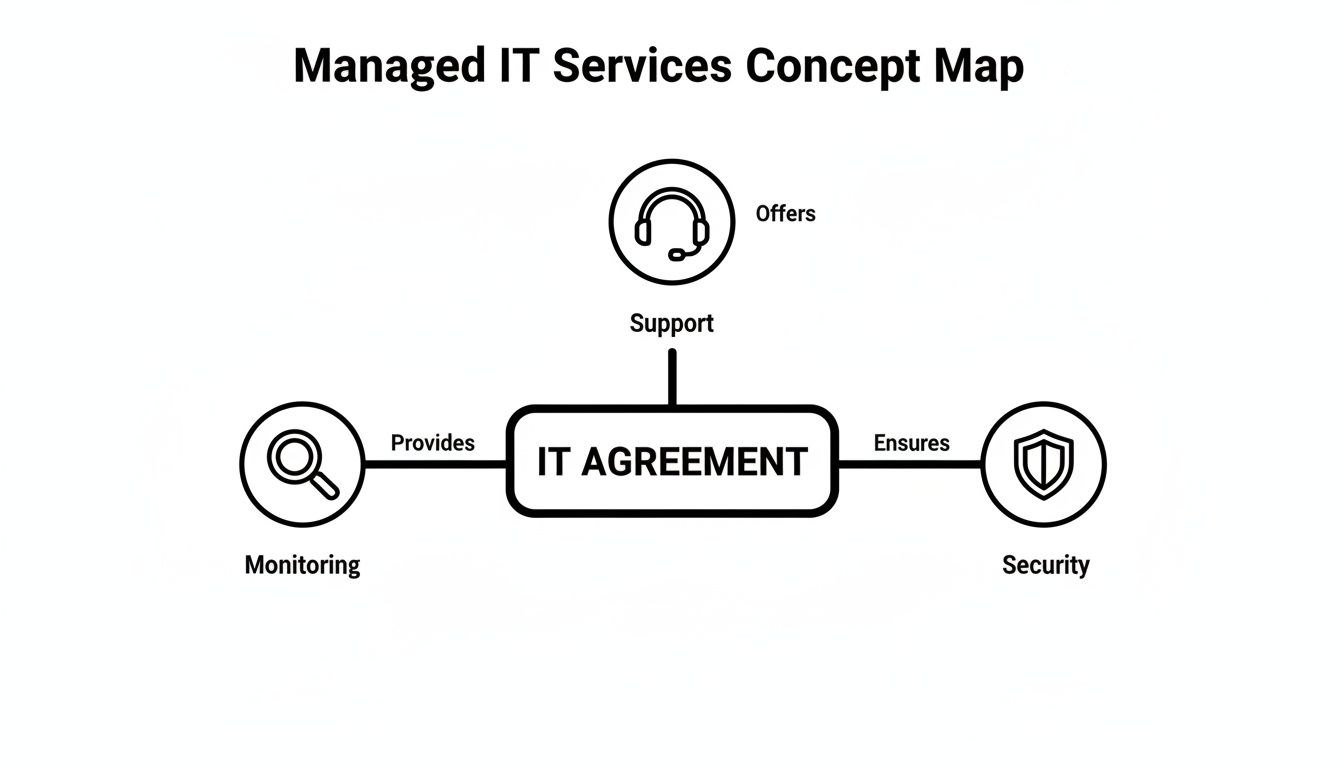
The vCIO's strategic oversight ensures these individual services work together to achieve broader business objectives, rather than functioning as disconnected technical tasks.
Key responsibilities of a vCIO often include:
- IT Budgeting and Planning: Developing detailed technology budgets that eliminate wasteful spending, support business goals, and provide a clear financial forecast.
- Technology Risk Assessments: Identifying potential risks in your IT environment, from aging hardware to compliance gaps, and creating a plan to mitigate them.
- Compliance and Security Strategy: Ensuring your technology meets industry and regulatory requirements (such as PIPEDA in Canada) and advising on security investments to protect sensitive data.
- Future-Proofing Investments: Evaluating new technologies to recommend solutions that deliver long-term value and can scale with your organization.
Making Smarter Technology Decisions
For business leaders, a vCIO enables more confident and informed decision-making. You are no longer guessing which software to purchase, when to upgrade servers, or how to approach a cloud migration. The vCIO provides recommendations based on data and a deep understanding of both technology and your specific business context.
A vCIO’s ultimate goal is to transform IT from a reactive cost center into a proactive competitive advantage. They ensure your technology not only supports current operations but also fuels future growth and innovation.
This level of strategic leadership is what distinguishes a basic IT vendor from a true partner invested in your success. Their guidance helps you avoid common mistakes, such as overspending on unnecessary technology or underinvesting in critical security measures. To learn more about this role, you can explore the benefits of fractional CIO services for your business growth.
Understanding Managed IT Pricing and Service Levels
A primary benefit of managed IT services is financial predictability. A managed services agreement replaces surprise repair bills and unpredictable hourly rates with a stable, fixed operational expense.
This model simplifies budgeting and allows for more strategic financial planning. Understanding the common pricing structures is the first step in evaluating whether a provider's proposal aligns with your business needs.
Common Pricing Models
Most Managed Services Providers (MSPs) use one of several straightforward pricing models designed to provide clarity and align services with business requirements.
Common models include:
- Per-User Pricing: This is a highly scalable model where you pay a flat monthly fee for each employee, typically covering all the devices they use. It simplifies management as your team size changes.
- Per-Device Pricing: With this model, the fee is based on the number of devices under management, such as servers, desktops, and firewalls. It is effective for businesses with a fixed number of workstations.
- Tiered Packages: Many MSPs bundle services into packages (e.g., Bronze, Silver, Gold) with increasing levels of support. This allows you to select a plan that fits your budget and service requirements.
The preference for predictable cost models is evident in the Canadian market. The managed services sector grew from USD 8,182.22 million in 2018 to an estimated USD 17,304.83 million by 2024, largely driven by businesses in regulated industries seeking fixed costs for compliance and scalability. More details are available on trends shaping the Canadian managed services market.
Defining Service Quality with SLAs
While pricing is important, the true value of a managed IT agreement is defined in its Service Level Agreement (SLA). An SLA is a contractual document that establishes clear, measurable expectations for the quality and responsiveness of the services you receive. It is your guarantee of performance.
A strong SLA contains specific metrics that hold your provider accountable. Without one, there is no formal mechanism to address inadequate or slow service.
An SLA transforms the client-provider relationship into a formal, accountable partnership. It defines success in measurable terms, ensuring both parties are aligned on expectations for performance and support.
Key metrics to look for in an SLA include:
- Response Time: The maximum time you should wait before the provider acknowledges a support ticket and begins work.
- Resolution Time: A target for how quickly an issue will be fully resolved, often tiered based on the severity of the problem.
- Uptime Guarantee: A commitment that critical systems like servers and networks will be operational for a specified percentage of time, such as 99.9% uptime.
When evaluating potential partners, carefully review their SLA. A confident provider will offer a clear, comprehensive agreement that protects your business operations.
How to Choose the Right Managed IT Provider in Canada

Selecting a Managed Services Provider (MSP) is a critical technology decision. You are not just hiring a vendor; you are choosing a long-term partner who will directly impact your operational stability, security, and capacity for growth.
The right provider acts as a strategic advisor, not just a helpdesk. They should possess specialized knowledge relevant to your industry, especially if you operate in a regulated field. To find a true partner, look beyond price and focus on providers who understand your business context.
Evaluate Industry Specialization
A generic, one-size-fits-all IT approach is often insufficient for businesses with specific operational or compliance needs. An MSP with experience in your industry already understands your unique challenges.
For example, a provider specializing in legal or financial services will be familiar with client confidentiality, data retention policies, and relevant compliance frameworks. This industry-specific knowledge is invaluable, as it enables them to provide proactive guidance that addresses your specific risks.
Assess Security and Compliance Expertise
Cybersecurity is a primary driver in the Canadian market. Industries like banking and finance, which held a 24.70% market share in 2024, are modernizing their systems, partly because cyber-insurance policies increasingly require managed security.
For businesses handling sensitive data, this translates to a need for services like end-user security training and active compliance management. While large enterprises account for 64.20% of the market, small and midsize businesses are increasingly turning to managed services to address these challenges. You can explore more on the Canadian IT services market dynamics for further insights.
Your provider must demonstrate a deep understanding of security best practices and regulatory requirements. Key areas to verify include:
- Certifications: Do their technicians hold recognized security certifications?
- Compliance Fluency: Can they speak knowledgeably about PIPEDA and other Canadian privacy laws?
- Proactive Security: Do they offer vulnerability scanning, employee security training, and incident response planning?
A provider’s security posture should be a core component of their service offering, not an afterthought. Their ability to protect your data is as important as their ability to maintain system uptime.
Verify Proficiency with Core Platforms
Your business likely relies on a central technology platform, such as Microsoft 365. A potential MSP must have deep, verifiable expertise in managing, securing, and optimizing these core systems.
A provider with advanced Microsoft specializations can help you maximize the value of your existing tools by improving collaboration, automating workflows, and strengthening data governance. Ask specific questions about their process for M365 security configurations or SharePoint permission management to gauge their technical depth.
If you are a smaller organization, it is also important to explore the specific benefits of managed IT services for small business to ensure the provider can scale their support to your needs.
Review the Client Onboarding Process
Transitioning to a new MSP can be disruptive if not managed properly. A professional provider will have a clear, documented onboarding process designed to ensure a smooth handover.
Ask them to walk you through their process step-by-step:
- How do they conduct the initial network assessment?
- What is the timeline for deploying their monitoring and security tools?
- How do they handle user orientation and training?
A structured plan is a strong indicator of a mature and organized provider who respects your time and is committed to a successful partnership.
What to Do Next
Managed IT is a strategic decision to build resilience, efficiency, and security into your business operations. The next step is to apply this understanding to your own organization by conducting a thorough review of your current technology environment. This internal assessment will help you identify risks, understand costs, and pinpoint where a proactive approach can deliver tangible business value.
Start with an Internal Technology Review
Before engaging with an external provider, create a clear picture of your internal IT landscape. This self-assessment will empower you to lead conversations with clarity and focus.
Key areas to analyze include:
- Current IT Spend: Consolidate all technology-related expenses from the past year, including hardware, software subscriptions, and any "break-fix" repair bills.
- Operational Pain Points: Identify recurring technical issues that hinder productivity or cause frustration for your team.
- Security and Compliance Gaps: Conduct an honest review of your current security measures against industry requirements. Assess your confidence in your data protection and disaster recovery plans.
This internal audit allows you to articulate your needs precisely. You can then have a focused discussion with potential providers about solving your specific business challenges, rather than vaguely inquiring about services.
Schedule a Strategic Consultation
Once you have a clearer understanding of your needs, the logical next step is to explore how a managed IT strategy could be tailored to your business goals. A no-obligation consultation with a qualified provider is an opportunity to discuss your findings and receive expert feedback. This conversation is designed to help you make an informed decision that will strengthen your organization for the future.
Frequently Asked Questions About Managed IT Services
Even with a clear understanding of the concept, business leaders often have practical questions about how managed IT works. Here are answers to some of the most common inquiries.
What is the difference between managed services and outsourcing?
Although related, these terms describe different approaches. Outsourcing typically involves hiring a third party for a single, specific function, such as payroll processing or a software development project. It is often transactional and focused on cost reduction for an isolated task.
Managed IT services, in contrast, represent a long-term partnership. An MSP assumes comprehensive responsibility for the health, security, and performance of your entire technology environment. The goal is to proactively improve operations, manage risk, and ensure technology aligns with business objectives for a predictable monthly fee.
How long does it take to onboard with a new MSP?
A well-organized onboarding process is a hallmark of a professional provider. While the exact timeline depends on the complexity of your IT environment, a typical onboarding takes between 30 and 90 days.
The process generally includes:
- Initial Discovery and Assessment: A thorough review of your current infrastructure, security posture, and software.
- Tool Deployment: Installation of monitoring agents, security tools, and backup solutions across your network.
- System Documentation: Creation of detailed records of your IT environment to enable fast and effective support.
- User Training: Orienting your team on new processes, including how to submit support requests.
Can an MSP work with my existing in-house IT staff?
Yes, this is a highly effective model known as co-managed IT. The goal is not to replace your internal team but to augment their capabilities.
The co-managed model frees your in-house staff to focus on strategic, business-driving projects while the MSP handles the daily maintenance, monitoring, and helpdesk support.
This partnership provides the best of both worlds: you retain the institutional knowledge of your internal team while gaining the specialized tools, broad expertise, and 24/7 coverage of an MSP.
What happens if we have a major IT emergency?
This is where the value of a managed services partner becomes most apparent. Your Service Level Agreement (SLA) is a contractual commitment that guarantees response and resolution times for critical incidents. A reputable MSP will have a well-defined and tested Incident Response Plan.
In an emergency, a dedicated team responds immediately to contain the issue, restore operations from backups, and provide clear communication throughout the process. This structured, calm-under-pressure approach minimizes downtime and financial impact, offering a stark contrast to the chaos of managing a crisis without expert support.
At Tricord I.T Solutions, we provide the strategic guidance and proactive management needed to turn your technology into a reliable asset. If you are ready to move from reactive fixes to a proactive IT strategy, schedule a consultation to discuss your business goals. Learn more at https://bvc.ee2.myftpupload.com.
Article created using Outrank