
Effective cybersecurity training for employees is a critical business strategy, not just an IT task. With human error implicated in the majority of security breaches, a well-trained team becomes your most valuable line of defense. A structured program transforms your staff from a potential vulnerability into an active security asset, protecting your operations, data, and client trust.
This guide explains how to build a training program that reduces business risk, satisfies compliance demands, and strengthens your company's resilience. It's a strategic investment in continuity and reputation.
Why Employee Training Is a Foundational Business Requirement

Technology alone cannot stop every cyber threat. Attackers know this and frequently target people—not just systems—using deceptive tactics like phishing and social engineering to bypass technical defenses. This reality makes an aware, vigilant workforce your most effective security asset.
Investing in your team's security knowledge directly reduces your risk of a successful cyberattack. When employees can confidently identify and report suspicious activity, they prevent incidents before they lead to financial loss, operational downtime, or reputational damage. This proactive stance is essential for any modern defense strategy.
The Human Element in Cybersecurity Breaches
Data consistently shows that people are at the center of most security failures. For businesses in California and nationwide, human error remains a leading cause of security incidents, particularly through phishing and business email compromise attacks.
Industry research confirms the human element is involved in approximately 68–74% of all breaches. This makes ongoing awareness training a practical necessity for risk management, not an optional best practice. Viewing training as a core business function is crucial for building a security-first culture where every team member understands their role in protecting company assets.
Meeting External Expectations and Reducing Risk
Beyond internal risk management, formal training programs are now a standard expectation from clients, partners, and regulators. Cyber insurance carriers, in particular, scrutinize a company’s training regimen during underwriting. A well-documented program can lead to better insurance terms and serve as a competitive advantage.
Ultimately, a complete approach to cybersecurity for small businesses must include empowering your team. By combining phishing simulations, continuous education, and clear security policies, you create a more resilient workforce. This not only strengthens your defenses but also demonstrates to partners and clients that you manage security responsibly. A well-trained team is the cornerstone of a secure and trustworthy organization.
The Pillars of an Effective Training Program
An effective cybersecurity training program is a continuous system, not a one-time event. It is built on several key pillars that work together to create a strong security culture. By combining these elements, you transform your team from a potential liability into an active and aware line of defense against modern cyber threats.
The goal is to build layers of awareness and skill, ensuring security principles are learned and consistently reinforced. This approach moves beyond simple compliance to achieve a genuine shift in employee behavior that significantly reduces business risk.
Foundational Onboarding Training
The first pillar is Foundational Onboarding Training, which sets the security baseline for every new hire. From day one, employees must understand the company’s security policies, their role in protecting data, and the common threats they will encounter. This initial training is crucial for instilling a security-first mindset.
Onboarding should cover essential topics, including:
- Acceptable Use Policy: Clear rules for using company technology, from email to internet access.
- Password and Credential Hygiene: Best practices for creating strong, unique passwords and the importance of multi-factor authentication (MFA).
- Data Handling Procedures: Guidelines for managing sensitive client or company information, especially within systems like Microsoft 365 and SharePoint.
- Recognizing Basic Threats: An introduction to identifying phishing, malware, and social engineering attempts.
This comprehensive Cyber Security Awareness Training Guide offers an excellent resource for building this foundational knowledge. This initial education ensures every team member starts with the same core understanding of security expectations.
Continuous Phishing Simulations
The next pillar, Continuous Phishing Simulations, puts theory into practice. These are controlled, simulated attacks designed to test your team’s ability to spot and report suspicious emails in a safe environment. Conducting these tests regularly provides invaluable data on your organization's real-world vulnerabilities.
An organization’s baseline Phish-prone Percentage (PPP) can be as high as 33.1% before any training. With consistent simulations and education, that risk can be reduced by over 40% in just 90 days.
Effective simulations should mimic real-world attack techniques, from generic password reset emails to highly targeted messages impersonating a senior executive. The goal is not to trick employees but to create teachable moments that build muscle memory for identifying and reporting threats.
Role-Based Training Modules
Not all employees face the same risks, which leads to the third pillar: Role-Based Training Modules. While general awareness is essential for everyone, certain departments are high-value targets for attackers and require specialized knowledge.
Consider the unique risks faced by these roles:
- Finance and Accounting: These teams require targeted training on business email compromise (BEC) and wire transfer fraud to prevent financial losses.
- Human Resources: HR staff handle sensitive employee data and need specific guidance on preventing data theft and protecting personally identifiable information (PII).
- IT and Help Desk: This team needs advanced training on verifying user identities and deflecting social engineering tactics aimed at gaining administrative access.
- Executive Leadership: C-suite members are prime targets for impersonation and sophisticated "spear phishing" attacks.
By tailoring content to these specific roles, you address their unique threat landscape, making the training more relevant and effective.
Annual Refresher Courses
The final pillar is Annual Refresher Courses. The cyber threat landscape is constantly evolving, with new attack methods emerging regularly. An annual course ensures your entire team's knowledge remains current and reinforces the core principles learned throughout the year.
This is an opportunity to cover new trends, review lessons from recent incidents or simulations, and re-emphasize company policies. This pillar ensures that cybersecurity awareness is an ongoing commitment, not a one-time project.
How to Design Your Training Roadmap
Knowing you need a training program is one thing; implementing an effective one is another. A clear, practical roadmap separates a compliance-focused exercise from a program that genuinely changes employee behavior. The goal is to build a steady, sustainable rhythm that reinforces good security habits.
A solid roadmap begins by defining success. Are you trying to reduce phishing clicks, or do you need to meet a specific compliance requirement for a key client or your insurance provider? Establishing clear objectives is the only way to select the right training and measure its effectiveness.
This timeline illustrates how to sequence training elements to build a strong security culture over time.
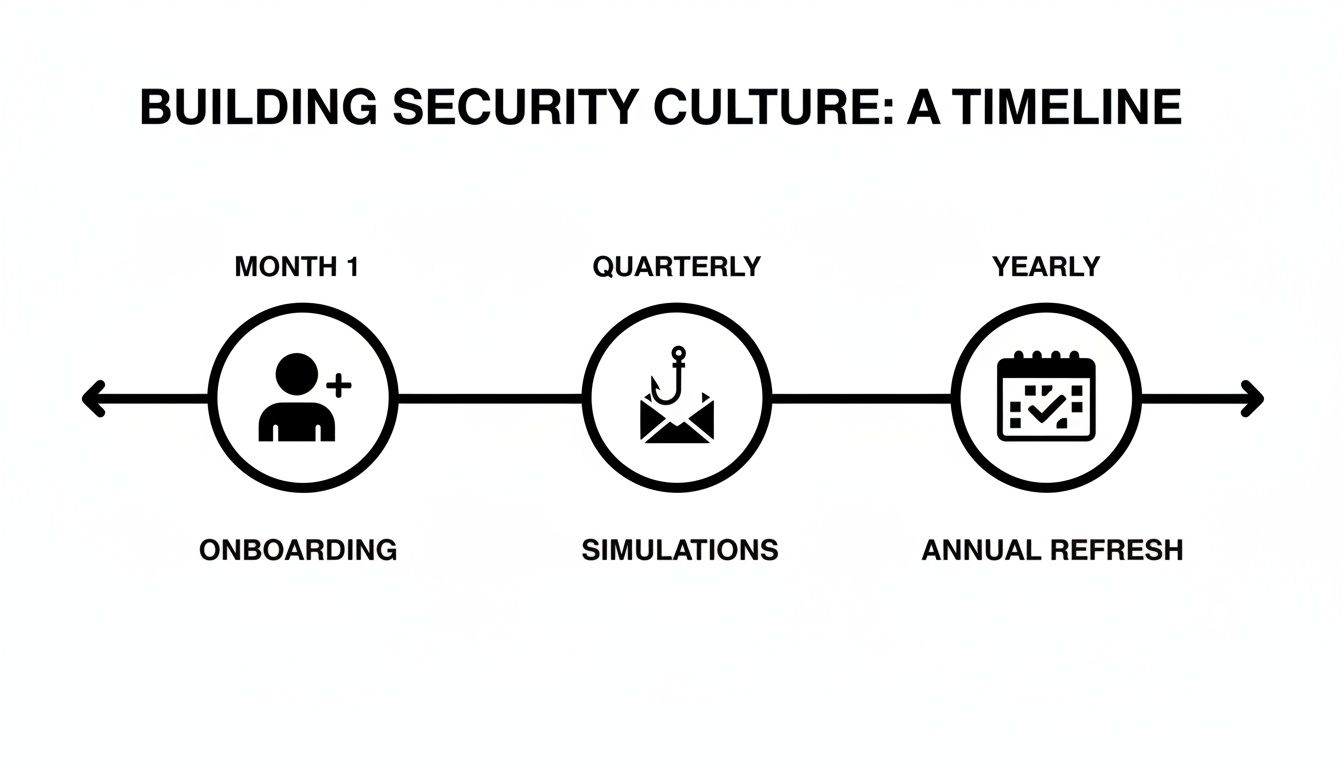
Security awareness is built progressively through initial onboarding, tested with regular simulations, and maintained with annual refreshers.
Setting Clear Objectives and Defining Success
Before developing a curriculum, define your goals. Vague targets like "making employees more secure" are impossible to measure. Focus on specific, actionable outcomes that tie directly to your business's risk profile and operational needs.
Your objectives should connect to real business impacts, such as meeting the training requirements of your cyber insurance carrier to lower premiums or reducing the time your IT team spends on security incidents.
A common mistake is treating training as a one-time event. An effective roadmap frames it as an ongoing business process, similar to financial reporting or performance reviews. This shift in perspective is crucial for achieving lasting cultural change and measurable risk reduction.
Examples of clearly defined success metrics include:
- Decreased Phishing Failures: Aim for a specific percentage drop in employees clicking on simulated phishing links over a 12-month period.
- Increased Threat Reporting: Track the number of employees actively reporting suspicious emails through proper channels, indicating engagement.
- Meeting Compliance Mandates: Document 100% completion of annual training to satisfy regulators, clients, or industry standards.
Selecting the Right Curriculum and Schedule
With clear objectives, you can build a curriculum that achieves them. Avoid a one-size-fits-all approach. While everyone needs basics like password hygiene, your finance team needs targeted training on wire transfer fraud, and your executives must understand the risks of business email compromise.
The training schedule is as important as the content. Spacing out information avoids burnout and improves retention, keeping employees engaged without disrupting productivity.
Sample 12-Month Cybersecurity Training Schedule
A well-structured timeline prevents training fatigue while keeping security top of mind. This sample schedule illustrates how to phase a program over one year to create a continuous cycle of learning and reinforcement.
| Quarter | Primary Focus | Key Activities | Target Audience |
|---|---|---|---|
| Q1 | Foundational Awareness | – Annual compliance training rollout – Initial phishing simulation benchmark |
All Employees |
| Q2 | Role-Based Risk Mitigation | – Targeted modules (e.g., wire fraud for finance) – Monthly phishing simulations |
Specific Teams |
| Q3 | Active Defense & Reporting | – Training on how to report threats – Mid-year progress review and communication |
All Employees |
| Q4 | Reinforcement & Planning | – "Security Awareness Month" campaign – Plan for next year’s curriculum |
All Employees |
This cadence transforms security from a disruptive event into a routine business function. It is a key part of how we structure our managed IT services for clients—building tailored schedules that are practical and effective.
Ensuring Team Buy-In and Program Communication
A training program will fail if your team does not understand its importance. You must communicate the "why" behind the training, connecting it to the protection of the company, its clients, and even their own personal data.
Leadership buy-in is essential. When executives participate in the training and champion the program, it sends a clear message that security is everyone's responsibility. Regular progress updates, such as celebrating a reduction in phishing clicks, also help maintain momentum.
A managed IT partner can handle the heavy lifting of program design, from technical setup and curriculum selection to ongoing administration and reporting. This allows you to focus on your business, confident that your training roadmap is actively reducing risk and building a more resilient organization.
Measuring the Success of Your Training Investment

How do you know if your training program is effective? Simply tracking completion rates does not indicate behavioral change. To justify the investment, you must demonstrate that the program is making a tangible difference in your company's security posture.
Effective measurement is about performance, not just participation. It should answer key leadership questions: Are we less vulnerable to a phishing attack today than we were last quarter? Are our employees actively contributing to our security efforts? The right metrics provide concrete proof of risk reduction and help secure future budgets.
Key Performance Indicators That Matter
Focus on Key Performance Indicators (KPIs) that reflect real-world behavior. These metrics provide a clear, ongoing picture of your company's security awareness maturity.
Three of the most important KPIs to track are:
-
Phishing Simulation Click Rate: The percentage of employees who click a malicious link or open an attachment during a simulated phishing test. The goal is to consistently drive this number down, proving that employees are improving their ability to spot threats.
-
Threat Reporting Rate: This KPI measures how many suspicious emails employees actively report to the IT department. A rising reporting rate is a strong indicator of a healthy security culture, showing that your team is engaged and taking ownership of security.
-
Time to Report: This metric tracks how long it takes an employee to report a potential threat. Faster reporting allows your security team to contain a problem before it spreads. An incident response plan template is only effective when fueled by rapid employee feedback.
From Data to Demonstrable Value
Tracking these numbers is just the beginning. The real power comes from using the data to tell a compelling story of progress. When reporting to leadership, translate these metrics into business outcomes, linking improved KPIs to goals like satisfying cyber insurance requirements or meeting client security demands.
The ultimate measure of success is not just knowledge, but behavior. An employee who can pass a quiz but still clicks on a suspicious link represents a failure of the program. True success is when reporting a potential threat becomes an ingrained, automatic reflex.
For example, demonstrating a 40% drop in phishing clicks over six months provides tangible proof that your training investment is strengthening your human firewall. Similarly, a steady increase in proactive threat reporting helps justify the program’s budget by showing it empowers employees to be an active part of your defense. To learn more, it is essential to understand How to Measure Training Effectiveness: A Practical Guide and move beyond surface-level statistics.
Recent research underscores the importance of focusing on behavior. One study of 19,500 employees found that training had a minimal effect because engagement was low, with 75% of participants spending less than a minute on the content. By measuring actual engagement and behavioral changes, such as reporting rates, you gain a far more accurate picture of your program’s real-world impact.
Meeting Compliance and Client-Driven Requirements
Cybersecurity training is no longer optional for businesses handling sensitive information; it is a non-negotiable external requirement. Think of it as a fundamental cost of doing business in today's environment.
Pressure comes from multiple directions. Cyber insurance providers, clients, and industry regulators all view employee training as a critical security control. Failing to provide and document it can negatively impact your bottom line and place your business at a competitive disadvantage.
The Influence of Cyber Insurance and Industry Frameworks
Cyber insurance applications now include detailed questions about security posture, with a strong focus on employee training. Insurers recognize that an untrained workforce is a significant liability and price policies accordingly. A mature, well-documented training program can lead to more favorable premiums.
Industry standards like those from NIST and ISO also explicitly require security awareness programs. Adherence to these frameworks is often necessary to win contracts with large enterprises or government bodies that require a secure supply chain.
A documented training program is more than an internal security task; it is a powerful business tool. It provides concrete proof to insurers, auditors, and clients that you are proactively managing human risk, which builds trust and opens new opportunities.
Satisfying Client Due Diligence
Your clients are also under pressure to secure their data, and that scrutiny extends to their partners. When you handle client information, they require proof that your team is trained to protect it. This is why due diligence questionnaires have become more specific about employee training and phishing simulations.
Being able to confidently answer "yes" and provide documentation can differentiate you from competitors. It demonstrates a level of security maturity that builds immediate client trust and can be a deciding factor in a competitive bid. Familiarizing your team with resources like our SOC 2 compliance checklist can help you prepare for these evaluations.
The Shift from Best Practice to Mandated Baseline
This trend is becoming the new standard. In California’s public sector, what was once a recommendation is now a mandate. The entire University of California system requires 100% of employees to complete annual cybersecurity awareness training.
Public-sector benchmarks often influence private-sector expectations, establishing a new standard for reasonable care. You can discover more about this cybersecurity mandate to understand its broader impact. Businesses that cannot prove systematic, universal training will increasingly face higher insurance costs or lose valuable contracts.
Let the Experts Handle Your Training Program
Implementing and managing an effective employee cybersecurity training program is a significant undertaking. Most businesses lack the in-house expertise, time, and resources to run a program that delivers measurable results.
Partnering with a dedicated expert can turn training from an administrative burden into a strategic advantage.
Less Admin Work, More Real-World Impact
A managed approach removes the administrative and technical workload from your team. Instead of asking your staff to design a curriculum, manage a training platform, and interpret the results, an experienced partner handles everything. This frees up your internal resources and ensures the program is effective, consistent, and aligned with your broader security goals.
A partnership solves the common challenges that prevent businesses from building a strong security culture by providing the necessary structure and resources without draining your team.
A managed training partnership typically includes:
- Custom Curriculum Design: We build a training roadmap that addresses your specific industry risks, compliance requirements, and company culture.
- Full Platform Management: All technical aspects are handled for you, from user enrollment and course assignments to launching phishing simulation campaigns.
- Realistic Phishing Simulations: We design and execute controlled phishing tests that mimic the real-world threats your employees face.
- Clear Monthly Reports: You receive straightforward, executive-ready reports that track key metrics, demonstrate progress, and identify areas for improvement.
A Strategic Way to Build a Secure Team
When you work with an expert, you gain more than a training platform; you gain a strategic advisor focused on strengthening your "human firewall." A managed program integrates seamlessly into your overall managed cybersecurity services, ensuring that insights from training inform and improve all other aspects of your defense.
Partnering for managed training allows you to focus on your core business, confident that your team is receiving consistent, high-quality education that is actively and measurably reducing your risk. It shifts the responsibility from your plate to an expert’s, ensuring the program runs with precision and purpose.
This collaborative approach ensures your employee cybersecurity training is not just a compliance checkbox but a dynamic component of your security posture. It provides the expertise needed to keep your program effective against emerging threats and the accountability to prove its value over time.
If your organization is ready to build a more aware and secure workforce without the administrative overhead, the next step is a simple conversation about your needs.
Answering Your Questions About Employee Training
When business leaders consider implementing a cybersecurity training program, a few practical questions often arise. Here are direct answers to help you make an informed decision.
How Much Time Does This Actually Take?
Productivity impact is a common concern. Modern training programs are designed to be efficient and integrate into the workday with minimal disruption.
Initial onboarding training for a new hire typically takes 60–90 minutes. Annual refreshers require a similar time commitment. Ongoing activities, such as monthly phishing tests or short educational videos, take only a few minutes each month—enough to keep security top of mind without causing burnout.
What Does a Typical Program Cost?
Costs vary based on team size and program depth, but a foundational plan often starts at just a few dollars per employee per month.
It is more accurate to view this as an investment rather than an expense. The cost of a robust training program is minimal compared to the financial and reputational damage of a single breach. Many cyber insurance carriers recognize this and may offer better premiums to businesses with a documented training program.
Is Training Really Effective Against Sophisticated Attacks?
Yes, because even the most "sophisticated" attacks often rely on a simple weakness: human behavior. Attackers use social engineering—deception and manipulation—to trick an employee into providing access. Even advanced malware frequently requires a user to click a link or open an attachment to activate.
Training works by strengthening your human firewall. It teaches your team to pause, question suspicious requests, and verify information before acting. This simple habit disrupts an attacker's strategy and can stop an incident before technical defenses are even engaged.
Can't We Just Use Free Training Resources?
While free resources can provide a basic introduction, they lack the structure and measurement capabilities required for a comprehensive risk management program.
A professional, managed program offers several critical advantages:
- A Structured Curriculum: A logical learning path that moves employees from foundational knowledge to understanding role-specific risks.
- Phishing Simulations: Controlled, safe tests that measure actual behavior, not just knowledge recall.
- Tracking and Reporting: The documentation needed to prove completion and demonstrate improvement for compliance, insurance, and client due diligence.
- Expert Guidance: Access to professionals who can tailor the program to address the real-world threats your industry faces.
A managed program provides the accountability and measurable results necessary to prove you are actively reducing your organization's risk profile.
Ready to build a more secure and aware workforce without adding to your administrative burden? Tricord I.T Solutions can design, implement, and manage a cybersecurity training program that fits your business perfectly, turning your team into your strongest line of defence.