

For many business leaders, outsourcing IT services is a strategic decision to enhance security, control costs, and improve operational reliability. It involves partnering with a specialized firm to manage your technology infrastructure—from cybersecurity and daily support to long-term planning. This allows your internal team to focus on core business functions that drive revenue, rather than managing complex IT challenges.
This guide explains what outsourcing IT services means for your business, the different models available, and how to choose a partner that aligns with your operational and financial goals. The primary benefit is transforming IT from an unpredictable cost center into a predictable, strategic asset that supports growth and mitigates risk.
What Does Outsourcing IT Services Mean for Your Business?
Outsourcing IT services means engaging an external provider to manage the technology functions traditionally handled by an in-house team. This is more than just fixing computers; it's a fundamental shift in how a business manages technology, risk, and operational efficiency. Instead of building and retaining a costly internal IT department, you gain immediate access to a team of certified specialists.
This strategic move turns technology from a reactive, unpredictable expense into a proactive, manageable asset. For businesses in regulated industries like finance or law, the complexity of modern cybersecurity and compliance makes a purely in-house approach both impractical and expensive. An outsourced partner provides the expertise and resources needed to maintain security and compliance without the associated overhead.
From In-House Cost to Strategic Partnership
The decision to outsource often comes down to a comparison: continue building an internal department or leverage the expertise of a dedicated partner. While an in-house team offers direct control, it also brings significant overhead, knowledge gaps, and the constant challenge of keeping pace with evolving threats. An outsourced partner delivers a level of expertise and efficiency that is difficult to replicate internally.
This partnership model unlocks several key advantages:
- Access to Specialized Expertise: Gain a team of certified professionals in cybersecurity, cloud infrastructure, and compliance without the cost of multiple full-time salaries.
- Predictable Cost Management: Transition from unpredictable capital expenses and emergency repair bills to a fixed, manageable monthly operational cost.
- Enhanced Security and Compliance: Partner with a firm whose core business is staying ahead of cyber threats and navigating complex regulatory requirements.
- Increased Operational Uptime: Benefit from proactive, 24/7 monitoring and maintenance designed to prevent issues before they disrupt business operations.
To provide a clearer picture, let's break down the core differences between maintaining an in-house IT team and engaging an outsourced partner.
Executive Summary: In-House IT vs. Outsourced IT Services
This table offers a high-level comparison of the key business considerations when weighing an internal IT team against an outsourced IT partner.
| Consideration | In-House IT Department | Outsourced IT Services Partner |
|---|---|---|
| Cost Structure | High fixed costs (salaries, benefits, training), plus unpredictable capital expenses. | Predictable, fixed monthly operational expense. |
| Expertise & Skills | Limited to the knowledge of a few individuals; skill gaps are common. | Access to a diverse team of certified specialists in multiple disciplines. |
| Availability | Typically 9-to-5, with challenges covering vacations, sick days, and after-hours emergencies. | 24/7/365 monitoring and support; no single point of failure. |
| Scalability | Slow and expensive to scale; hiring and training new staff takes months. | Rapidly scalable up or down to match business needs without HR overhead. |
| Strategic Focus | Often reactive, focused on firefighting and day-to-day tickets. | Proactive and strategic, focused on long-term planning, security, and efficiency. |
| Tools & Technology | Requires significant investment in enterprise-grade software and hardware. | Leverages best-in-class tools and platforms across multiple clients, reducing costs. |
Ultimately, the choice depends on your business's specific needs, but for most small and mid-sized businesses, the strategic advantages of an outsourced partner are compelling.
For a deeper dive into how this trend is reshaping modern business, you can read more about outsourcing in IT. This shift isn’t just a niche trend; North America is on track to hold a 33.2% share of the global IT services outsourcing market by 2025. Businesses are making this change to sharpen their focus, cut operational drag, and get back to what they do best.
A successful IT outsourcing relationship is built on a foundation of shared goals. The provider's success is directly tied to the client's operational stability, security, and growth, creating a powerful alignment of interests that benefits the entire organization.
In the end, choosing professional business IT services is about gaining a true strategic advantage. It allows you to offload the immense, time-consuming burden of technology management, knowing a dedicated team of experts is protecting your operations and paving the way for future growth.
Choosing the Right Model for IT Outsourcing
Deciding to engage an external IT partner is not a simple yes-or-no question. The success of outsourcing hinges on selecting a model that fits your business structure, operational needs, and long-term goals.
Think of it like hiring a contractor. Do you need a firm to manage a project from start to finish, or do you have a capable team that just needs specialized support for complex tasks? Each scenario requires a different type of engagement. A careful assessment of your challenges—whether they are a lack of cybersecurity expertise, an overwhelmed internal team, or the need for high-level strategic guidance—is the first step.
Comparing IT Outsourcing Models
Here’s a brief overview of the most common IT outsourcing models. This table clarifies what each model does best and for whom it is designed.
| Model | Best For | Primary Function | Cost Structure |
|---|---|---|---|
| Managed Services | Businesses with no internal IT or a small, overloaded team. | Acts as a complete, outsourced IT department, handling everything. | Fixed monthly fee. |
| Co-Managed IT | Companies with an existing IT team that needs extra support or expertise. | Augments the in-house team with specialized tools and senior-level help. | Fixed monthly fee, often with project-based add-ons. |
| Fractional/Virtual CIO | Organizations needing high-level strategy but not daily technical support. | Provides executive-level guidance, planning, and budgeting. | Retainer or project-based fee. |
Each of these models solves a different business problem. Understanding the distinctions is key to making a sound investment.
The Fully Managed Services Model
The fully managed services model is the most comprehensive approach to IT outsourcing. In this model, you hand over complete responsibility for your technology infrastructure to a Managed Services Provider (MSP). For a predictable, flat monthly fee, the MSP proactively monitors, manages, and maintains all of your IT systems.
This model is ideal for businesses that do not have a dedicated IT department or whose internal team is stretched thin. The MSP functions as your IT department, handling everything from daily helpdesk support and network security to long-term technology planning, allowing you to focus on your core business.
The flowchart below illustrates a typical decision-making process for businesses evaluating IT support options.
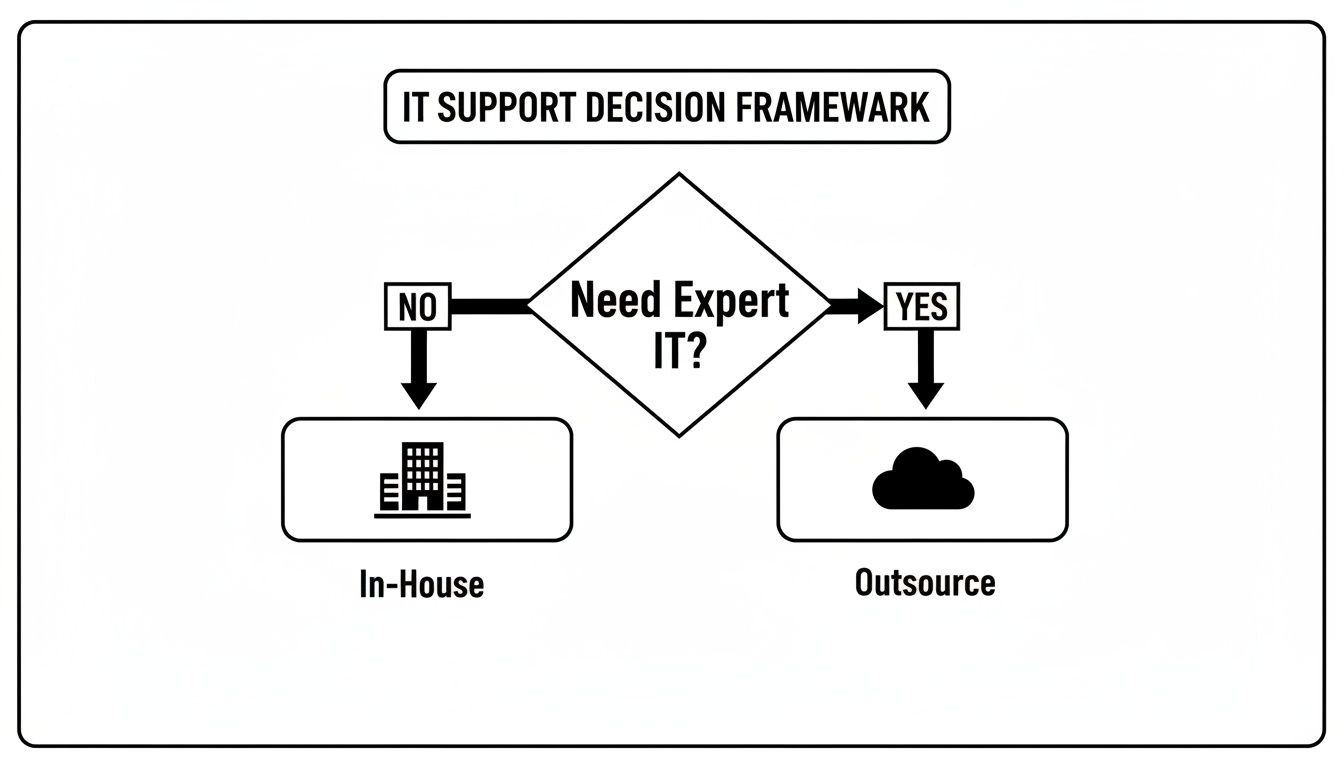
As shown, when specialized IT expertise is essential, outsourcing provides a direct path to comprehensive support without the overhead of building an in-house team from the ground up.
The Co-Managed IT Model
The co-managed IT model is built on partnership. It is designed not to replace your existing IT team, but to strengthen it. Your internal staff continues to handle daily, user-facing issues, while the MSP provides advanced tools, specialized expertise, and additional support when needed.
This collaborative approach is ideal for organizations with a capable IT department that needs to scale its capabilities or fill specific knowledge gaps.
Key benefits of a co-managed model include:
- Accessing Specialized Security Tools: Your team gains the benefits of enterprise-level security monitoring without the significant capital investment.
- Filling Knowledge Gaps: The MSP provides specialists in complex areas like cloud architecture or compliance that your internal team may not possess.
- Providing Escalation Support: When your team encounters a complex problem, they have a direct line to senior engineers for fast resolution.
- Freeing Up Your Team for Strategic Projects: By offloading routine monitoring and maintenance, your staff can focus on initiatives that drive business growth.
The Fractional or Virtual CIO Model
A Fractional or Virtual CIO (vCIO) provides high-level strategic guidance without the expense of a full-time C-suite executive. This model is focused on strategy, planning, and budgeting, not daily technical support. A vCIO works with your leadership team to ensure that technology investments align with business objectives.
A vCIO acts as your senior technology advisor, translating business goals into a practical IT roadmap. They help you make informed decisions on major investments, manage risk, and ensure your technology infrastructure can support future growth.
This service is particularly valuable for businesses with a competent technical team but lack executive-level technology leadership. A vCIO helps answer critical questions like, "Are we allocating our IT budget effectively?" and "How can technology provide a competitive advantage?" To learn more, explore our guide on what managed IT services are and how strategic oversight plays a role.
Unlocking the Core Business Benefits of IT Outsourcing
When considering outsourcing IT, the focus should be on tangible business outcomes. For leaders, particularly in regulated industries, the real value lies in how a strategic IT partner can strengthen a company's financial position, operational resilience, and competitive edge. These are measurable improvements that directly impact the bottom line.

This is a strategic move, one that turns a reactive cost center into a proactive driver of efficiency and security.
Gain Predictable Cost Control
A primary benefit of outsourcing IT is the transition from unpredictable capital expenditures to a fixed, manageable monthly cost. An in-house IT department often incurs unexpected expenses, from emergency hardware replacement to unplanned software licensing fees. With a managed services model, you pay a consistent fee that covers support, maintenance, and security.
This predictability simplifies budgeting and eliminates financial shocks that can disrupt cash flow. Instead of reserving capital for potential IT failures, you can invest those funds into growth-oriented activities.
Access Specialized Expertise Instantly
Hiring, training, and retaining top-tier experts in fields like cybersecurity, cloud architecture, and compliance is a significant challenge. Talent is scarce, and the salaries for certified professionals can be prohibitive for small and mid-sized businesses. Outsourcing solves this problem immediately.
You gain access to an entire team of seasoned specialists who are continuously updating their skills and certifications. This is especially critical if you handle sensitive data. Having a partner with deep experience in advanced cybersecurity frameworks ensures your defenses remain current without the overhead of building that team internally.
Outsourcing IT transforms the expertise problem from a major hiring obstacle into a simple service agreement. It provides enterprise-level knowledge on a budget that is accessible to a growing business.
The data supports this. Across US businesses, 59% outsource to cut costs, with some seeing labor cost reductions as high as 72%. But it’s not just about saving money; 78% of businesses report significant improvements in the functions they outsource, especially in critical areas like cybersecurity. You can find more details on these outsourcing trends on Sumatosoft. Outsourcing is a proven strategy for boosting both financial and operational health.
Enhance Operational Resilience and Uptime
Downtime is not just an inconvenience; it directly impacts revenue and reputation. Every minute your systems are offline, your team cannot serve clients or perform their duties. A major benefit of outsourcing is proactive, 24/7 monitoring that identifies and resolves most issues before they cause an outage.
An outsourced partner uses sophisticated tools to monitor your network, servers, and applications around the clock. This constant vigilance, combined with a structured maintenance schedule, leads to significantly higher uptime and a more resilient business.
This is achieved through:
- Proactive Maintenance: Regular patching, updates, and system health checks prevent common problems from occurring.
- 24/7/365 Monitoring: Automated alerts instantly notify engineers of potential issues, allowing them to intervene before your team is impacted.
- Rapid Incident Response: A dedicated team is always on standby to handle emergencies, minimizing the duration and impact of any unavoidable downtime.
This focus on stability ensures your business operates reliably, protecting productivity and profitability.
Evaluating Potential Risks and How to Mitigate Them
While the benefits of outsourcing IT are significant, a prudent business decision requires a clear-eyed look at potential challenges. Partnering with an external provider involves a high degree of trust. Understanding and managing common risks is key to a successful, long-term relationship.
Addressing these concerns from the outset prevents future complications and builds a foundation for a transparent partnership. Most risks fall into three categories: loss of control, security vulnerabilities, and unexpected costs. A well-defined strategy and a comprehensive agreement can effectively mitigate these issues.
Maintaining Control and Visibility
A common fear associated with outsourcing is the loss of control over a critical business function. Business leaders worry they will lose visibility into their own systems or that a provider will be less responsive than an in-house employee. This is a valid concern, but it is entirely manageable.
The solution is to establish a detailed Service Level Agreement (SLA) before the engagement begins. An SLA is more than a contract; it is a written commitment that clearly defines expectations for both parties.
A strong SLA must include:
- Specific Performance Metrics: Define measurable goals for system uptime (e.g., 99.9% availability), response times for support tickets, and problem resolution targets.
- Clear Reporting Requirements: Mandate regular, detailed reports on system health, security posture, and support activity. This ensures you maintain a clear view of your technology's performance.
- Defined Escalation Paths: Outline the exact process for escalating urgent issues, so you always know who to contact and when to expect a response.
With a comprehensive SLA, you do not lose control. Instead, you gain a structured framework for managing performance and ensuring accountability.
Addressing Security and Compliance Gaps
Entrusting your data to a third party naturally raises security concerns. An improperly vetted provider could expose your business to significant risks, from data breaches to regulatory fines. Thorough due diligence is non-negotiable.
A critical part of evaluating potential risks in IT outsourcing involves establishing a robust vendor risk management framework to thoroughly assess and mitigate third-party exposure. This process is fundamental to protecting your sensitive data and maintaining your compliance posture.
Your vetting process must verify a provider's security credentials. Request proof of their internal security policies, data handling procedures, and relevant certifications, such as SOC 2. If you operate in a regulated industry, confirm the provider has direct experience with frameworks like HIPAA or FINRA. By examining their security protocols, you can ensure they align with your standards. To learn more, read our detailed article on implementing advanced cybersecurity frameworks to protect your business.
Avoiding Hidden Costs and Scope Creep
Predictable pricing is a primary driver for outsourcing. However, a poorly defined contract can lead to "scope creep," where work outside the original agreement results in additional charges. These hidden costs can negate the financial benefits of the partnership.
To prevent this, ensure your contract specifies exactly what is included in your monthly fee and what is considered an out-of-scope project. Discuss potential future needs, such as an office move or a major software migration, and clarify how those would be priced. A transparent partner will provide a clear menu of services and project rates, eliminating the risk of unexpected invoices.
How to Choose the Right IT Outsourcing Partner
Selecting the right company for outsourcing IT services is a critical business decision. The evaluation should focus on more than just technical skill; it's about finding a partner whose approach to security, service, and strategy aligns with your business goals. A structured vetting process is essential for identifying a provider that can protect your operations and support your growth.

This process should be a structured evaluation based on evidence, such as proven expertise, security credentials, and a verifiable track record. This is especially important for businesses in regulated fields where compliance is a core requirement. A clear framework helps you look past marketing claims and assess a provider's actual capabilities.
Verify Industry Experience and Expertise
Generic IT support is no longer sufficient. Your business has unique workflows, software requirements, and compliance obligations that demand specific expertise. A provider with experience in your industry will understand these nuances from the start.
When interviewing potential partners, ask for concrete examples of their work with businesses similar to yours.
- Request Industry-Specific References: Ask to speak with current clients in your field to get a firsthand account of how they handle relevant challenges.
- Discuss Core Technology Platforms: If your business relies on platforms like Microsoft 356 and SharePoint, ensure the provider has deep, certified expertise in managing and securing them.
- Inquire About Compliance: Ask how they have helped clients meet industry-specific regulations, such as those governing legal or financial data.
A provider with relevant experience will deliver results more quickly and effectively than one learning on the job.
Scrutinize Their Security and Compliance Posture
Security must be integral to a provider's culture and operations, not an afterthought. Their security posture directly impacts yours, making this a critical part of your due diligence. You are not just buying support; you are entrusting them with your most sensitive information.
Begin by asking direct questions about their internal security policies and incident response procedures.
A provider’s game plan for a security breach is the ultimate test of their competence. They should be able to hand you a clear, documented incident response plan that spells out communication, containment, and recovery steps. Any hesitation here is a huge red flag.
The market reflects this demand for performance. In the US IT outsourcing market, outcome-based contracts now account for 43% of new deals. These agreements tie a vendor's payment to achieving specific targets, such as guaranteed application uptime or incident resolution times, effectively shifting performance risk to the provider. You can read the full research about this trend on Mordor Intelligence. This model is particularly relevant when vetting partners for critical functions like cybersecurity services.
Evaluate Service Delivery and Support Processes
A provider's day-to-day support process will define your experience. Look for a structured, professional, and transparent process that prioritizes clear communication and timely resolutions. A disorganized helpdesk can become a significant source of frustration and reduce productivity.
Key questions to ask include:
- What does your client onboarding process look like? A detailed plan indicates a commitment to a smooth, organized transition.
- How are support requests triaged and escalated? Understand their system for prioritizing critical issues to ensure urgent problems receive immediate attention.
- What are your standard response and resolution times? These metrics should be clearly defined in their Service Level Agreement (SLA).
- How do you handle after-hours or emergency support? Confirm they have a reliable process for 24/7 assistance.
- Can we see examples of your client-facing reports? Reporting should be easy to understand and provide meaningful insights into system health and support trends.
A high-quality partner will have well-documented processes for all aspects of service delivery. This provides confidence that your team will be well-supported. Choosing a partner who can also provide high-level strategic guidance, such as a Virtual CIO, ensures that technical support aligns with your broader business objectives.
Navigating the Onboarding Process and Beyond
Once you've signed a contract, the real work begins. A well-managed transition from your current IT setup to a new partner is crucial for a successful long-term relationship. It minimizes disruption and builds trust from the outset.
A professional provider will guide you through a structured, transparent process designed to build confidence and deliver immediate value.

The process typically begins with a detailed discovery and audit. Your new partner will work with your team to gain a deep understanding of your existing infrastructure, workflows, and security posture. This comprehensive analysis maps out your entire technology environment, identifying risks and inefficiencies before any changes are made.
From Audit to Implementation
Following the audit, the migration and implementation phase begins. This should be a carefully managed project with clear timelines and consistent communication. Whether it involves moving data to the cloud, deploying new security tools, or integrating with existing systems, the goal is a seamless transition.
Your provider should handle the technical implementation, ensuring minimal disruption to your team. This phase typically includes:
- System Integration: Aligning new management tools with your current infrastructure.
- Security Deployment: Rolling out endpoint protection, firewalls, and monitoring agents.
- User Training: Instructing your staff on how to submit support requests and use any new systems.
This methodical approach helps avoid the common pitfalls of a rushed transition, keeping your daily operations running smoothly.
A successful onboarding is not just about installing software. It is about transferring knowledge, establishing trust, and aligning the provider’s team with your specific business objectives and operational needs from day one.
Measuring Success and Driving Continuous Improvement
After onboarding is complete, the focus shifts to ongoing management and performance measurement. A true IT partner will work with you to define Key Performance Indicators (KPIs) that are meaningful to your business. These metrics ensure accountability and demonstrate the value of your investment.
Common KPIs to track include:
- System Uptime: Monitoring the availability of critical servers and applications, with a target of 99.9% or higher.
- Ticket Resolution Time: Measuring how quickly support issues are addressed and resolved.
- Security Incidents Prevented: Reporting on threats that were identified and neutralized before they could cause damage.
Regular performance reviews and strategic planning meetings are essential for a healthy long-term partnership. These discussions, often guided by a Virtual CIO, ensure your technology roadmap remains aligned with your business goals.
The logical next step is often an initial consultation or a full IT assessment. This provides a data-driven view of your current technology environment and identifies the most impactful opportunities for improvement.
Common Questions About IT Outsourcing
When business leaders consider outsourcing IT, several key questions consistently arise. Addressing these common concerns can provide clarity and help inform your decision.
What is the typical cost of outsourcing IT?
The cost depends on the services required and the chosen model. Most Managed Service Providers (MSPs) offer a fixed monthly fee, typically ranging from $100 to $250 per user per month. This subscription-style pricing covers all support, routine maintenance, and security monitoring, which helps avoid unexpected IT expenses. The most accurate way to determine cost is through a detailed assessment of your current environment and future needs.
Is my sensitive data secure with an outsourced provider?
Yes, provided you partner with a reputable firm. A specialized IT provider can often deliver a higher level of security than most small or mid-sized businesses can achieve internally. Their business is built around it. Look for providers with relevant credentials, such as SOC 2 certification, and experience with compliance frameworks specific to your industry (e.g., HIPAA for healthcare). They should offer services like 24/7 threat monitoring, managed firewalls, and employee security training.
Choosing the right partner means security becomes a strength, not a liability. An expert provider elevates your defensive posture, leveraging enterprise-grade tools and processes that are often out of reach for individual businesses, ensuring your sensitive data is actively protected.
Will I lose control over our technology decisions?
No. A quality IT outsourcing relationship is a partnership, not a takeover. You retain control over all strategic technology decisions. Your provider acts as a trusted advisor, managing daily operations while offering expert guidance that aligns with your business goals. Through clear communication, regular meetings, and detailed reporting, you remain informed and in control of your technology direction.
What does the transition from an in-house team look like?
A professional IT provider ensures a seamless transition. The process usually begins with a discovery phase, where they audit your entire infrastructure to understand its current state. From there, a carefully planned onboarding process is executed. Agents are deployed, systems are integrated, and all configurations are documented. The objective is a smooth cutover with minimal disruption to your team. Your staff receives training on the new support process, and the provider manages all backend coordination.
If you are ready to explore how a strategic IT partnership can enhance security, control costs, and support business growth, the team at Tricord I.T Solutions is available to help. We invite you to schedule a no-obligation consultation to discuss your specific needs and goals.