
Effective cybersecurity is no longer just an IT issue; it is a core business function essential for protecting your company's finances, reputation, and operational stability. For a small business, a security incident can lead to significant downtime, data loss, and compliance failures. A strong security posture is a direct investment in business resilience and long-term success.
This guide provides a practical roadmap for business leaders to understand common threats, implement foundational security controls, and build a culture of security awareness. By focusing on risk management rather than just technology, you can protect your assets and build a more resilient organization.
Why Cybersecurity Is a Core Business Function

Many business leaders once viewed cybersecurity as a technical cost center. This perspective is now dangerously outdated. Today's cyber threats are direct risks to a company's financial health and market reputation.
Attackers often target small and midsize businesses, assuming they lack sophisticated defenses. This common misconception leaves many companies vulnerable to costly exploits. The reality is that if your business handles money or data, it is a target.
The Financial and Reputational Stakes
A successful cyberattack triggers a cascade of costly consequences that extend far beyond the initial technical breach. These are not abstract IT problems; they have a direct impact on your bottom line and your ability to operate.
- Operational Disruption: Ransomware can lock your systems for days or weeks, halting operations and preventing you from serving clients or generating revenue.
- Direct Financial Loss: This includes stolen funds from fraudulent wire transfers, the high costs of system restoration, and potential regulatory fines if customer data is compromised.
- Reputational Damage: Losing client trust is difficult to recover from. A data breach can permanently tarnish your brand and drive customers to competitors.
- Legal and Compliance Penalties: For businesses in regulated industries like law or healthcare, a failure to protect data can lead to severe penalties and legal action.
According to the Canadian Anti‑Fraud Centre, Canadians lost over CA$530 million to fraud in 2022. The average cost for a small business to recover from a cyberattack can be crippling, often exceeding six figures.
Viewing cybersecurity through a business lens means shifting the focus from simply buying technology to managing risk. It’s about ensuring your business can withstand a disruptive event and continue to operate effectively.
Proactive security is responsible business management, as fundamental as sound financial planning or quality customer service. Integrating cybersecurity into your core strategy, often with the support of managed IT services for small business, is essential for building a resilient organization.
Understanding the Threats You Actually Face
To build an effective defense, you must first understand your adversary. Cybersecurity threats are often described in technical jargon, but for a business owner, they translate into practical problems: operational disruption, financial loss, and reputational harm.
Cybercriminals use automated tools to scan for vulnerable targets, making small businesses with fewer defenses an attractive path of least resistance. Understanding how these common attacks work is the first step toward developing a sound cybersecurity for small businesses strategy.
Phishing and Business Email Compromise
A Business Email Compromise (BEC) attack is a sophisticated form of phishing where an attacker impersonates a trusted executive or vendor. For example, your finance manager might receive a fraudulent email that appears to be from you, urgently requesting a wire transfer to a new supplier.
These scams exploit human trust and create a false sense of urgency. The goal is simple: trick an employee into wiring money or disclosing sensitive information directly to a criminal.
The fallout from a single successful BEC attack can be devastating. One fraudulent invoice payment or an unauthorized wire transfer can lead to an immediate, and often irreversible, financial loss that hits your cash flow hard.
Ransomware Attacks
In a ransomware attack, criminals gain access to your network—often through a phishing email or an unpatched software vulnerability—and encrypt your critical data. A message then appears on every screen demanding a large payment, typically in cryptocurrency, to restore access.
The consequences extend well beyond the ransom demand itself.
- Severe Operational Downtime: Every hour your systems are locked is an hour of lost productivity, missed deadlines, and lost revenue.
- Data Loss: Paying the ransom is a gamble. There is no guarantee you will get your data back, and even if you do, it may be corrupted.
- Reputational Harm: Informing clients that their confidential information was compromised can shatter trust and damage your brand permanently.
Data Breaches and Insider Threats
A data breach occurs when confidential information—such as client lists, employee records, or financial data—is accessed by an unauthorized individual. While external attacks are common, a significant number of breaches originate internally.
An insider threat is not always a malicious employee. More often, it is a well-meaning team member who makes a mistake, such as clicking a malicious link, misconfiguring a cloud storage setting, or losing a company laptop. Regardless of intent, the result is the same: sensitive data is exposed, creating legal and reputational liabilities under Canadian privacy laws like PIPEDA.
Your Foundational Cybersecurity Roadmap
Building effective cybersecurity does not require a massive budget or a large in-house team. It requires a clear, practical roadmap that prioritizes critical risks and establishes a solid foundation to protect your operations, clients, and reputation.
Security is an ongoing process, not a one-time purchase. By breaking it down into four core pillars—People, Policies, Processes, and Technology—you can build a resilient defense, layer by layer, and make smart investments that align with your specific business risks.
The People Pillar: Strengthening Your Human Firewall
Technology is a critical component, but your employees are your first and most important line of defense. Attackers often exploit human psychology through phishing and social engineering because it is easier than breaking through technical controls. A security-aware culture is a non-negotiable part of modern business resilience.
This begins with ongoing employee training. Your team must understand the threats they face and know how to recognize them. They should learn to spot a suspicious email, verify urgent payment requests, and handle sensitive client data securely. Human error remains a leading cause of security incidents, making end-user awareness programs a core security control.
The Policies Pillar: Setting Clear Rules of Engagement
Clear, documented policies provide the guardrails for how your team uses technology and handles data. They establish consistent rules that are fundamental for both security and compliance. Without them, security becomes subjective and dependent on individual judgment.
Essential policies for any small business include:
- Acceptable Use Policy: Defines how employees are permitted to use company equipment, networks, and software.
- Access Control Policy: Dictates who can access specific data and systems, based on the principle of least privilege—granting only the minimum access necessary for a person to perform their job.
- Data Handling Policy: Outlines procedures for managing sensitive information, from collection to secure disposal.
These documents should be clear, concise, and easy for your team to understand and follow. The goal is to create a shared understanding of security expectations.
The Processes Pillar: Building Operational Resilience
Robust processes turn your policies into repeatable, reliable actions. They ensure that critical security tasks are performed consistently, which reduces human error and improves your ability to respond to an incident.
One foundational process is secure IT Asset Lifecycle Management, which covers everything from onboarding new equipment to securely retiring old hardware. This ensures every device is tracked, secured, and properly wiped of data before disposal.
Other critical operational processes include:
- Data Backup and Recovery: Regularly back up all critical data and, just as importantly, test the backups to ensure you can restore systems quickly after an incident.
- Incident Response Plan: A documented plan that outlines the exact steps to take during a security incident: who to call, which systems to isolate, and how to communicate with stakeholders.
- Software Patching and Updates: A consistent process for applying security updates to all software and systems to close vulnerabilities that attackers actively exploit.
The Technology Pillar: Deploying Essential Tools
While people and processes are foundational, the right technology provides the necessary tools to block threats and detect malicious activity. For small businesses, the focus should be on high-impact, foundational tools that offer the most protection for the investment.
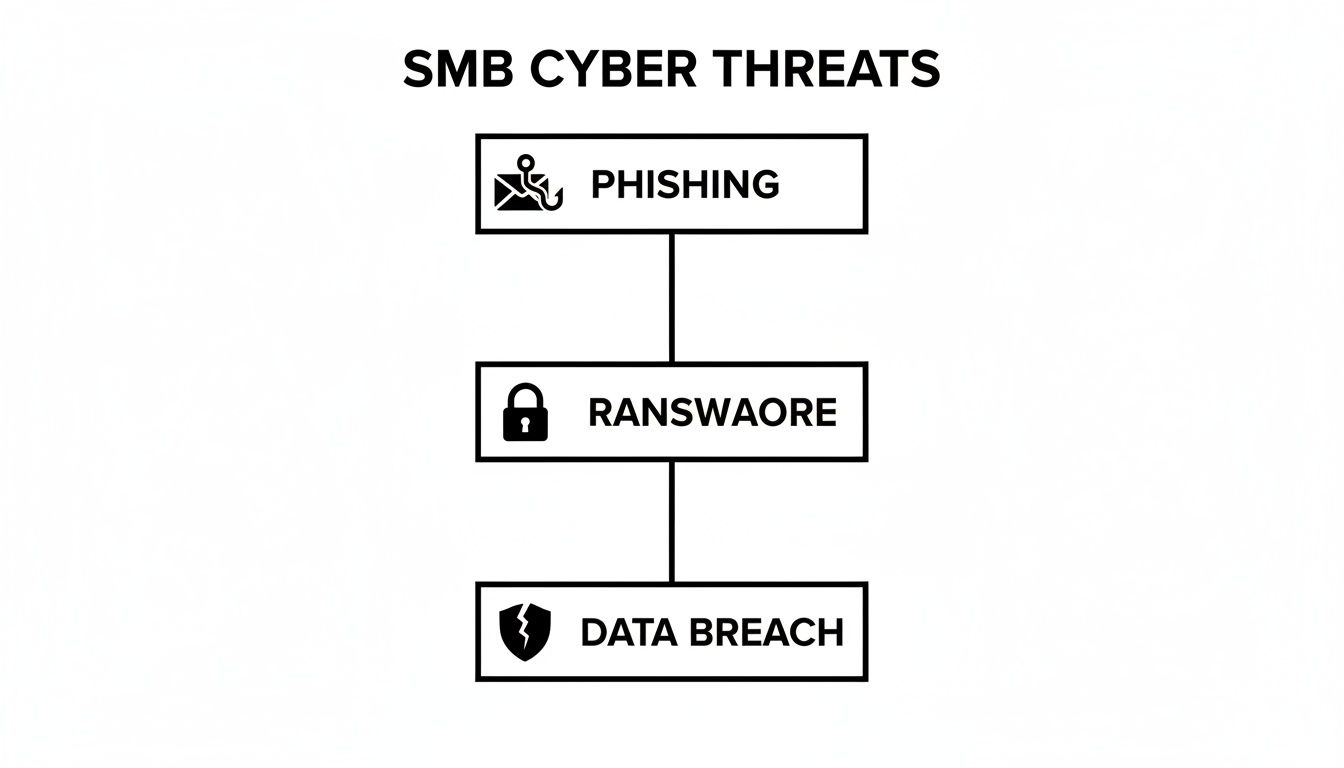
This chart illustrates how phishing often serves as the entry point for more damaging attacks like ransomware and data breaches, highlighting the need for layered defenses.
The Four Pillars of a Small Business Cybersecurity Program
This table breaks down the four essential pillars of a comprehensive cybersecurity strategy, providing actionable examples for each category to get you started.
| Pillar | Focus Area | Key Actions for Small Businesses |
|---|---|---|
| People | Human Firewall & Security Culture | Conduct regular phishing simulations and security awareness training. Foster a culture where employees feel comfortable reporting mistakes. |
| Policies | Governance & Rule-Setting | Develop and enforce clear policies for Acceptable Use, Access Control, and Data Handling. Review and update them annually. |
| Processes | Operational Consistency & Resilience | Implement documented procedures for data backups, incident response, and regular software patching. Test these processes routinely. |
| Technology | Technical Controls & Threat Prevention | Deploy foundational tools like MFA, endpoint protection, a firewall, and email security. Monitor systems for suspicious activity. |
Viewing security through this four-pillar framework helps ensure you build a balanced defense that addresses your biggest risks from every angle.
The most effective security stack for a small business focuses on preventing that initial access and quickly detecting any threats that manage to slip through. It's about building layers of defence, not searching for a single silver-bullet solution.
Start with these essential technology controls:
- Firewall and Network Security: Your firewall acts as a gatekeeper for your network, filtering malicious traffic before it reaches your internal systems.
- Multi-Factor Authentication (MFA): This is one of the single most effective controls you can implement. It requires a second form of verification beyond a password, stopping most unauthorized access attempts.
- Endpoint Protection: Every device connected to your network—laptops, desktops, servers—is an endpoint. Modern endpoint protection goes beyond traditional antivirus to detect and block sophisticated threats. You can learn more about endpoint detection and response.
- Email Security: Since most attacks begin with a phishing email, a dedicated email filtering service is essential. It can block spam, malware, and phishing attempts before they reach your employees' inboxes.
Securing Your Microsoft 365 Environment
For most Canadian small businesses, Microsoft 365 is the operational core of the company. It houses client communications, sensitive documents, and daily team collaboration. This central role also makes it a primary target for cybercriminals.
Securing your Microsoft 365 environment is not just a technical task; it is about protecting the core of your business. Attackers know that a single compromised account can provide access to everything from confidential emails to financial records. Fortunately, powerful security tools are already built into your subscription—they simply need to be enabled and configured correctly.
Implement Multi-Factor Authentication Everywhere
If you take only one step to improve your security, enable multi-factor authentication (MFA). MFA requires a second form of verification—such as a code from a mobile app—before granting access. It is a simple control that is highly effective at preventing unauthorized access.
Even if an attacker steals an employee's password, MFA acts as a deadbolt, stopping them from gaining entry. Microsoft data shows that MFA can block over 99.9% of account compromise attacks. Implementing it across your organization is the single most impactful action you can take in your cybersecurity for small businesses strategy.
Use Role-Based Access Controls to Limit Exposure
The principle of least privilege dictates that employees should only have access to the information and systems they absolutely need to perform their jobs.
Microsoft 365 allows you to enforce this with Role-Based Access Controls (RBAC). Instead of granting broad administrative rights to all users, you can assign specific roles that limit what each person can see and do.
By properly configuring RBAC, you shrink your "attack surface." If an employee's account is compromised, the damage is contained because the attacker can only get to the limited set of data that one person was permitted to see.
This is not about a lack of trust; it is smart risk management. Limiting access is a critical control for preventing a minor incident from escalating into a major breach.
Safeguard Data with Practical Policies
Beyond controlling who has access, you must also control what happens to your data. Microsoft 365 includes tools like Data Loss Prevention (DLP) policies that can automatically find, monitor, and protect sensitive information.
You can create rules to prevent employees from accidentally or maliciously sharing confidential data outside the company. For example, a policy could automatically block any email containing a SIN or credit card number from being sent to an external address. An expert can help you configure these tools to align with both your business needs and your compliance obligations for cloud data.
Configure SharePoint for Secure Collaboration
SharePoint is an excellent tool for collaboration, but its default settings can sometimes be too permissive. Securing SharePoint is essential for protecting your intellectual property and client files.
Key actions to take include:
- Review Sharing Settings: Restrict who can share files externally. You can configure SharePoint to allow sharing only with specific, trusted domains, preventing employees from sending sensitive documents to personal email accounts.
- Apply Sensitivity Labels: Classify documents as "Confidential," "Internal," or "Public." These labels can be linked to security policies that automatically encrypt files or restrict access based on classification.
- Establish Clear Governance: Work with an IT partner to design a logical site structure and permission model that reflects your business operations, ensuring data remains organized, findable, and secure.
By taking these steps, you can transform Microsoft 365 from a potential vulnerability into a secure, resilient platform that supports your business goals.
Meeting Compliance and Regulatory Demands
For businesses in regulated industries like law, healthcare, or finance, cybersecurity is a legal and ethical requirement. Failing to protect client and patient data can result in severe penalties, audits, and a permanent loss of trust.
These regulations exist to ensure sensitive personal information is handled responsibly. Meeting these standards demonstrates to your clients that you are committed to protecting their interests. When you adopt a proactive approach to security, proving compliance becomes a straightforward byproduct of good practice.
Translating Legal Jargon into Business Imperatives
Compliance frameworks like Canada's Personal Information Protection and Electronic Documents Act (PIPEDA) can seem intimidating. At their core, however, they require sound business and security practices for handling personal information.
For a small business, this boils down to a few key operational requirements:
- Secure Information Handling: Implement technical and procedural safeguards to protect personal information from loss, theft, or unauthorized access. This includes encryption and strong access controls.
- Data Residency and Sovereignty: Be aware of Canadian laws that may require certain types of data to be stored on servers physically located within Canada.
- Maintaining Audit Trails: You must be able to track who accessed sensitive data and when. These logs are essential for investigating potential breaches and demonstrating due diligence to regulators.
- Accountability and Consent: Your organization is accountable for the information it controls. This requires clear policies and an appointed individual to oversee compliance efforts.
A well-designed cybersecurity program naturally produces the evidence needed for compliance. When you have strong access controls and data handling policies in place, an audit becomes a simple matter of demonstrating the effective systems you already use every day.
Compliance as a Business Enabler
Viewing compliance as a burden is a common mistake. A better perspective is to see it as a framework for building trust and operational excellence. A business that can demonstrate it meets regulatory standards has a significant competitive advantage.
Ultimately, robust cybersecurity for small businesses and regulatory compliance are two sides of the same coin. A strong security foundation simplifies meeting legal obligations, turning a potential liability into a clear indicator of your company’s professionalism and reliability.
Your Cybersecurity Action Plan and Next Steps
Understanding the risks is the first step; taking action is what protects your business. It's time to translate knowledge into a practical plan that balances quick wins with long-term security goals. This is how you build tangible protection for your operations, reputation, and bottom line.
The goal is not to achieve flawless security overnight but to make consistent, measurable progress. By prioritizing the highest-impact actions, you can significantly reduce your risk profile and build a more resilient foundation.
Immediate Actions to Take This Week
These foundational steps are quick to implement and provide an immediate return on your security investment.
- Activate Multi-Factor Authentication (MFA): Enforce MFA across all critical systems, especially email, financial applications, and cloud services. It is one of the most effective ways to prevent unauthorized account access.
- Conduct a Basic Risk Assessment: Identify your most critical data assets (e.g., client files, financial records). List the most likely ways this data could be compromised. This simple exercise will help focus your efforts.
- Schedule Your First Awareness Training: Book a 30-minute session with your team to review how to spot a phishing email and practice good password hygiene. Consistent reminders build a strong human firewall.
Strategic Next Steps for the Coming Quarter
Once the basics are in place, shift your focus to building more structured, long-term resilience. These steps move your business from a reactive posture to a proactive one.
A documented plan is the difference between organized recovery and operational chaos. Knowing exactly who to call and what to do when an incident occurs saves precious time, reduces financial damage, and preserves client trust.
A key component of this strategy is creating a simple but effective incident response plan. A good starting point is to review a professional incident response plan template to understand the core components.
This is also the right time to evaluate a partnership with a managed cybersecurity provider. An expert partner brings the specialized skills needed to manage advanced security tools, monitor for threats 24/7, and keep your business ahead of emerging risks. You can also lean on resources that offer practical cybersecurity tips for small businesses.
Building strong cybersecurity for small businesses is a continuous cycle of assessment, improvement, and adaptation. For a tailored roadmap that aligns with your specific operational needs and compliance requirements, the most effective next step is to seek expert guidance.
Frequently Asked Questions
Here are some of the most common questions we hear from business leaders trying to get a handle on cybersecurity.
Is Cybersecurity Really a Big Risk for My Small Business?
Yes, it is one of the most significant risks your business faces. Cybercriminals often target small businesses, assuming they have weaker defenses. The data supports this: a large percentage of all cyber breaches affect companies with fewer than 1,000 employees. A single attack can disrupt operations for weeks or, in the worst cases, threaten the viability of your business.
How Much Should a Small Business Budget for Cybersecurity?
There is no single answer. The right budget depends on your specific risks, industry, and compliance requirements. It is more effective to view security as an investment in business continuity rather than a cost. Start with a risk assessment to identify your most critical assets and vulnerabilities. This will help you invest wisely in foundational controls like Multi-Factor Authentication (MFA), endpoint protection, and employee training.
Can We Handle Cybersecurity In-House?
Managing cybersecurity without dedicated expertise is a significant risk. The threat landscape changes daily, and keeping up requires specialized knowledge that most small business teams do not have the time to develop. A single misconfiguration or a missed software update can leave your network exposed.
Relying on untrained staff for security often creates a false sense of protection. The operational cost of recovering from a breach almost always exceeds the investment in professional guidance from a dedicated partner.
Where Is the Best Place to Start?
The single most impactful action you can take is to implement Multi-Factor Authentication (MFA) across all critical applications, especially email and financial systems. This step has been shown to block over 99% of account compromise attacks.
After that, your priorities should be:
- Employee Training: Teach your team how to identify phishing emails, which remain the top entry point for attackers.
- Data Backups: Implement a reliable, automated backup system for all critical data and test it regularly to ensure you can restore it when needed.
- Basic Risk Assessment: Identify your most valuable data and consider the most likely threats to it. This provides a clear focus for your security efforts.
A proactive approach to cybersecurity for small businesses is non-negotiable for protecting your operations and client trust. At Tricord I.T Solutions, we build security roadmaps that make sense for your business goals. We provide the expert guidance and proactive management you need, so you can focus on what you do best.
Ready to strengthen your defences? Contact us for a consultation today.