

For many small business owners, cybersecurity can feel like a complex technical issue or an expense to be deferred. In reality, it is a core business function essential for operational resilience and protecting your bottom line. A common misconception is that small businesses are too insignificant to be targeted by cybercriminals. The opposite is true: attackers often view smaller companies as easier, less defended entry points to valuable data, making them prime targets.
This guide provides a practical, business-focused overview of the key cybersecurity principles that small businesses need to implement. We will explain the real-world risks, outline foundational security controls, and provide a clear action plan to help you reduce risk and protect your company’s assets, reputation, and future.
Why Your Small Business Is a Prime Target for Cyberattacks
Cybercriminals are opportunistic; they seek the path of least resistance. Small businesses are frequently seen as "soft targets" because they typically have fewer resources dedicated to security. This perceived vulnerability makes them susceptible to the automated, widespread attacks that criminals launch daily, seeking access to financial data, client information, or operational systems.

A single successful breach can have a devastating impact that extends far beyond the initial technical problem. The consequences often create a cascade of operational, financial, and reputational damage that many small companies cannot overcome.
The Business Impact of a Security Breach
When a cybersecurity incident occurs, the focus shifts from fixing technology to business survival. The fallout from an attack can disrupt every facet of your organization.
Key areas of business impact include:
- Financial Loss: Direct costs accumulate quickly from stolen funds, regulatory fines (especially in sectors like law or healthcare), legal fees, and the significant expenses of investigation and recovery.
- Operational Disruption: System downtime means your team cannot work, you cannot serve clients, and your entire operation is at a standstill. Every minute of downtime translates directly to lost revenue and productivity.
- Reputational Damage: The loss of client trust is often the most severe and long-lasting consequence. A damaged reputation can lead to an exodus of current clients and make it nearly impossible to attract new business.
The financial toll can be staggering. For small businesses, recovery costs can average over $100,000 per attack. Even more sobering, studies show that a significant percentage of small and medium-sized businesses would fail if faced with damages under $50,000. You can learn more about the financial risks from the California Public Utilities Commission.
Viewing cybersecurity as an investment in business continuity, not just an IT cost, is critical. It protects your revenue, preserves client relationships, and ensures your company can operate in an increasingly hostile digital environment. Proactive measures are always less costly than reactive recovery.
Building Your Core Security Defenses
Effective cybersecurity is not about purchasing the most expensive software. It is about implementing foundational controls that provide the greatest risk reduction for your investment. These core defenses are essential layers of protection that make it significantly harder for attackers to compromise your systems.
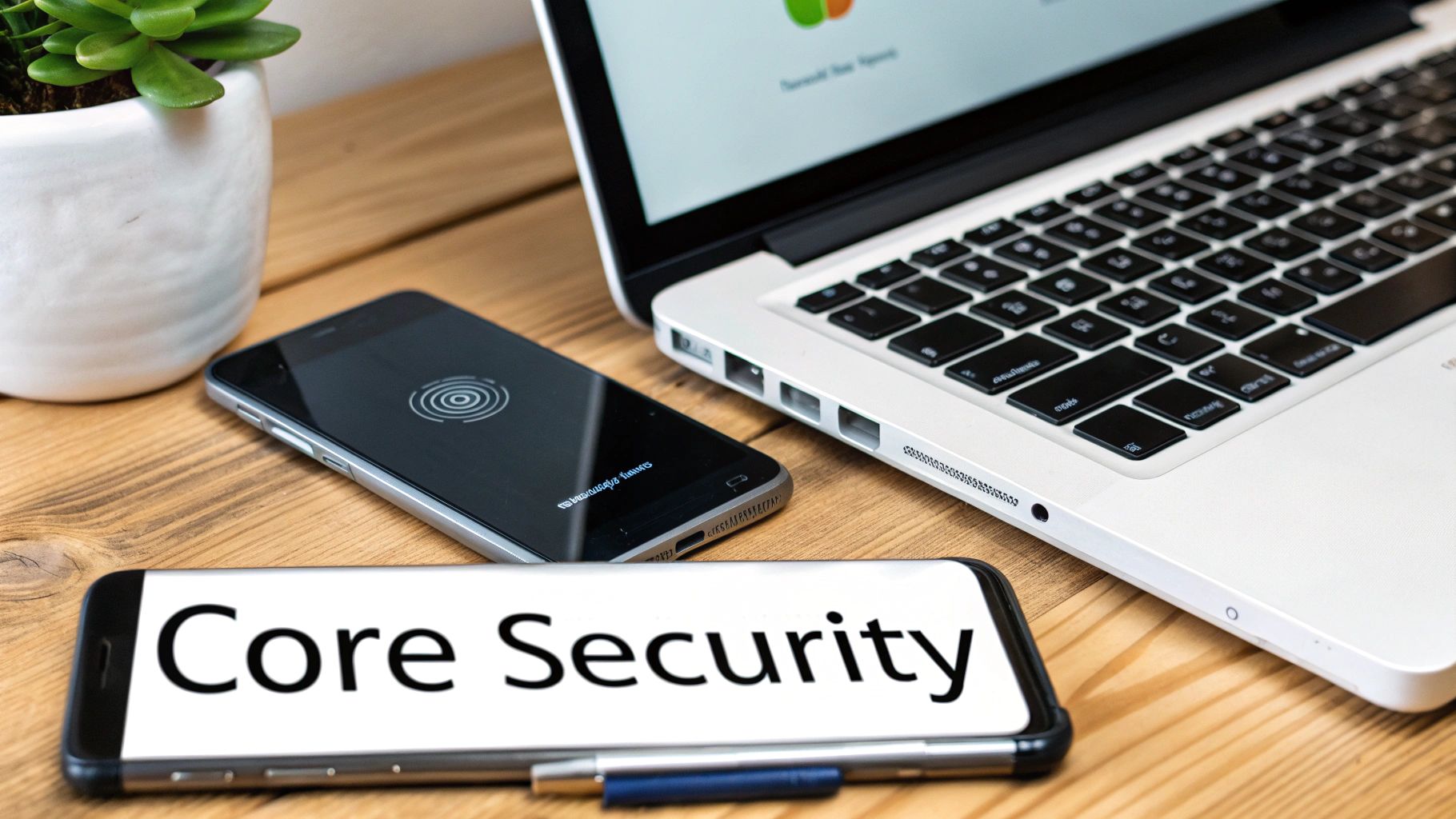
The process begins with controlling who can access your systems and data. The goal is to ensure only authorized individuals can get in and are limited to only what they need to perform their jobs.
Control Access to Your Systems and Data
Stolen credentials are one of the most common ways attackers breach a network, making strong access controls your first line of defense.
- Multi-Factor Authentication (MFA): This is the single most effective security control you can implement. MFA requires a second form of verification—such as a code from a smartphone app—in addition to a password. This simple step blocks an estimated 99.9% of automated attacks that rely on stolen passwords.
- Principle of Least Privilege: This concept is as simple as it is powerful. Grant employees access only to the data and systems they absolutely need for their specific role. For example, your marketing coordinator does not need access to financial records. This approach contains potential damage if an employee's account is compromised.
Implementing these two controls creates a robust barrier at the primary entry points to your business data. For small businesses looking to empower their teams with essential knowledge, a Cyber Security Course can provide a strong foundation.
Secure Your Devices and Network
Once you have controlled who can access your data, the next priority is securing the devices and networks they use. Every laptop, smartphone, and server is a potential entry point for an attacker.
Your network perimeter—the digital boundary between your internal network and the internet—must be fortified with a properly configured firewall. A firewall acts as a gatekeeper, inspecting all incoming and outgoing traffic and blocking anything that appears suspicious or violates predefined security rules.
Secure Wi-Fi is another essential component. Always use strong encryption (WPA3 is the current standard) and create separate networks for employees and guests. A guest network prevents visitors from accessing your internal business systems, adding a simple but highly effective layer of security. This segmentation helps contain potential threats and keeps critical assets safe. For more information, explore our guide to advanced cybersecurity frameworks.
These foundational layers—strong access controls, device security, and network protection—work together to create a resilient defense. They address the most common attack vectors, significantly reducing your risk profile.
Data Backups and Patch Management: Your Safety Net
Strong defenses are crucial for prevention, but a resilient business must also be prepared for a worst-case scenario. This readiness depends on two critical pillars: keeping your software updated and maintaining reliable, tested data backups.
Many successful cyberattacks exploit known software vulnerabilities for which a fix is already available. That is why systematic patch management—the process of regularly updating all your software, from operating systems to business applications—is one of the most effective security measures. These updates close the exact loopholes attackers are looking for.
The Critical Role of Patch Management
Delaying software updates is like leaving a side door unlocked. It gives attackers an easy way in, allowing them to bypass other defenses. A disciplined approach to patching shrinks your attack surface, making your business a much harder target. Unpatched software is a primary entry point for ransomware, which is often the single biggest cost driver in a security breach.
A Bulletproof Data Backup Strategy
Even with perfect patching, no defense is impenetrable. A solid backup strategy is your ultimate safety net, ensuring that if an attacker encrypts, deletes, or destroys your data, you can restore operations with minimal disruption.
The industry standard is the 3-2-1 backup rule:
- Keep three complete copies of your data.
- Store these copies on two different types of media (e.g., an external hard drive and cloud storage).
- Ensure one of those copies is stored completely off-site.
This approach is designed to eliminate single points of failure. A fire, flood, or ransomware attack that compromises your local network and connected backups will not be able to destroy everything. That off-site copy is your guarantee of recovery.
However, having backups is not enough; you must test them regularly. A backup that cannot be restored is useless. Scheduling periodic test-restores confirms your data is intact and your recovery process works as expected. When retiring old equipment, remember that proper data disposal is part of the security lifecycle. Services for secure hard drive destruction ensure old data cannot be recovered, keeping you compliant and secure.
Turning Your Team into a Security Asset
Technology is only half of the cybersecurity equation. Your employees can be your strongest defense or your greatest vulnerability, depending on the security culture you build. Fostering a security-conscious team is about empowering people with practical knowledge, not just enforcing rules.
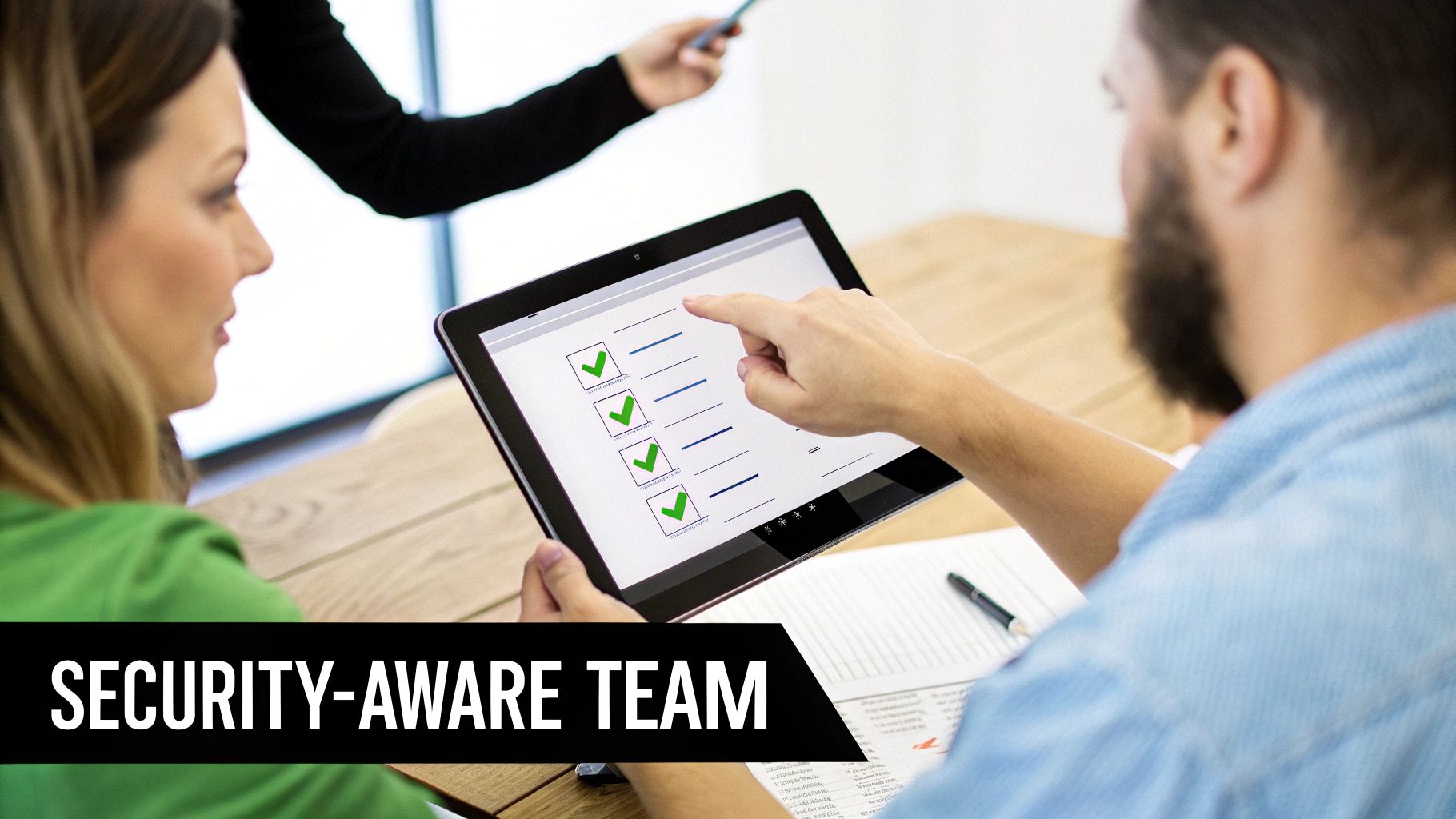
Attackers consistently target the human element with phishing and social engineering because it is often easier to trick a person than to breach a firewall. This is why ongoing security training is one of the highest-return investments a business can make.
Cultivating a Security-Aware Culture
Effective training must be a continuous process that keeps security top-of-mind and helps your team recognize evolving threats.
Practical steps to build a security-aware culture include:
- Regular Phishing Simulations: Send simulated phishing emails to staff to test their awareness in a controlled environment. This provides invaluable practice for spotting suspicious links and fraudulent requests.
- Bite-Sized Training Modules: Use short, frequent modules that cover specific topics like identifying fake login pages, creating strong passwords, or handling sensitive data securely.
- Open Communication: Create a culture where employees feel comfortable reporting anything unusual without fear of blame. A quick report about a strange email could prevent a major incident.
This approach transforms security from an IT problem into a shared business responsibility. You can find more strategies in our guide to cybersecurity training for employees.
Establishing Clear Policies and Plans
Alongside training, you need clear, practical policies that guide your team’s actions. These documents are operational playbooks for protecting the business.
An Acceptable Use Policy (AUP) sets clear expectations for how employees should use company technology and data, which helps reduce risky behavior. Even more critical is an Incident Response Plan (IRP), which outlines the exact steps to take during a security event. It answers crucial questions in advance: Who needs to be contacted? What systems should be shut down first? How will you communicate with clients?
A tested Incident Response Plan is the difference between controlled action and chaos during a crisis. It enables your team to act decisively, contain damage, and begin recovery faster, minimizing financial and reputational harm.
Unfortunately, many businesses operate without this foundational planning. Recent data from VikingCloud's security report shows that only 29% of small to medium-sized businesses feel their defenses are mature, and 44% lack any formal security plan. Creating these simple but effective playbooks is a vital step toward maturing your defenses.
When to Engage a Cybersecurity Partner
For most small business owners, managing cybersecurity starts as another task on a long list but can quickly become a full-time, high-stakes responsibility. The tipping point often arrives when you realize the complexity of modern threats has outpaced your team’s available time and expertise. This is the moment to consider a strategic security partner.
Business triggers often force this conversation. You may be handling more sensitive client data, such as financial or legal records, which elevates your risk profile. Or perhaps you face mandatory compliance regulations like PIPEDA that carry steep penalties for non-compliance.
From IT Fixes to Strategic Guidance
A clear sign you have outgrown your current IT setup is when your team is perpetually reacting to problems instead of proactively building defenses. The threat landscape evolves daily, and keeping up demands a dedicated focus that most small business teams cannot provide.
Engaging a security partner is not just about outsourcing IT tasks; it is an investment in strategic expertise. A true partner looks beyond simple break-fix solutions to provide guidance that aligns technology with your business goals. They bring the experience of defending hundreds of other businesses, offering insights you could not develop internally.
Think of it as gaining access to a Virtual Chief Information Officer (vCIO) and a security operations center for a predictable monthly cost. This approach shifts your cybersecurity from a reactive expense into a strategic asset that supports growth, manages risk, and builds client trust.
An ROI-Driven Decision
The value of a security partner is measured in risk reduction and operational resilience. When you partner with experts, you gain access to enterprise-grade tools, 24/7 monitoring, and a team of specialists dedicated to keeping your business safe. This proactive stance is far more cost-effective than absorbing the financial and reputational fallout of a breach.
For many businesses, the return on investment is clear:
- Reduced Risk: Proactive monitoring and expert management drastically lower the likelihood of a successful attack.
- Controlled Costs: A fixed monthly fee makes budgeting predictable, eliminating surprise bills from emergency IT calls.
- Enhanced Focus: Freeing your team from complex security management allows them to concentrate on core business activities that generate revenue.
- Compliance Confidence: A knowledgeable partner helps you navigate and meet regulatory requirements, avoiding potential fines and legal issues.
The goal is to build a secure foundation that allows your business to operate with confidence. This enables you and your leadership to focus on serving clients and growing the company, knowing your digital assets are professionally protected. A good first step is to explore what is included in comprehensive managed IT services for small businesses.
Your Small Business Cybersecurity Action Plan
This section distills the key concepts into a prioritized checklist you can use as a quick self-assessment to identify strengths and uncover gaps that require attention.
The diagram below outlines the straightforward process of engaging a partner to help mature your security posture.
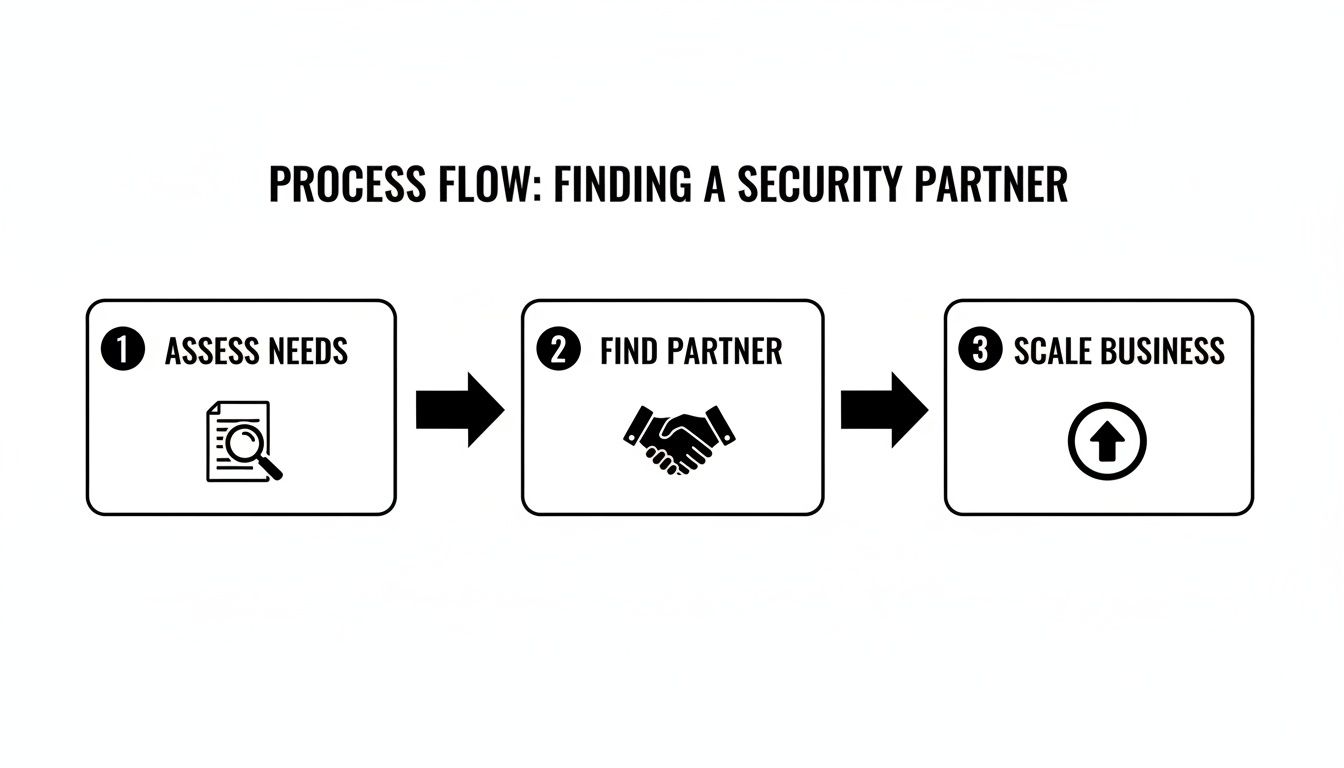
Finding the right expertise is not just an IT decision—it is a strategic move that supports sustainable business growth.
Foundational Security Checklist
- Enforce Multi-Factor Authentication (MFA): Is MFA active on all critical accounts, especially email, banking, and key cloud applications? This is your single most effective defense.
- Confirm Data Backups: Are your backups running successfully? Have you recently tested restoring a file to ensure they work?
- Verify Patch Management: Is there a reliable process to ensure all software—from operating systems to applications—is kept up to date?
- Review Access Controls: Do employees only have access to the data they need to perform their jobs? When did you last review and remove old or unused accounts?
- Assess User Training: Does your team know how to spot a phishing email? Do they know who to notify and what to do if they click a suspicious link?
This checklist serves as a starting point for assessing your security posture. It reinforces that effective cybersecurity is an achievable, ongoing process of managing business risk.
If this list highlights gaps or raises more questions than answers, that is a positive outcome. Acknowledging your current state is the essential first step toward building a more resilient and secure operation.
For a formal, in-depth review of your security posture, consider a professional cybersecurity assessment.
Frequently Asked Questions About Small Business Cybersecurity
Business owners often ask similar questions when developing their security strategy. Here are concise, business-focused answers to the most common inquiries.
Is cybersecurity really that important for my small company?
Yes. Attackers target small businesses precisely because they assume security is lacking. A single successful attack can lead to devastating financial losses, cripple your operations, and destroy client trust. For many small companies, such a blow is unrecoverable. Investing in cybersecurity is an investment in business continuity.
What is the single most important security measure I can take?
Implement Multi-Factor Authentication (MFA). Enable it for every critical account, including email, financial platforms, and cloud services. MFA requires a second proof of identity beyond a password, such as a code from your phone. This one step blocks the vast majority of automated attacks that rely on stolen credentials. It is the highest-impact security control you can deploy.
How much should a small business budget for cybersecurity?
There is no single magic number; your budget depends on your industry, data sensitivity, and specific risks. A law firm handling confidential client files has different needs than a local retailer. Rather than focusing on a number, adopt a layered approach. Start with foundational controls offering the greatest return: MFA, reliable backups, and continuous employee training.
Proactive defense is always more cost-effective than incident response. The costs of emergency recovery, regulatory fines, and rebuilding a damaged reputation will always exceed the investment in getting security right from the start.
Can I manage cybersecurity myself?
While you might handle basic tasks initially, cybersecurity quickly becomes a full-time responsibility requiring specialized expertise. The threat landscape evolves daily. If you handle sensitive data, must meet compliance standards, or lack the time to manage security properly, it is time to engage a professional. Partnering with an expert offloads the burden and allows you to focus on running your business with confidence.
Protecting your business requires a strategic plan that aligns with your operational needs. At Tricord I.T Solutions, we provide the expert guidance and managed security services you need to operate securely and grow with confidence.
Schedule a consultation to build your cybersecurity roadmap.